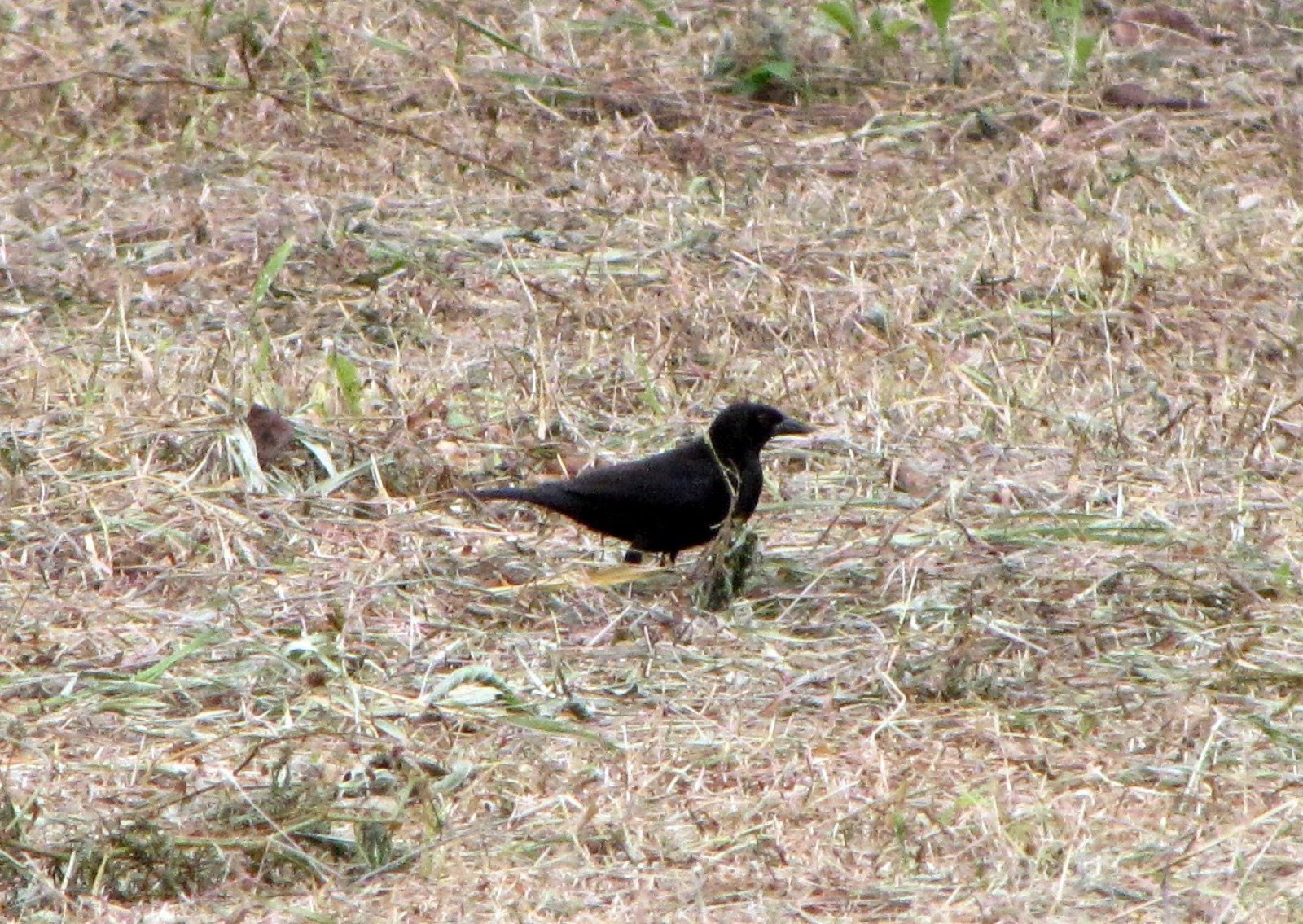
Family Icteridae
Bronzed Cowbird
Molothrus aeneus
In Spanish: Vaquero Ojirrojo (Pius)
- Resident
A stocky, red-eyed black bird of towns, pastures and farm edges.
The Bronzed Cowbird is one of four common black birds of Costa Rica, along with the Great-tailed Grackle, Groove-billed Ani and Melodious Blackbird. On a trip we build, guests meet it around towns and in deforested edge country, from the lowlands to middle elevations.
The red eye and the thick neck are the marks to look for. Together they sort it from its main lookalike here, the Shiny Cowbird, which makes it a good first lesson in looking past plain black plumage.
Deforestation has made it very common in Costa Rica, and it has even reached the high Talamanca mountains.
How to find it
Look for it in open places such as pastures, farm fields, golf courses and scrubby grassland. It is fairly easy to find within its range.
Around cattle and farms, scan the ground and the wires for stocky black birds. In towns and garden suburbs of the Central Valley, check the lawns too.
In Costa Rica a small group of dark birds flying past that look like winter finches is likely to be Bronzed Cowbirds. Once one is in view, check the eye and the thick neck.
How to recognise it
The male is glossy black with a bronze-green sheen, and the wings and tail look bluish. In good light he shows a deep blue gloss on the wings. Cornell describes a compact, bull-necked bird, and its red eyes are intense in both sexes.
In Costa Rica males measure about 20 cm and females about 18.5 cm. The body is stocky, with a short tail and a thick, cone-shaped bill.
The male's eye is red during the breeding season and brown at other times. The female is duller black above and browner below, with brown eyes. Young birds look like females but have grey feather edges.
What it sounds like
Recording: Francis Pérez, CC BY 4.0, source, read 4 Nov 2026.
Behaviour and diet
It forages on the ground for seeds and grains, usually in flocks, and sometimes feeds with other blackbird species. In Costa Rica it often goes with cattle and around farms, foraging on the ground or perching on wires.
It is a brood parasite. It lays its eggs in other birds' nests, and the host parents raise the cowbird chick. Young cowbirds develop fast and leave the nest after 10 to 12 days. One Costa Rican commenter noted that chontes (oropendolas) are among the hosts.
Where it lives
Range-wide, it lives in open country, and farmland, brush and feedlots are typical places for it. In Costa Rica it turns up around towns and in deforested edge country, from the lowlands to middle elevations.
It also reaches the high Talamanca area. Researchers found it around El Copey de Dota at about 1850 m, in apple orchards, cloud forest, cattle pasture and forest edges. In the Central Valley suburbs near San José it is a bird of towns and gardens.
When to see it
In Costa Rica it lays its eggs from March to July, so courtship and breeding activity fit that window.
Similar birds
The Shiny Cowbird is the main lookalike in Costa Rica. It is slender, with dark eyes, a longer tail and no thick neck, and its colour is a more even purplish. The Bronzed is the thicker, red-eyed one. Male Shiny Cowbirds also have a thinner bill and lack the neck ruff, and female Shinys are paler with dark eyes. The Melodious Blackbird is bulkier than the Shiny Cowbird and has a bigger beak.
Names and lore in Costa Rica
The AOCR Spanish name is Vaquero Ojirrojo, with the nickname Pius in brackets. Other Spanish names in use are tordo ojirrojo, tordo ojo rojo and vaquero de ojos rojos.
Status and conservation
The AOCR list marks it as a resident (R), and the IUCN lists the species as Least Concern, so it is not at immediate risk.
Photography tips
Open pastures, farm edges and wires are the best places to get a clear view. Wait for good light, when the males show their deep blue gloss on the wings, and frame the red eye and thick neck.
How we know this 19 sources, each read on the date shown
- Wikipedia read 2026-11-04
https://en.wikipedia.org/wiki/Bronzed_cowbird - Bellas Aves de El Salvador (quoting Biodiversidad de Costa Rica) read 2026-11-04
http://bellasavesdeelsalvador.blogspot.com/2015/05/molothrus-aeneus-vaquero-de-ojo-rojo-o.html - All About Birds, Cornell Lab read 2026-11-04
https://www.allaboutbirds.org/guide/Bronzed_Cowbird/overview - Birda read 2026-11-04
https://app.birda.org/species-guide/35414/Bronzed_Cowbird - Ecoregistros read 2026-11-04
https://www.ecoregistros.org/ficha/Molothrus-aeneus - World Bird Photos read 2026-11-04
https://www.worldbirdphotos.com/photo/cowbird-bronzed-molothrus-aeneus-adult-costa-rica/ - Birds of the World, Cornell Lab read 2026-11-04
https://birdsoftheworld.org/bow/species/brocow/cur/introduction - Birding Craft read 2026-11-04
https://birdingcraft.com/wordpress/2010/06/15/four-common-black-birds-of-costa-rica/ - Cornell All About Birds read 2026-11-04
https://www.allaboutbirds.org/guide/Bronzed_Cowbird/species-compare/ - Audubon Field Guide read 2026-11-04
https://www.audubon.org/field-guide/bird/bronzed-cowbird - National Geographic read 2026-11-04
https://nationalgeographic.com/animals/birds/b/bronzed-cowbird - Cornell All About Birds read 2026-11-04
https://www.allaboutbirds.org/guide/bronzed_cowbird/lifehistory - Aves Ibericas, Aves Costa Rica read 2026-11-04
https://www.avesibericas.es/costaricaaves10.htm - Ornitología Neotropical read 2026-11-04
https://digitalcommons.usf.edu/cgi/viewcontent.cgi?article=1097&context=ornitologia_neotropical - Naturalista Costa Rica (Wikipedia text) read 2026-11-04
https://costarica.inaturalist.org/taxa/10369-Molothrus-aeneus - Ornitología Neotropical read 2026-11-04
https://digitalcommons.usf.edu/cgi/viewcontent.cgi?article=2036&context=ornitologia_neotropical - Birding Craft read 2026-11-04
https://birdingcraft.com/wordpress/2008/10/19/costa-rica-common-birds-1-city-birds/ - Birding Craft read 2026-11-04
https://birdingcraft.com/wordpress/2018/04/11/the-most-endangered-least-concern-bird-species-in-costa-rica/ - Animalia read 2026-11-04
https://animalia.bio/bronzed-cowbird