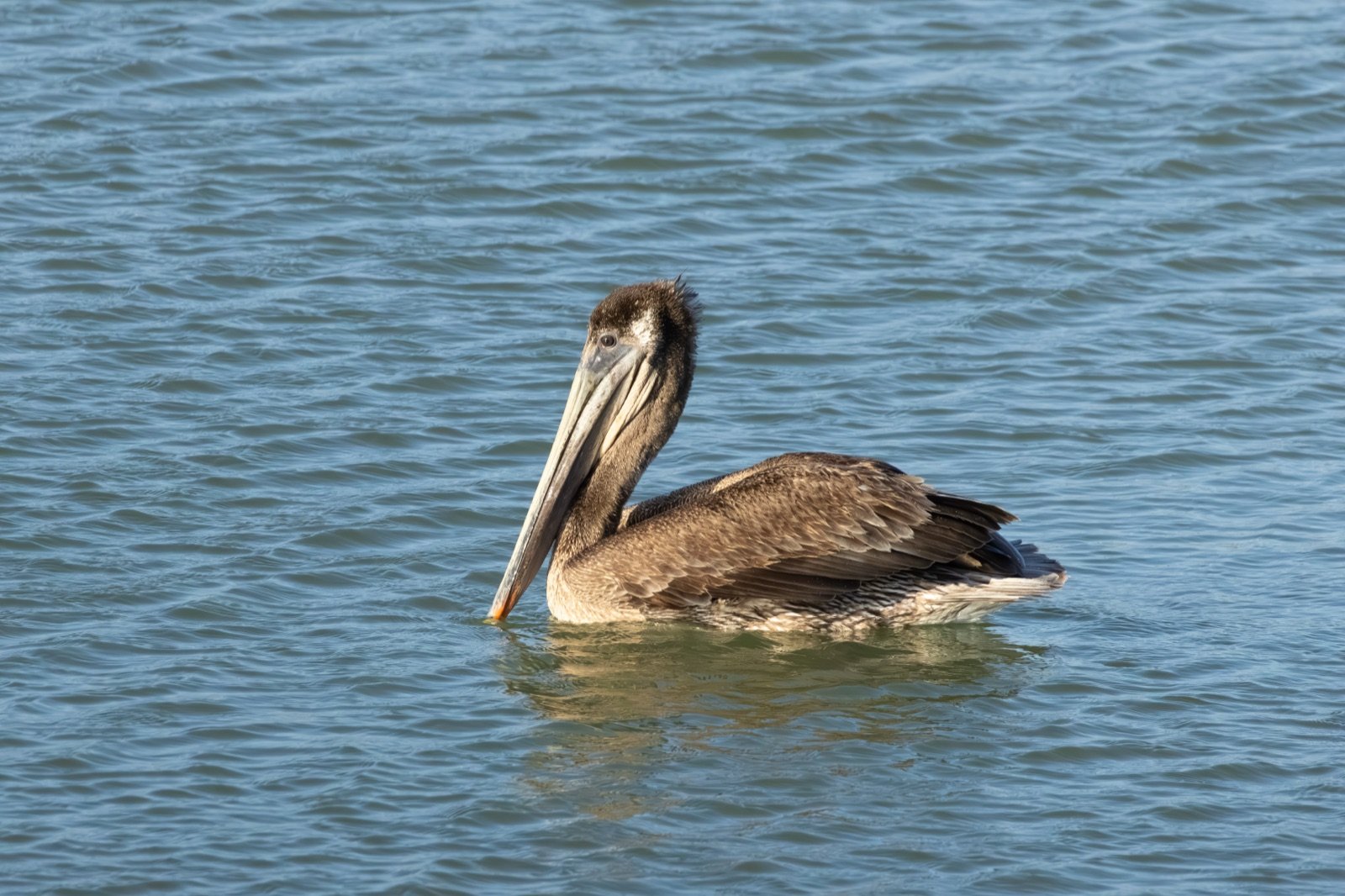
 Brown Pelican
Family Pelecanidae
Brown Pelican
Pelecanus occidentalis
In Spanish: Pelícano Pardo (Buchón, Pelícano, Alcatraz)
- Resident
A big dark pelican that plunge-dives, easy along the Pacific coast
The Brown Pelican is one of the easiest big birds to enjoy on a Costa Rican beach. It occurs on both the Caribbean and Pacific coasts, but it is much more common on the Pacific side, where it is a resident, common to abundant.
Watch from a beach at sunset, when flocks fly in V formations to their evening roost and single-file lines glide low along the breaking waves. The only breeding colonies in the country are on Pacific islands, and on a trip we build, a boat crossing in the Gulf of Nicoya can take you past one of them.
For a beginning birder it is a friendly first lesson in coastal birding: the bird is large, often close and busy fishing in plain view.
How to find it
Watch from a beach at sunset, when flocks fly in V formations to their evening roost and single-file lines glide low along breaking waves. At Playa Grande in Guanacaste pelicans are very common, gathering by the rock between Playa Grande and Playa Ventanas and flying in and out of the waves along the 5 km beach. Playa Flamingo is another place where sightings are common, and in March 2024 pelicans gathered there in unusually large numbers because of a school of sardines. Look offshore for plunge-dives and for birds following fishing boats. A cruise from Puntarenas to Isla Tortuga passes the Isla Guayabo nesting colonies, as does the Paquera to Puntarenas ferry.
How to recognise it
Adults are dark grayish brown with a silvery sheen on the upperparts. The head and neck are white, the legs black, and the pouch and facial skin grayish. Adults have a yellowish crown.
The profile is distinctive: long wings and neck, a large straight bill and a huge throat pouch for swallowing fish.
In breeding dress the neck turns mostly black, the head has a yellow tint, the skin around the eye is reddish, the bill looks pinkish and the nape crest is chestnut.
Immatures are gray-brown on the back and neck, with white underparts. Birds reach adult plumage after about 3 years.
The bird is about 109 cm long and weighs about 3 kg, and by one account it is the largest water bird in Costa Rica.
Behaviour and diet
The Brown Pelican hunts by plunge-diving, dropping into the sea from as high as about ten meters. It scoops fish near the surface in its pouch, and it takes scraps and waste, visiting and following fishing boats.
It usually travels in small groups flying in a coordinated single file, and flocks of 20 or more can form. Pelicans use air currents and ocean waves to fly with little effort, so they can cover the shoreline gliding. They rest on rocks, trees and boats. Across its range the species lives in flocks of both sexes all year round.
Where it lives
This is a coastal species that prefers coasts and estuaries, and Costa Rican sources also list mangroves and wetlands. Pelicans stay in coastal waters and seldom leave them.
Rarely they reach lagoons or slow rivers inland, and young birds sometimes fly inland to lakes. It occurs on both coasts but is much more common on the Pacific side. On the Caribbean coast it is an uncommon non-breeding visitor, present throughout the year.
When to see it
Costa Rican nesting peaks with egg laying in January and February, and most young fly by May. Big flocks gather in September to October and April to May.
Similar birds
Costa Rican accounts call it unmistakable, being the only common pelican on the country's coasts. The American White Pelican is only an accidental visitor. If you do meet one, the Brown Pelican is darker and smaller, and it dives for fish from the air instead of fishing together from the surface.
Names and lore in Costa Rica
In Costa Rica the bird goes by several Spanish names: Pelícano Pardo, Alcatraz and Buchón. Plain "pelícano" is also used.
Status and conservation
The AOCR list marks it as a resident (R), and the species is now listed as Least Concern.
Photography tips
Sunset is the moment: flocks in V formation and single-file lines gliding low against the sky make strong silhouettes. Watch a breaking wave and you may catch a line riding its lift. Plunge-dives and boat-following birds offer action shots from a beach or a crossing.
How we know this 15 sources, each read on the date shown
- costarica.com read 2026-11-04
https://www.costarica.com/wildlife/brown-pelicans - The Tico Times read 2026-11-04
https://ticotimes.net/2023/04/22/costa-rica-wildlife-meet-the-brown-pelican - Costa Rica Monkey Tours read 2026-11-04
https://costaricamonkeytours.com/costarica-travelguide/wildlife/birds/the-brown-pelican-of-costa-rica/ - Indra Inn, Playa Grande read 2026-11-04
https://indrainn.com/explore/birdwatching/brown-pelican/ - Las Catalinas Daily Blog read 2026-11-04
https://thedaily.lascatalinascr.com/monday-march-11-2024 - Wikipedia read 2026-11-04
https://en.wikipedia.org/wiki/Brown_pelican - US Fish and Wildlife Service read 2026-11-04
https://www.fws.gov/media/brown-pelican-pelecanus-occidentalis - Flickr (Costa Rica natural history text) read 2026-11-04
https://www.flickr.com/photos/jobando/33300143532 - Ecosistemas de Costa Rica read 2026-11-04
https://ecosistemasdecostarica.blogspot.com/2012/11/reserva-biologica-isla-guayabo.html - Hotel Rivel blog read 2026-11-04
https://hotelrivel.online/es/sobrevolando-el-paraiso-el-pelicano-pardo-de-las-costas-de-costa-rica/ - Aves de Costa Rica read 2026-11-05
https://avesdecostarica.com/Pelecanus-occidentalis.html - Birds Colombia read 2026-11-05
https://birdscolombia.com/2017/12/02/pelicano-pardo-brown-pelican-pelecanus-occidentalis/ - Travel To Eat read 2026-11-05
https://traveltoeat.com/california-brown-pelican-pelecanus-occidentalis/ - EcoRegistros (Manuel Antonio photo, 27 Jan 2019) read 2026-11-05
https://www.ecoregistros.org/site/imagen.php?id=315405 - Nicoya Peninsula site read 2026-11-05
https://nicoyapeninsula.com/wildlife/waterbirds/