Family Troglodytidae
Cabanis’s Wren
Cantorchilus modestus
In Spanish: Soterré Chinchirigüí (Huevos Blancos, Chinchirigüí)
- Resident
A shy, duetting Pacific slope wren, heard far more often than seen.
Cabanis's Wren, known in Costa Rica as the chinchirigüí, is a bird you meet with your ears first. The name imitates its loud, rollicking song, and a male and female often sing it together as a duet.
In Costa Rica it reaches the central part of the country and is limited to the Pacific slope. On a trip we build, it can be met in Guanacaste, where it is a common permanent resident throughout Santa Rosa and most of the Guanacaste Conservation Area, and in the Central Valley near San José.
It is a shy skulker, so a little patience is part of the pleasure. Listen first, then wait for it to show.
How to find it
Listen for it in garden and edge scrub, then wait for it to show. Around Carara, listen for it chortling from dry, open, brushy areas, and go at dawn when wrens are singing. Carara, where dry, brushy areas meet humid forest, is described as a wren hotspot. At Santa Rosa National Park, a guide whistled the song to draw one out, and it answered from a slope but stayed hidden, so it was logged as heard only. Be ready for that outcome and enjoy the listening.
How to recognise it
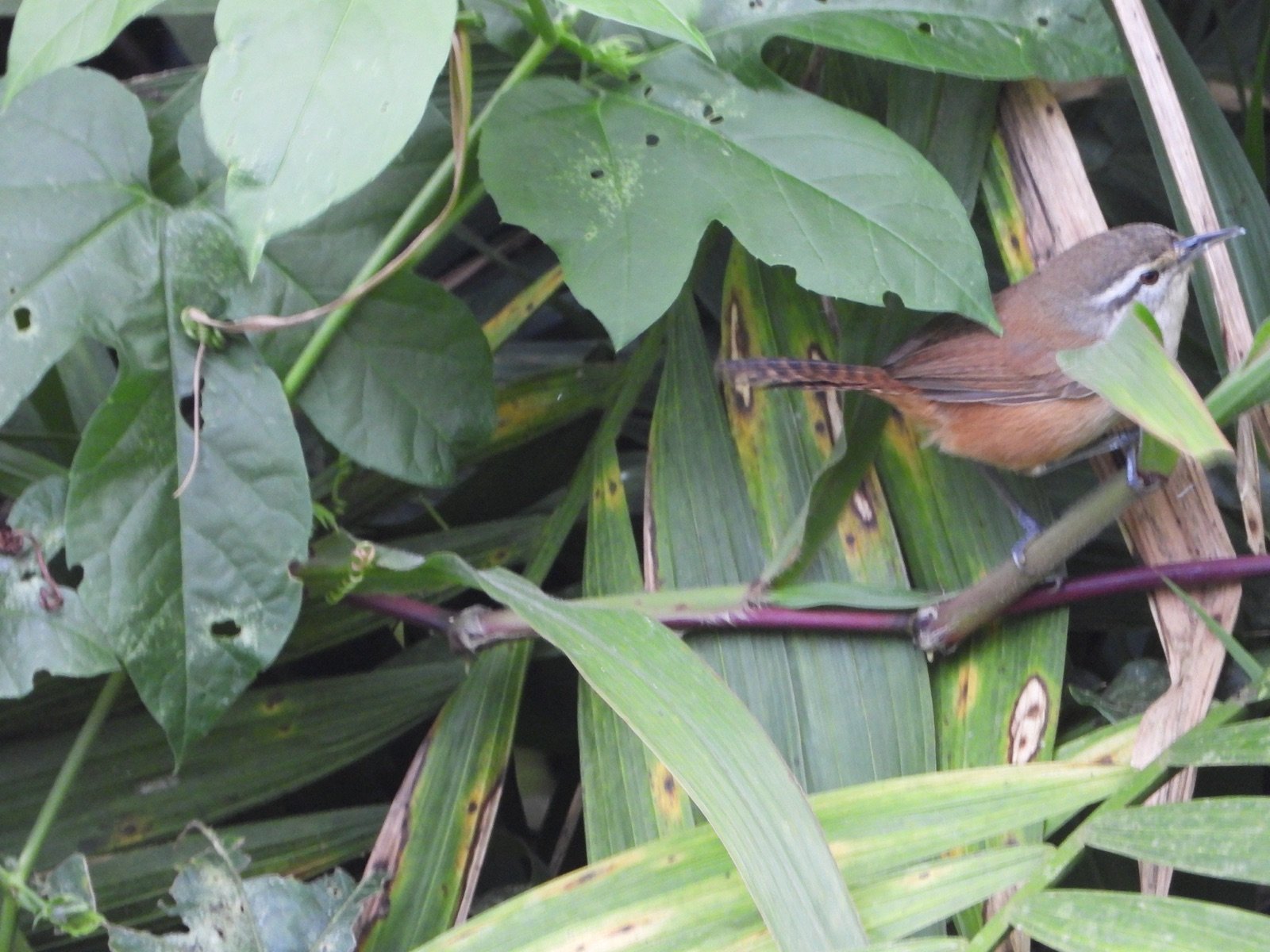
The plumage is plain, and few field marks set this wren apart. Look for these:
A white eyebrow.
A rufous-brown back and an orange-rufous rump.
A white throat.
Orange-buff flanks.
A dark orange eye in Costa Rica.
That dark orange eye helps separate it from Isthmian Wren, which looks duller and is the wren expected east of central Costa Rica. Among the three wrens once lumped together as Plain Wren, Cabanis's is described as the most colorful. Because the look is so modest, song and range are your best clues.
What it sounds like
Recording: Eduardo A. Bolaños Vargas, CC BY 4.0, source, read 4 Nov 2026.
Behaviour and diet
This is a shy skulker, more often heard than seen. It hops from branch to branch, hidden by leaves and twigs, and keeps to dense edges. One Monteverde birder played a Canebrake Wren song to a Cabanis's Wren, and it sang the female part of a tightly coordinated duet with the recording. It builds two kinds of nests: a thin-walled cylinder used for roosting, and a sturdier oval nest with a downward-facing entrance used for breeding.
Where it lives
In Costa Rica this wren is limited to the Pacific slope and reaches the central part of the country. It has been recorded in the northwest Pacific lowlands of Guanacaste, in the Greater Metropolitan Area of the central valley, and in Monteverde, Puntarenas, including a cloud forest record and a garden song recording at a school. Across its wider range it is common or abundant in forest edges, secondary growth, well-planted gardens and citrus plantations with epiphytes, in both dry and humid zones, from sea level to about 2,000 m.
Similar birds
Isthmian Wren replaces it in southwestern Costa Rica and Panama, and Canebrake Wren replaces it on the Caribbean slope from Nicaragua to western Panama. All three were once lumped as Plain Wren. At Carara, Rufous-naped Wren also sings from dry, open, brushy areas, so listen to tell them apart: the Rufous-naped song is long and rollicking, built from repeated up and down whistles.
Names and lore in Costa Rica
In Costa Rica the common Spanish name is soterrey chinchirigüí, and a Costa Rican cooperative bird list gives the short name Chinchirigüí. Locals call it chinchirigüí, a name that imitates its loud, rollicking song. Elsewhere it goes by other names, such as chivirín modesto in Mexico, charralero culirrufo in Nicaragua and colchonero común in Honduras.
Status and conservation
It is a resident (R) on the AOCR list and is rated Least Concern by the IUCN.
Photography tips
These wrens are very hard to see, so track down a singing bird and be patient. It lives in dense forest edges and hops from branch to branch, hidden by leaves and twigs. Playback is technically illegal inside official protected areas, so there you must simply wait.
How we know this 20 sources, each read on the date shown
- Wikipedia (es) read 2026-11-04
https://es.wikipedia.org/wiki/Cantorchilus_modestus - Cornell Neotropical Birds read 2026-11-04
https://neotropical.birds.cornell.edu/Species-Account/nb/p_p_spp/overview?p_p_spp=535756 - Biosonidos UNED read 2026-11-04
https://biosonidos.uned.ac.cr/node/120 - Museo Nacional de Costa Rica read 2026-11-04
https://www.museocostarica.go.cr/nuestro-trabajo/investigaciones/historia-natural/gam/ - EcoRegistros read 2026-11-04
https://www.ecoregistros.org/ficha/Cantorchilus-modestus - BirdForum read 2026-11-04
https://www.birdforum.net/gallery/cabaniss-wren.735480/ - iNaturalist (Wikipedia text) read 2026-11-04
https://www.inaturalist.org/taxa/518292-Cantorchilus-modestus - Dan Mennill's Bird Songs of Costa Rica read 2026-11-04
https://web2.uwindsor.ca/courses/biology/dmennill/CostaRica/CRSongs.html - Birdernaturalist (WINGS Costa Rica tour) read 2026-11-04
http://birdernaturalist.blogspot.com/2017/04/birds-on-wings-costa-rica-tour-in-spring.html - Birds for Beer read 2026-11-04
https://birdsforbeer.com/2020/11/13/band-backed-wren-big-and-noisy/ - Meadowhawk blog read 2026-11-04
https://meadowhawk.wordpress.com/2017/05/31/santa-rosa-national-park/ - Birding Craft read 2026-11-04
https://birdingcraft.com/wordpress/2024/06/07/costa-rica-birding-a-whole-lot-of-wrens-going-on/ - Field Guides Birding Tours read 2026-11-04
https://fieldguides.com/triplists/cr119.html - Cooperativa Las Cabañas bird list read 2026-11-04
http://coopecabanas.org/images/2020_Octubre_Lista_de_Aves_en_Las_Cabanas.pdf - Avibase read 2026-11-04
https://avibase.bsc-eoc.org/species.jsp?avibaseid=D45F6618E22D7209 - Field Guides trip list read 2026-11-04
https://fieldguides.com/triplists/cos24.html - Birds of Costa Rica (birdsofcolombia.org) read 2026-11-04
https://www.birdsofcolombia.org/costarica/Cantorchilus.html - The Nature Admirer read 2026-11-04
https://thenatureadmirer.com/2019/06/27/cabaniss-wren-cantorchilus-modestus/ - Wikipedia read 2026-11-04
https://en-m-wikipedia-org.translate.goog/wiki/Cabanis's_wren?_x_tr_sl=en&_x_tr_tl=es&_x_tr_hl=es&_x_tr_pto=tc - Birds of the World (Cornell) read 2026-11-04
https://birdsoftheworld.org/bow/species/plawre1/cur/introduction