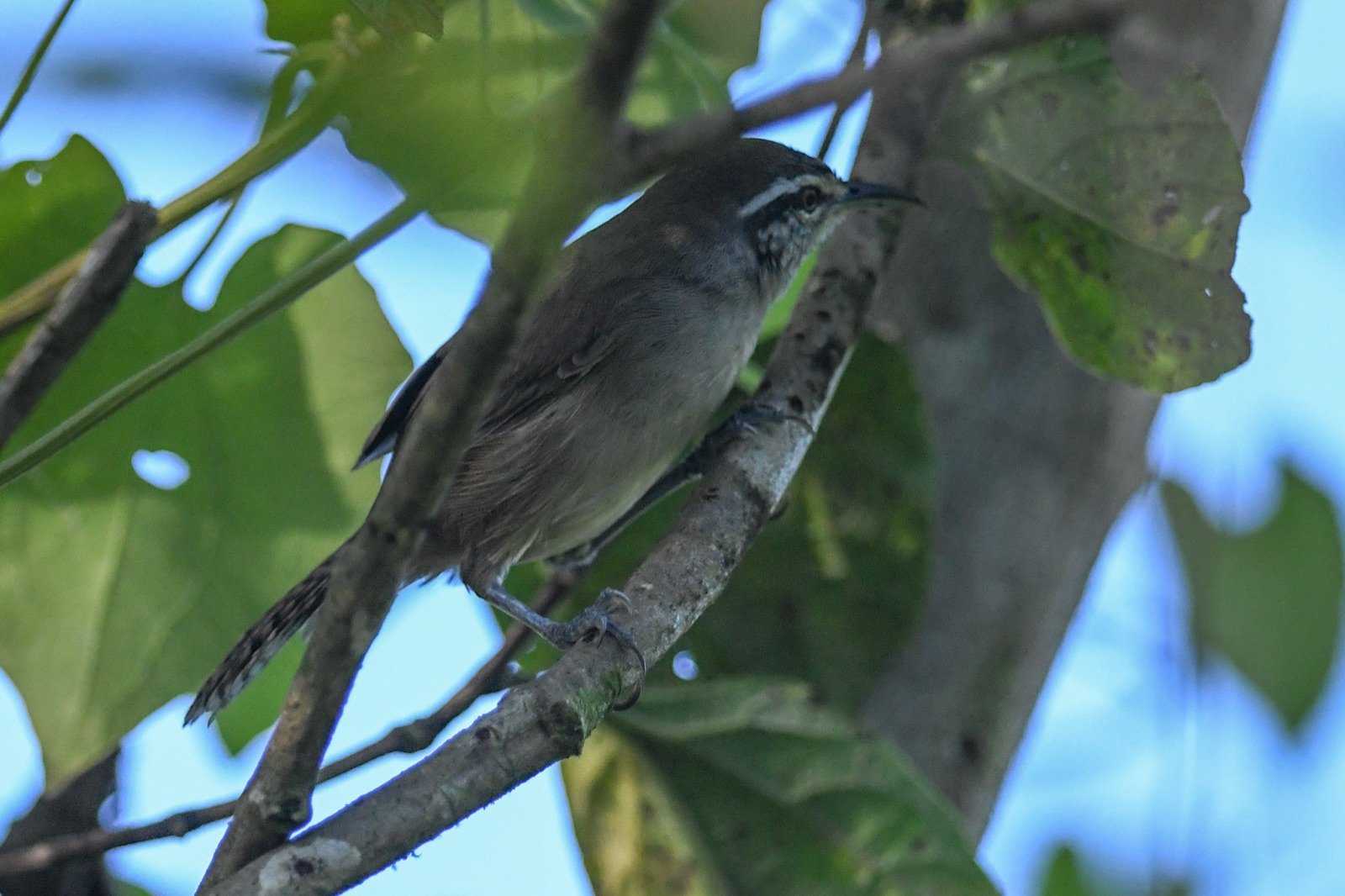
Family Troglodytidae
Canebrake Wren
Cantorchilus zeledoni
In Spanish: Soterré de Zeledón
- Resident
- Regional endemic
A Caribbean lowland wren whose pairs duet so tightly they sound like one bird.
The Canebrake Wren (Soterré de Zeledón) is a small wren of the Caribbean side of Costa Rica, and the AOCR list marks it R-END. It is common but hard to see, so most first meetings begin with a sound rather than a sight.
What makes it worth the patience is the singing. Pairs sit side by side and answer each other so quickly that two voices sound like one singer.
A Costa Rican natural history page calls it common on the coastal lowlands of the Caribbean slope. With forest clearing it spread inland and reached La Selva Biological Station in the early 1970s. On a trip we build to the Caribbean lowlands, it is a bird to listen for at the edge of thick, tangled growth.
How to find it
Look for it in lowland second growth anywhere in the Caribbean lowlands, and expect it to take a while to show itself. Learning its calls helps a lot, because it is common but hard to see. Listen for the fast duet first, then watch the dense undergrowth, long grass and scrub where the sound is coming from. Garden and edge habitat can also hold it. Patience matters more than speed, since it skulks until it decides to appear.
How to recognise it
This is a small wren, about 14 cm long. Look for these marks:
A brown crown.
A white eyebrow stripe.
A dark gray-brown line through the eye.
Cheeks mottled gray and off-white, with black streaking over a white background in Spanish-language descriptions.
An eye described as red in the same Spanish text.
Below, the throat is off-white, the chest is gray and the lower belly is gray-buff. The upperparts are brownish gray, becoming olive-gray on the rump. The tail is olive-brown with clear darker bars, a useful mark when the bird flicks through the undergrowth for a second or two.
Behaviour and diet
The Canebrake Wren is cryptic and forages in dense undergrowth. It sings and nests in hidden sites, and it tends to skulk until it decides to show itself.
A Costa Rica study found nesting from March to August. Nests are oval balls with a side entrance, hung on thin branches in thick vegetation near the ground. Both sexes also build separate roosting nests. Clutches are two or three eggs, and both parents feed the chicks. Predators took most nests in the study: only two chicks survived from 20 eggs.
Where it lives
This wren lives in secondary growth, farmland and wild cane thickets, and it stays out of mature forest. It occurs from sea level to about 600 m. In Costa Rica it is a bird of the Caribbean side, and its range runs from eastern Nicaragua through eastern Costa Rica to far northwestern Panama.
It seems to cope well with moderately disturbed habitat, such as regenerating farmland and secondary growth. It also uses long grass and scrub around floating reed beds in forest clearings. One birder heard it above a lodge in the middle elevations, so it may be moving upslope along grassy roadsides, though it is unclear whether it is established there.
When to see it
A Costa Rica study put the nesting season at March to August.
Similar birds
It was once lumped with the Plain Wren, and differs by voice, a grayer back, paler flanks and slightly larger size. Pacific-slope Cabanis's and Isthmian wrens look much like it. Cabanis's lives north of Quepos and Isthmian south of it. Location, not looks, is the safest guide: Canebrake is the Caribbean one.
Names and lore in Costa Rica
In Costa Rica the name used is Soterrey de Zeledón, and Panama uses Sotorrey de Zeledón. The species name honors Costa Rican naturalist José Castulo Zeledón (1846 to 1923).
Status and conservation
The AOCR list marks it R-END (resident endemic), and it is rated Least Concern after genetic and anatomical work led to its split from the Plain Wren.
Photography tips
The wren is cryptic and forages in dense undergrowth, so photographs usually come after a wait. Learn the calls, find the singing pair, and watch the edges of cane and scrub until it decides to show itself.
How we know this 15 sources, each read on the date shown
- Wikipedia read 2026-11-04
https://en.wikipedia.org/wiki/Canebrake_wren - GBIF (Spanish Wikipedia text) read 2026-11-04
https://www.gbif.org/species/165183107 - Animalia.bio (from Wikipedia) read 2026-11-04
https://animalia.bio/canebrake-wren - Wikipedia (Spanish) read 2026-11-04
https://es.wikipedia.org/wiki/Cantorchilus_zeledoni - Macaulay Library (Cornell) read 2026-11-04
https://macaulaylibrary.org/asset/209459 - Birds of Costa Rica (birdsofcolombia.org) read 2026-11-04
https://www.birdsofcolombia.org/costarica/Cantorchilus.html - BirdForum Opus (citing Birds of the World) read 2026-11-04
https://www.birdforum.net/opus/Canebrake_Wren - Museo Nacional de Costa Rica read 2026-11-04
https://www.museocostarica.go.cr/nuestro-trabajo/investigaciones/historia-natural/gandoca-manzanillo-y-sixaola/aves/ - Flickr photo page quoting Costa Rican natural history text (La Virgen de Sarapiqui) read 2026-11-04
https://www.flickr.com/photos/jobando/26780143294 - The Condor (Mann et al. 2003) read 2026-11-04
https://academic.oup.com/condor/article/105/4/672/5563269?login=false - Birding Craft read 2026-11-04
https://birdingcraft.com/wordpress/tag/caribbean-lowland-birds/ - Field Guides tour report read 2026-11-04
https://fieldguides.com/triplists/cr217.html - Birding Craft read 2026-11-04
https://birdingcraft.com/wordpress/2016/07/20/where-to-see-the-new-species-on-the-costa-rica-bird-list/ - Birding Craft read 2026-11-04
https://birdingcraft.com/wordpress/2018/10/22/recent-birding-in-thesouthern-caribbean-lowlands-of-costa-rica/ - University of Edinburgh expedition report read 2026-11-04
https://biology.ed.ac.uk/sites/default/files/2024-06/Brenner%20Rennie%202002.doc