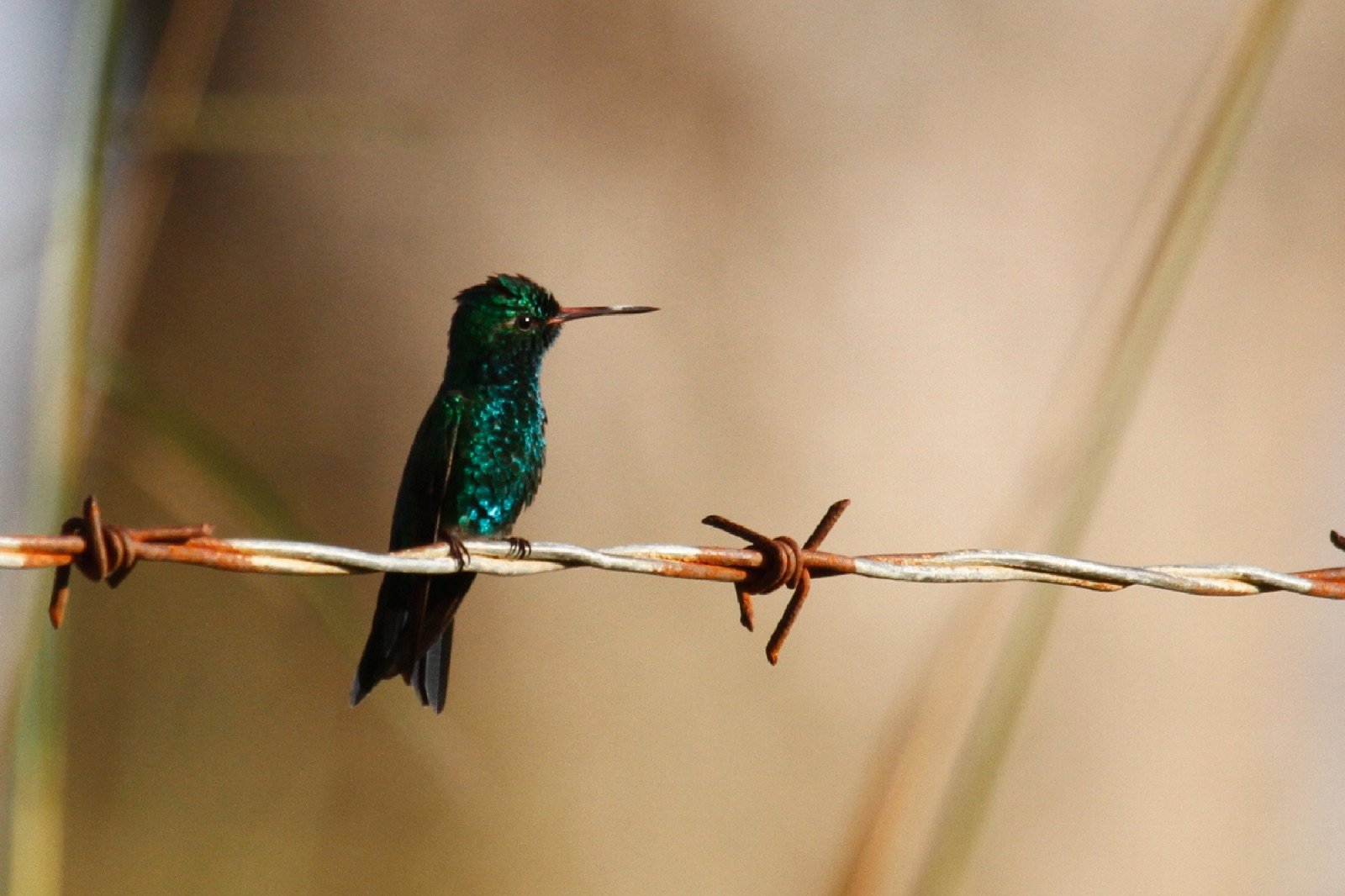
Family Trochilidae
Canivet's Emerald
Cynanthus canivetii
In Spanish: Esmeralda Rabihorcada
- Resident
A tiny forked-tailed hummingbird of dry edges and gardens in the northwest
Canivet's Emerald (Esmeralda Rabihorcada) is a tiny, glittering green hummingbird with a long, forked blue-black tail. In Costa Rica the local subspecies, salvini, lives on the Pacific side of the northwest.
It favours edges, gardens and scrubby country rather than deep forest, so it is a bird for roadsides and forest borders. The male is often secretive despite his bright plumage, and the duller female is easily overlooked. The species is not rare, but it can be hard to find.
On trips we build through Guanacaste, dry-forest stops list it among the birds to watch for, and listening at an edge for a singing male is the best way in.
How to find it
Listen first. Males sing again and again from low perches in thickets along forest and scrub edges, so a singer at an edge is a good way to locate one. Look along roadsides, forest borders, scrubby savannas and gardens with flowering shrubs and small trees. Check flowering shrubs for a small bird working a route of scattered blooms, and watch for a wagging, partly open tail. Females are easy to overlook, so scan carefully through the hummingbirds you do find. A guided roadside walk near Caldera, where dry forest meets mangroves, found one in January 2025.
How to recognise it
The male is a tiny, glittering green hummingbird, about 8 to 9 cm long and roughly 2 to 3 g. Look for:
- a red bill with a black tip
- white thigh tufts
- a long, forked blue-black tail
The female is bright green above and light gray below. She has a dark cheek and a pale stripe behind the eye. Her tail is less forked, with white tips on the outer feathers.
The Costa Rican salvini male differs from the nominate form. Its upper bill is dusky rather than red, and the central tail feathers have dark sooty gray tips.
Behaviour and diet
This hummingbird visits a circuit of flowering plants, a habit called trap-lining, and does not defend a feeding territory. It often uses small flowers that other hummingbirds ignore. It feeds from near the ground up to mid-height in vegetation, holding its tail partly open and wagging it while it feeds. It also eats small arthropods. Males sing again and again from low perches in thickets along forest and scrub edges. In aggressive encounters, and perhaps courtship, they make a shallow dive display that ends with a dry sputtering sound at the bottom.
Where it lives
In Costa Rica the salvini form lives on the Pacific side of the northwest, mainly in the highlands of that slope. It occurs only up to about 1,500 m in the country, while elsewhere in its range it reaches roughly 1,900 m. Across its range it favours dry to semi-humid, semi-open country: forest edges and clearings, secondary forest, scrubby savanna and gardens. A record from Playa Real, in Guanacaste, is also listed for Costa Rica.
When to see it
Breeding in Costa Rica runs from November to March or April. The nest is a small cup of plant fibres and down, placed 1 to 3 m above the ground.
Similar birds
It looks almost identical to the Garden Emerald, which has an all-black bill, while Canivet's has a red base to the bill. Their ranges do not overlap. A Costa Rica garden owner was first offered Garden Emerald for a female, but rejected it because that species was not mapped for his area and the bird lacked its glittering green.
Names and lore in Costa Rica
The AOCR Spanish name is Esmeralda Rabihorcada, a name used in Costa Rica and Nicaragua. Other Spanish names are esmeralda tijereta (Honduras, Mexico) and esmeralda de Canivet.
Status and conservation
The AOCR lists it as a resident species in Costa Rica, and the IUCN rates it Least Concern, with a very large range and a stable population.
Photography tips
The male is often secretive despite his bright plumage and long tail, so patience at a flowering shrub or a singing perch pays off. Look for the tail held partly open and wagging while it feeds. The duller female is easily overlooked.
How we know this 16 sources, each read on the date shown
- Wikipedia read 2026-11-04
https://en.wikipedia.org/wiki/Canivet's_emerald - Anthony Lujan read 2026-11-04
https://www.anthony-lujan.com/hummingbirds/canivets-emerald - EcoRegistros read 2026-11-04
https://www.ecoregistros.org/ficha/Cynanthus-canivetii&idusuario=3007&idpais=14 - Animalia.bio read 2026-11-04
https://animalia.bio/canivets-emerald - Lista Oficial de las Aves de Costa Rica read 2026-11-04
https://listaoficialavesdecostarica.wordpress.com/lista-oficial/lista-oficial-online/ - Flickr (Historia Natural de Costa Rica text) read 2026-11-04
https://www.flickr.com/photos/jobando/53981162479 - Costa Rica Focus read 2026-11-04
https://www.costaricafocus.com/birding-guanacaste-costa-rica-a-complete-guide/ - Eagle-Eye Tours read 2026-11-04
https://www.eagle-eye.com/blog/costa-rica-sampler-trip-report-jan-4-15-2025/ - Enchanting Costa Rica read 2026-11-04
https://enchanting-costarica.com/nature-and-adventures/birdwatching-in-guanacaste-discover-the-extraordinary-birdlife-of-hacienda-guachipelin/ - Retired in Costa Rica read 2026-11-04
https://www.charliedoggett.net/tag/cynanthus-canivetii/ - Wikipedia (Spanish) read 2026-11-04
https://es.wikipedia.org/wiki/Cynanthus_canivetii - Retired in Costa Rica read 2026-11-04
https://www.charliedoggett.net/tag/canivets-emerald-2/ - Oiseaux.net read 2026-11-04
https://www.oiseaux.net/photos/frederic.leviez/canivet.s.emerald.1.html - Birds of the World (Cornell) read 2026-11-04
https://birdsoftheworld.org/bow/species/caneme1/cur/systematics?lang=es - Valéry Schollaert read 2026-11-04
https://valeryschollaert.wordpress.com/emeraude-de-canivet-cynanthus-canivetii/ - Retired in Costa Rica read 2026-11-04
https://www.charliedoggett.net/2022/04/25/a-canivets-emerald-hummingbird/