Family Trochilidae
Garden Emerald
Chlorostilbon assimilis
In Spanish: Esmeralda Jardinero
- Resident
- Regional endemic
A tiny glittering hummingbird of sunny hedges and gardens in the south.
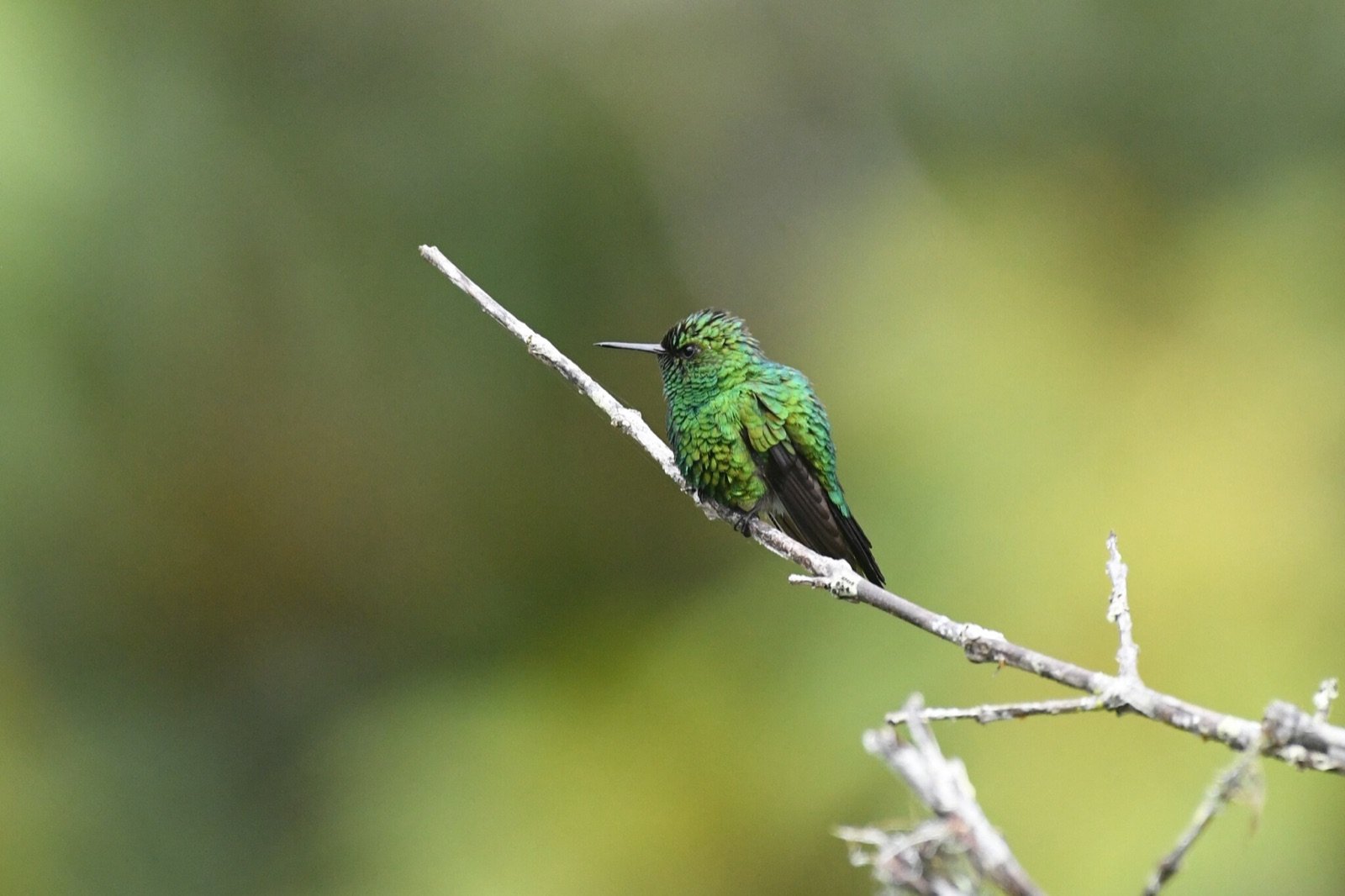
The Garden Emerald (Esmeralda Jardinero, Chlorostilbon assimilis) weighs only about 2.6 g, and it breeds only in Costa Rica and Panama. In Costa Rica its range is southwestern, and the AOCR list marks it as a resident endemic.
It is not a bird of closed forest. Look for it in open, sunny garden spots and hedges, where a male may have to compete with Rufous-tailed Hummingbirds and others for flowers.
On a trip we build in the southern zone, heliconia gardens are where guests meet it, alongside Purple-crowned Fairy and Crowned Woodnymph.
How to find it
Choose open, sunny places rather than forest: garden clearings, hedges and flowering borders. A local guide regularly finds it at a hedge of rabo de gato (Stachytarpheta) near San Rafael de Pavones, on the Turrialba to Siquirres road, and the hedge draws the birds. Heliconia gardens in the southern zone also attract it. Around Turrialba it is the only emerald a visitor there is likely to see. Expect larger hummingbirds to chase it, so give the flowers a few patient minutes.
How to recognise it
The male is only about 8 cm long. Look for:
- bronze-green upperparts
- bright green underparts
- white thighs
- a deeply forked tail
At first look he is simply glittering green.
The female looks so different that a casual observer may take her for another species. She has grey underparts, a white stripe behind the eye and dusky ear patches. Her tail is not deeply forked and has white tips. The white stripe often shows well, which separates her from the female Snowcap, widespread and common in parts of the Turrialba area.
What it sounds like
Recording: Maria Janeiro, CC BY 4.0, source, read 4 Nov 2026.
Behaviour and diet
The Garden Emerald visits small flowers, including ones other hummingbirds ignore, and it also takes tiny insects. Larger hummingbirds often chase it away, so watch the edges of a flowering patch rather than the best blooms.
Breeding males perch on open branches and may perform a dive display, which makes an exposed sunny perch a good place to scan.
Where it lives
It lives in open country: forest edges, hedgerows, streamside thickets, scrub and gardens. In Costa Rica it ranges from sea level up to 1,500 m, though it is mostly recorded in coastal lowlands and foothills. A Costa Rica birding guide lists it among the hummingbirds of mid-elevation gardens, at roughly 800 to 1,200 m.
It lives in the southwest, including the Térraba Valley and the Dota Mountains, as a resident of the southern Pacific slope. It is also reported around Turrialba on the Caribbean slope.
When to see it
A nest with two feathered chicks was found on 28 March 2009 at La Amistad International Park, and the chicks fledged by 18 April. In Panama breeding appears to run from at least November to March.
Similar birds
It resembles Canivet's Emerald (Chlorostilbon canivetii), but has a less forked tail and a duller crown. Birds along the Pacific coast between Carara and Palmar look intermediate between the two species. Elsewhere their ranges are said not to overlap.
Names and lore in Costa Rica
Costa Rican Spanish names include Esmeralda Jardinera and Esmeralda Jardinero. Wider Spanish names include Esmeralda de Panamá and Esmeralda Afín.
Status and conservation
The AOCR list marks it R-END, a resident endemic, and the IUCN lists it as Least Concern.
Photography tips
Set up at a sunny hedge of flowering Stachytarpheta or a heliconia garden and wait. Males perch on open branches, so an exposed perch near the flowers is a good place to focus.
How we know this 17 sources, each read on the date shown
- Wikipedia (Spanish) read 2026-11-04
https://es.wikipedia.org/wiki/Chlorostilbon_assimilis - Wilson Journal of Ornithology (ResearchGate) read 2026-11-04
https://www.researchgate.net/publication/230562590_Nest_Description_of_the_Garden_Emerald_Chlorostilbon_assimilis_from_Costa_Rica - Flickr species account (Spanish, Costa Rica) read 2026-11-04
https://www.flickr.com/photos/jobando/37938732542 - Wikipedia read 2026-11-04
https://en.wikipedia.org/wiki/Garden_emerald - Earthlife read 2026-11-04
https://earthlife.net/garden-emerald-hummingbirds/ - How To Enjoy Hummingbirds read 2026-11-04
https://howtoenjoyhummingbirds.com/garden-emerald/ - Wikipedia read 2026-11-04
https://translate.google.com/translate?u=https%3A%2F%2Fen.wikipedia.org%2Fwiki%2FGarden_emerald&hl=es&sl=en&tl=es&client=srp&prev=search - Birds for Beer read 2026-11-04
https://birdsforbeer.com/2020/10/04/garden-emerald-glittering-green/ - Costa Rica Focus read 2026-11-04
https://www.costaricafocus.com/best-spots-for-spotting-hummingbirds-in-costa-rica/ - Danica Mbad blog read 2026-11-04
https://danicambad.com/2021/06/05/vista-sur-punta-burica/ - Costa Rica Focus read 2026-11-04
https://www.costaricafocus.com/birdwatching-costa-rica/ - Avibase read 2026-11-04
https://avibase.bsc-eoc.org/species.jsp?avibaseid=C99DAFD10F9F9A42 - Field Guides trip list read 2026-11-04
https://fieldguides.com/triplists/cr118.html - Field Guides trip list read 2026-11-04
https://fieldguides.com/triplists/cos19.html - Reflections of the Natural World read 2026-11-04
https://reflectionsofthenaturalworld.com/2024/07/31/garden-emerald/ - Simply Birding read 2026-11-04
https://www.simplybirding.com/birds/garden-emerald-chlorostilbon-assimilis/ - Anthony Lujan read 2026-11-04
https://www.anthony-lujan.com/hummingbirds/garden-emerald