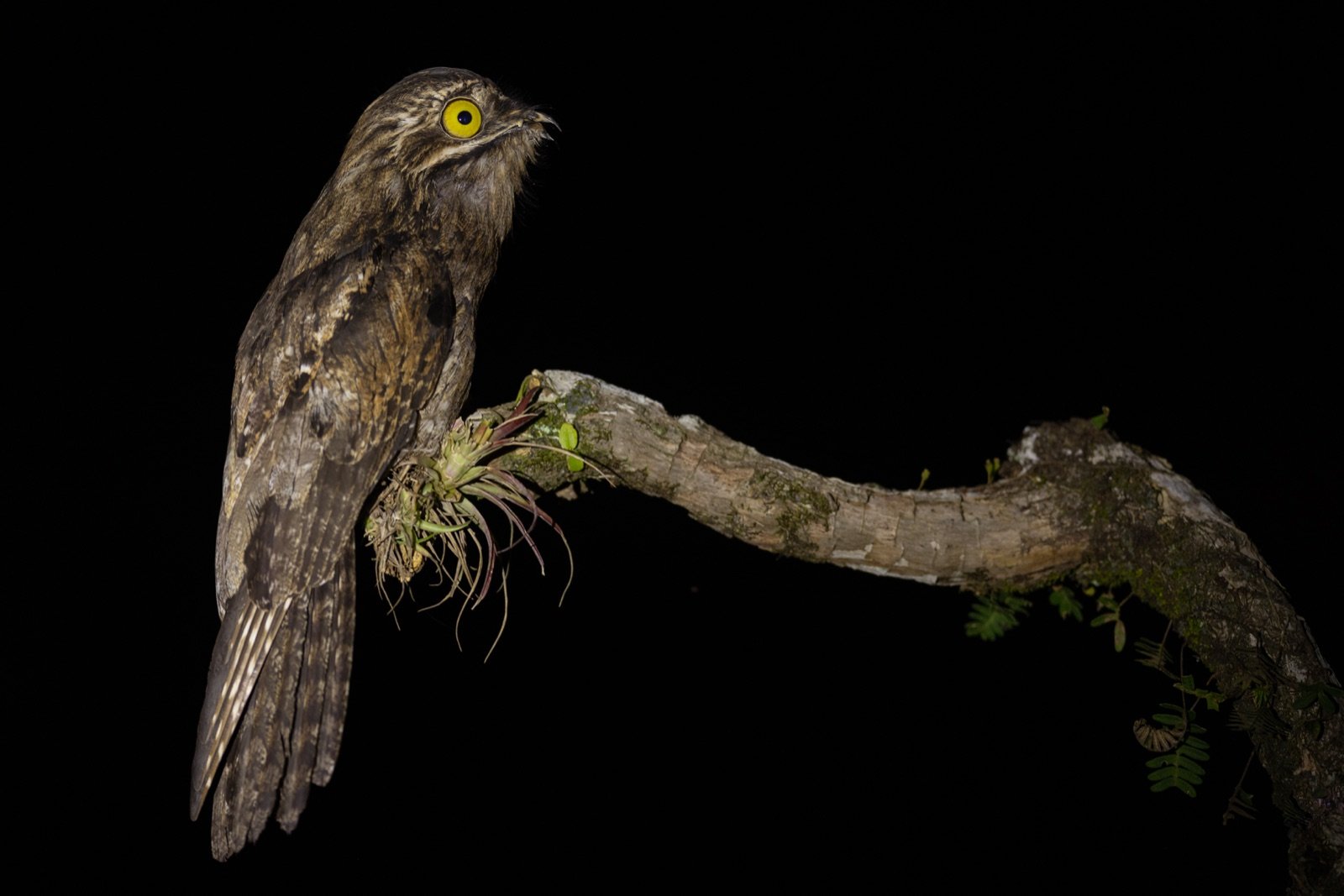
 Common Potoo
Family Nyctibiidae
Common Potoo
Nyctibius griseus
In Spanish: Nictibio Común (Pájaro Estaca, Pájaro Palo)
- Resident
The stump that opens its eyes: a night bird that hides in plain sight.
The Common Potoo (Nictibio Común, Nyctibius griseus) spends the day perched upright and still on a stump or dead branch, looking like part of the wood. Costa Ricans call it pájaro estaca, the stake bird, and pájaro palo, the stick bird, for exactly that habit.
It is a resident across Costa Rica and the most widely distributed of the three Costa Rican potoos. Despite its name it is generally uncommon, and you will not find it on every trip, but it is not rare if you look in the right places.
It is heard far more often than seen, so the best meetings come at dusk, by following a call, or with a guide who knows a day roost.
How to find it
Get out before dawn and follow the call: one writer found a roosting bird exactly that way. Listen at night and look for odd shapes on branch tips, especially near streetlamps beside good habitat. A spotlight can pick out potoos by eyeshine at the tops of exposed perches, though lights should be used sparingly and your guide's instructions followed. A guide who knows the local roosts helps a great deal. The Sierpe River in the South Pacific is a good place to find adults roosting, and nests have been reported along its banks.
How to recognise it
Look for an upright, motionless shape on a stump, fence post or dead branch.
Size: about 38 cm long.
Eyes: yellow, almost closed in daytime. At night they shine bright orange in a light beam.
Upperparts: grayish brown with fine mottling.
Breast: a band of large black spots crosses the lower breast.
Head: small feather tufts below the eyes look like horns.
Face: a white malar line followed by a black one.
When it feels threatened, it points its bill at the sky and sleeks its feathers, looking thinner, like a branch.
What it sounds like
Recording: Fabrício Mil Homens Riella, CC BY 4.0, source, read 4 Nov 2026.
Behaviour and diet
At night it hunts insects by flying out from exposed perches. Moths and beetles are on the menu, and by day it may rest on fence posts, dead trees or dry branches.
It lays a single egg with no real nest, set on a stump or broken branch. A roosting bird relies on camouflage, and at dusk it relaxes into a more horizontal, owl-like posture.
Where it lives
In Costa Rica it lives in lowland forest and forest edges on both slopes, from sea level up to about 1,200 meters. It is more common along rivers and mangroves on the Pacific slope from Carara south to Panama.
On the Caribbean slope you can also find it, especially in open and semi-open areas. It occurs there and on the central and southern Pacific slope, in the lowlands and mid elevations.
When to see it
Breeding in Costa Rica is reported from December to March, and also in June. It is also described as a dry season breeder.
Similar birds
Costa Rica has three potoos, and the best way to separate them is by their very different voices. Northern Potoo is almost identical, but it is found only in Guanacaste in the northwest, so range and voice separate them. Great Potoo (leona) is much larger and paler. By day Common Potoo looks like a huge nightjar but sits upright, and owls have rounder heads and shorter tails.
Names and lore in Costa Rica
Costa Ricans mainly call it pájaro estaca (stake bird) or pájaro palo (stick bird), both from its habit of sitting upright on a stump or branch tip. The potoo family also goes by leona and bruja (witch), depending on species and region. In Sabanillas de Acosta some villagers call this bird bruja, because its strange night call had never been linked to any known animal.
Status and conservation
Resident (R) on the AOCR list, generally uncommon but locally more frequent in the Térraba region, and Least Concern for the IUCN.
Photography tips
For distant day roosts, a spotting scope gives good views, and a 400 to 600 mm telephoto lens suits photography. At a roost beside a road, keep a safe distance, which matters most when a chick is present. Use lights sparingly and follow your guide's instructions.
How we know this 17 sources, each read on the date shown
- Costa Rica Birding Trips read 2026-11-04
https://costaricabirdingtrips.com/nyctibiidae/common-potoo-nyctibius-griseus/ - Ballena Tales Magazine read 2026-11-04
https://ballenatales.com/the-common-potoo-king-of-comouflage/ - Birding Craft read 2026-11-04
https://birdingcraft.com/wordpress/2023/05/10/potoos-the-pseudo-owls-of-costa-rica/ - Contenido Tico read 2026-11-04
https://contenidotico.com/biodiversidad/aves/pajaro-estaca/ - Aves de Costa Rica read 2026-11-04
https://avesdecostarica.com/Nyctibius-griseus.html - Birdfact read 2026-11-04
https://www.birdfact.com/birds/common-potoo - Wikipedia (Spanish, via Wikiwand) read 2026-11-04
https://www.wikiwand.com/es/Nyctibius_griseus - Biofotos read 2026-11-04
https://biofotos.org/DetalleAves.aspx?Cod=317 - Aves de Costa Rica (Nyctibiidae) read 2026-11-04
https://www.avesdecostarica.org/nyctibiidae.html - El Jornal CR read 2026-11-04
https://eljornalcr.com/el-pajaro-estaca/ - BirdForum read 2026-11-04
https://www.birdforum.net/tags/common-potoo/ - Birding Craft read 2026-11-04
http://birdingcraft.com/wordpress/2025/04/ - Charlie Doggett's Costa Rica photo gallery read 2026-11-04
https://charliedoggett.smugmug.com/BIRDS/Costa-Rica-Birds-by-Species/Common-Potoo - Birds for Beer read 2026-11-04
https://birdsforbeer.com/2019/02/01/great-potoo-at-catie/ - Costa Rica Species read 2026-11-04
https://costaricaspecies.com/es/especies/700ea21a-a4b4-41ab-b94b-7e5462cdf82b/nyctibius-griseus - Birds of the World read 2026-11-04
https://birdsoftheworld.org/bow/species/compot1/cur/introduction - Costa Rica Focus read 2026-11-04
https://www.costaricafocus.com/bird-species/great-potoo/