Family Falconidae
Crested Caracara
Caracara plancus
In Spanish: Caracara Cargahuesos (Cargahuesos, Querque, Quebrantahuesos)
- Resident
A large, bold scavenger of roadsides and pastures, common in Guanacaste.
The Crested Caracara is the largest and most widespread of Costa Rica's three caracaras, and it lives in the open country that most trips drive through. Look for it on roadsides and in pasture.
Costa Ricans call it Cargahuesos, the bone carrier, because it flies up with bones and drops them on hard ground to get at the marrow.
How to find it
Drive slowly along roadsides, where it picks over road-killed animals, especially in Guanacaste and Puntarenas. Check freshly mowed fields, where it gathers to feed. In the breeding season, listen for the loud cackle and follow it to a bird calling from a branch.
How to recognise it
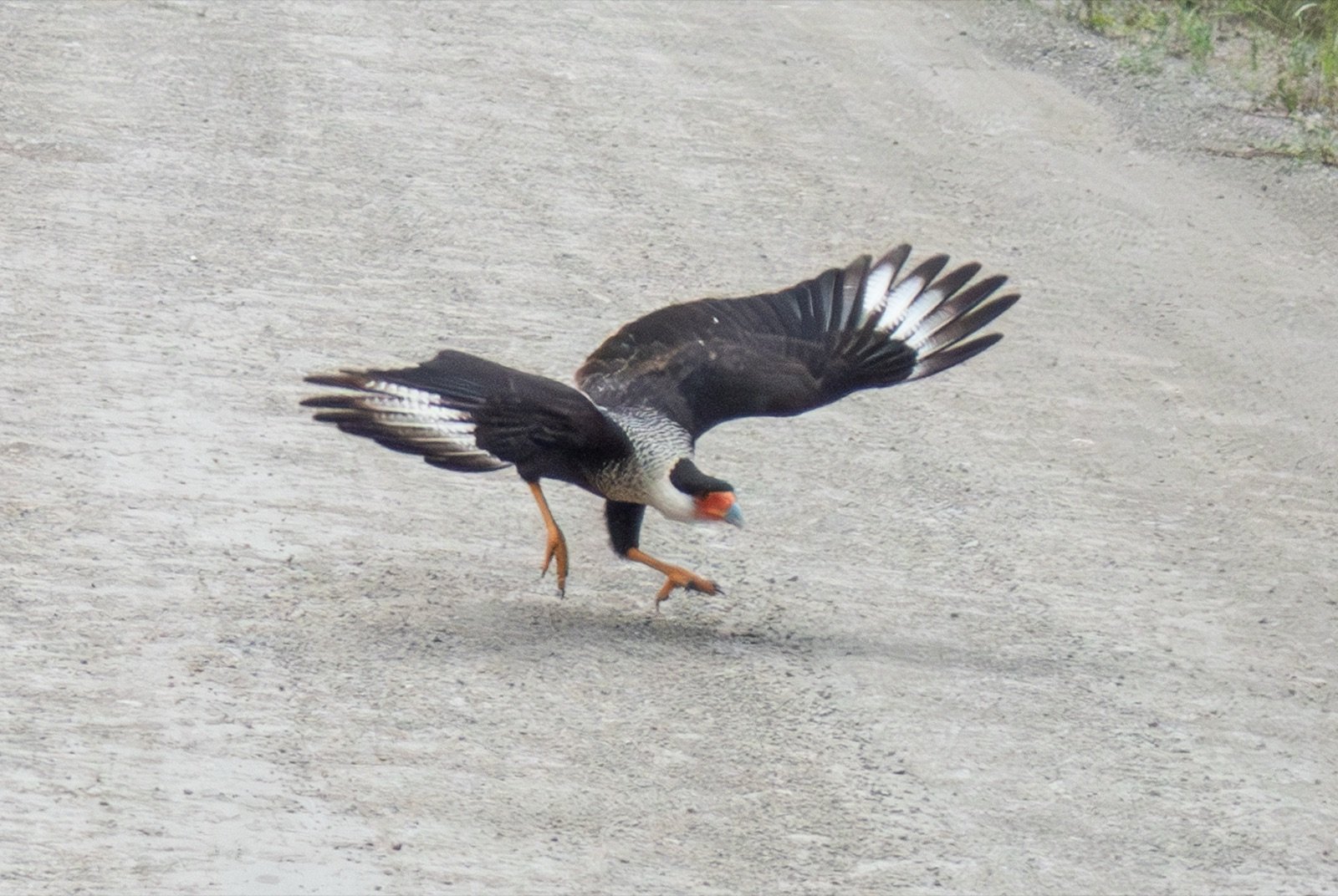
This is a large caracara, about 61 cm long and about 1 kg, with a fairly long neck, wings and legs. Adults have a black crown and crest, a pale face with orange or yellowish skin, and a dark brown to black body. The chest is streaked with white. Wings and tail are dark with pale tips. The face skin can change colour within seconds when the bird is threatened or excited, usually orange to red and sometimes shifting toward yellow. Immatures look like adults but are duller and browner.
What it sounds like
Recording: Bruno Avilez, CC BY 4.0, source, read 4 Nov 2026.
Behaviour and diet
It walks on the ground looking for dead small animals, and it also attacks snakes, frogs, rodents and chicks. It is seen alone or in small groups. It picks over road-killed animals along roadsides and gathers in freshly mowed fields to eat animals killed by the mowers. It takes bones, flies up and drops them on hard ground to crack them open for the marrow.
Where it lives
It prefers open country: savanna, pasture, farmland, scrub, beaches and the edges of both deciduous and evergreen forest. It lives across much of Costa Rica and is a common resident of the dry northwest lowlands, climbing to about 750 m in the nearby mountains. It is absent from high altitudes and from the Caribbean coast, though reports above 1500 m are becoming more frequent.
When to see it
It breeds from December to March, and the call is heard especially in the breeding season. A fledged juvenile has been recorded being fed by both parents in September.
Similar birds
Yellow-headed Caracara is smaller, with a buff to cream head and underparts against a dark brown back, and shows white patches at the base of the primaries in flight. Red-throated Caracara has only a few scattered reports.
Names and lore in Costa Rica
Costa Ricans call it Cargahuesos (bone carrier), Quebrantahuesos (bone breaker) and Querque. The first two names come from its habit of carrying bones and cracking them open for marrow.
Status and conservation
It is a resident (R) on the AOCR list, and the Costa Rican wildlife agency gives its population trend as increasing.
Photography tips
Roadsides and freshly mowed fields are where it can be found at close range. One visitor saw it quite close to the road on the way into Palo Verde, the closest they had seen this bird.
How we know this 14 sources, each read on the date shown
- Tico Times read 2026-11-04
https://ticotimes.net/2023/03/11/costa-rica-wildlife-meet-the-crested-caracara - Costa Rican natural history account (Flickr page) read 2026-11-04
https://www.flickr.com/photos/jobando/27106283772 - Birds for Beer (Turrialba) read 2026-11-04
https://birdsforbeer.com/2024/03/02/crested-caracaras-at-angostura/ - Costa Rica Journeys read 2026-11-04
https://www.costaricajourneys.com/crested-caracara/ - Ballena Tales read 2026-11-04
https://www.ballenatales.com/the-bonecarrier-caracara-caracara-cheriway/ - Mexican Birds read 2026-11-04
https://www.mexican-birds.org/crested-caracara/ - Costa Rica Focus read 2026-11-04
https://www.costaricafocus.com/bird-species/yellow-headed-caracara/ - ResearchGate, El Quebrantahuesos read 2026-11-04
https://www.researchgate.net/publication/313512260_EL_QUEBRANTAHUESOS - Spizaetus, Neotropical Raptor Network bulletin 28 read 2026-11-04
https://assets.peregrinefund.org/docs/newsletters/final-spizaetus-28-spanish-2019-12-24_155707.pdf - Fauna Decomisada, Costa Rica read 2026-11-04
https://faunadecomisada.go.cr/guia-de-especies/aves/falconidae/caracara-cheriway - Costa Rica Focus read 2026-11-04
https://www.costaricafocus.com/birding-guanacaste-costa-rica-a-complete-guide/ - The Wildlife Diaries read 2026-11-04
https://www.thewildlifediaries.com/exploring-palo-verde-national-park/ - FotoNaturaleza read 2026-11-04
https://www.fotonaturaleza.net/foro/?m=t&tid=5441 - Aves de Costa Rica read 2026-11-04
https://www.avesdecostarica.com/Caracara-cheriway.html