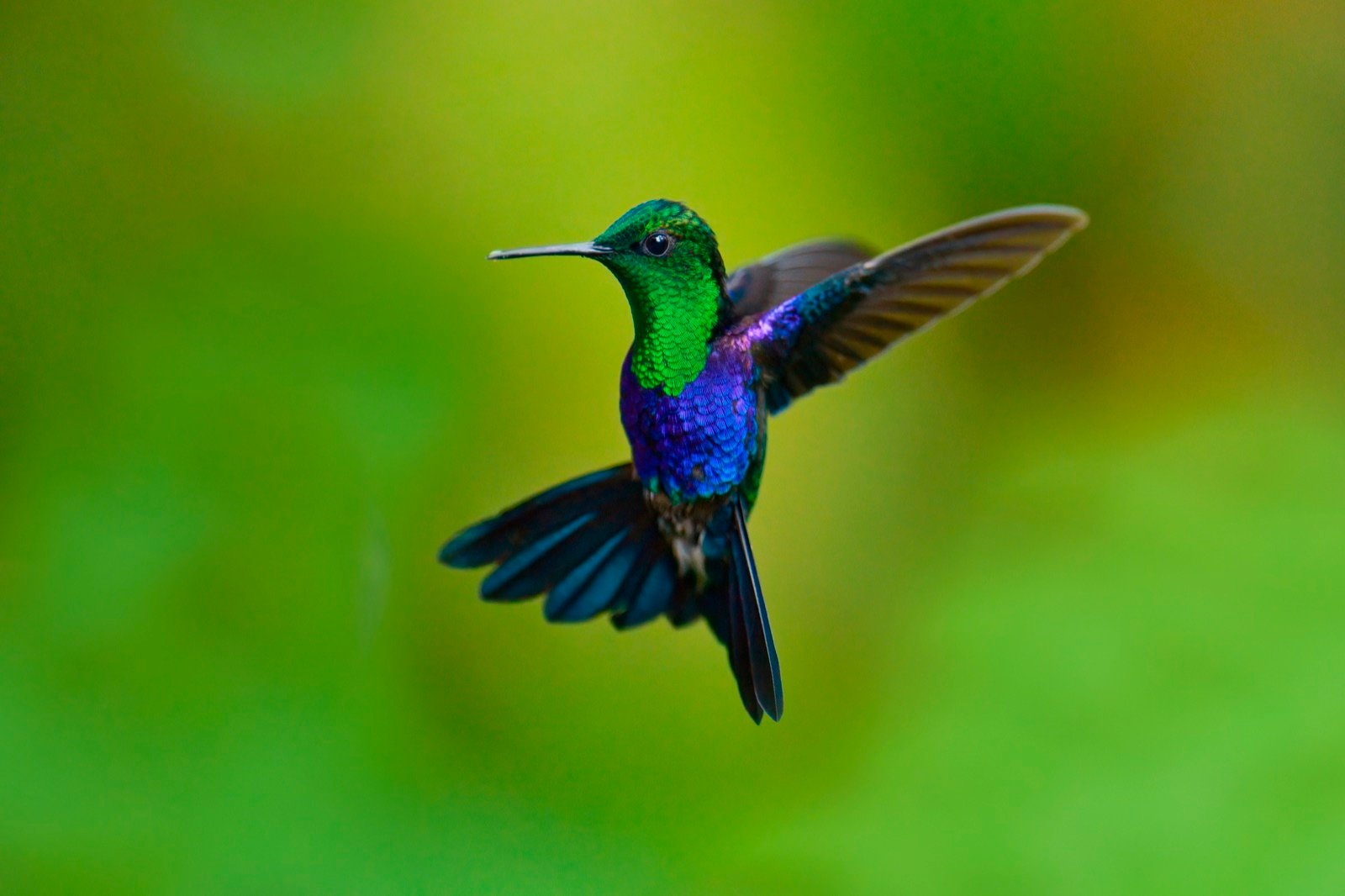
 Crowned Woodnymph
Family Trochilidae
Crowned Woodnymph
Thalurania colombica
In Spanish: Colibrí Ninfa Verde-Violeta
- Resident
A dark, violet and green hummingbird of humid Caribbean lowland forest.
The Crowned Woodnymph (Colibrí Ninfa Verde-Violeta) is a very common resident of humid lowlands, valleys and foothill slopes on the Caribbean side of Costa Rica, from sea level to about 750 m. On the Pacific side it reaches north to the Quepos-Parrita area.
At Rara Avis, a classic rainforest birding site, it was the most common hummingbird, with several at feeders and many more in the forest. A day or two of birding lowland or foothill rainforest in Costa Rica will probably turn up several of them.
The sexes look nothing alike, so this page covers both, along with the flowers and places where birders tend to meet them on the trips we build.
How to find it
Look for it at Heliconia and other flowering plants in forest edges, clearings and shaded gardens. Flowering events draw it in, and after breeding many birds gather at Heliconia. Both sexes visit Cephaelis flowers in clearings, so check those too. It comes to sugar-water feeders, and both male and female have been photographed at feeders in Cartago province. In shady forest a male feeding high overhead looks like a dark, plain hummingbird, and you may need a scope to see its purple and green glitter.
How to recognise it
Males look very dark, with a deeply forked tail. The adult male has a deep violet crown, upper back and belly, a glittering green throat and chest, and a blue-black tail. Males are about 10 cm long and weigh about 4.5 g.
Females are smaller, about 9 cm and 4 g. They are bright green above with a pale gray throat and chest, and a darker belly. The tail is blue-black with white tips on the outer three feather pairs, and the bill is black.
Young males show little or no violet or bright green. They are dusky green above and bronzy below, with a shorter tail than adults.
Behaviour and diet
The birds are solitary. In the breeding season males visit flowers of epiphytes such as bromeliads in the forest canopy, while females stay mostly in the understory at flowering shrubs such as Besleria. After breeding, many gather at Heliconia flowers, where males defend territories.
Both sexes catch insects and spiders from leaf surfaces, and males catch more insects in the air. Across the species' range, both sexes defend rich nectar sources, and females are more aggressive than males about it.
Where it lives
In Costa Rica it prefers very humid forest of lowlands and slopes, including forest edges, tall second growth and partly open areas. It is mainly a Caribbean side bird, reaching the Pacific side north to the Quepos-Parrita area.
It breeds from sea level up to about 900 m. After breeding it moves as high as 1,200 m, and it also moves locally to follow flowering plants. Across its range it also uses semi-open places such as coffee and cacao plantations and gardens, and it avoids open scrub.
When to see it
It is a resident. Breeding in Costa Rica runs from about February to May or June, and the nest is a small cup of tree fern scales and plant down bound with spiderweb, placed under a leaf on a horizontal twig.
Similar birds
Females often confuse birders in Costa Rica because they look nothing like the dark males. Their contrasting gray throat is a strong field mark, since no other hummingbird living alongside them shares it. Males seen in dim understory are best identified by shape: dark plumage, a forked tail and a very slightly downcurved bill point to this species in humid lowland forest.
Names and lore in Costa Rica
Costa Ricans know it as Colibrí Ninfa Verde-Violeta. Other names used include ninfa verde-violeta and ninfa violeta y verde. One Costa Rican bird site also lists colibrí, gorrión and ninfa coronivioleta.
Status and conservation
The AOCR list marks it as a resident (R), and in Costa Rica it is described as a very common resident.
Photography tips
Garden feeders and hummingbird bathing pools are good bets. At one lodge near Turrialba, pools drew a male to bathe, alongside White-necked Jacobin and Stripe-throated Hermit. In the forest canopy, shade hides the colour, so plan for a scope or aim for feeders and flowering Heliconia at eye level.
How we know this 14 sources, each read on the date shown
- Aves de Costa Rica read 2026-11-04
https://www.avesdecostarica.com/Thalurania-colombica.html - Flickr (J. Obando, natural history notes) read 2026-11-04
https://www.flickr.com/photos/jobando/34486095991 - Greg Lasley Nature Photography read 2026-11-04
https://www.greglasley.com/vcwoodn.html - Ecos del Bosque read 2026-11-04
https://ecosdelbosque.com/fauna/thalurania-colombica - Wikipedia read 2026-11-04
https://en.wikipedia.org/wiki/Crowned_woodnymph - Animalia.bio read 2026-11-04
https://animalia.bio/crowned-woodnymph - Birda read 2026-11-04
https://app.birda.org/species-guide/3447/Crowned_Woodnymph - BirdBuddy Wiki read 2026-11-04
https://app.mybirdbuddy.com/birds/crowned-woodnymph/b3e61d3e-3d52-4010-951d-44f12bcb2da6 - Birding Craft read 2026-11-04
https://birdingcraft.com/wordpress/tag/violet-crowned-woodnymph/ - Getty Images read 2026-11-04
https://www.gettyimages.com/photos/green-crowned-woodnymph - Wikipedia (es) read 2026-11-04
https://es.wikipedia.org/wiki/Thalurania_colombica - Anthony Lujan read 2026-11-04
https://www.anthony-lujan.com/hummingbirds/crowned-woodnymph - Rockjumper trip report read 2026-11-04
https://app.rockjumperbirding.com/sites/rockjumper/attachments/9/Trip%20Report%20-%20RBL%20Costa%20Rica%20-%20Cloud%20Forest%20&%20Quetzals%20and%20Ext%202017.pdf - Flickr (jobando) read 2026-11-04
https://www.flickr.com/photos/jobando/35501976812