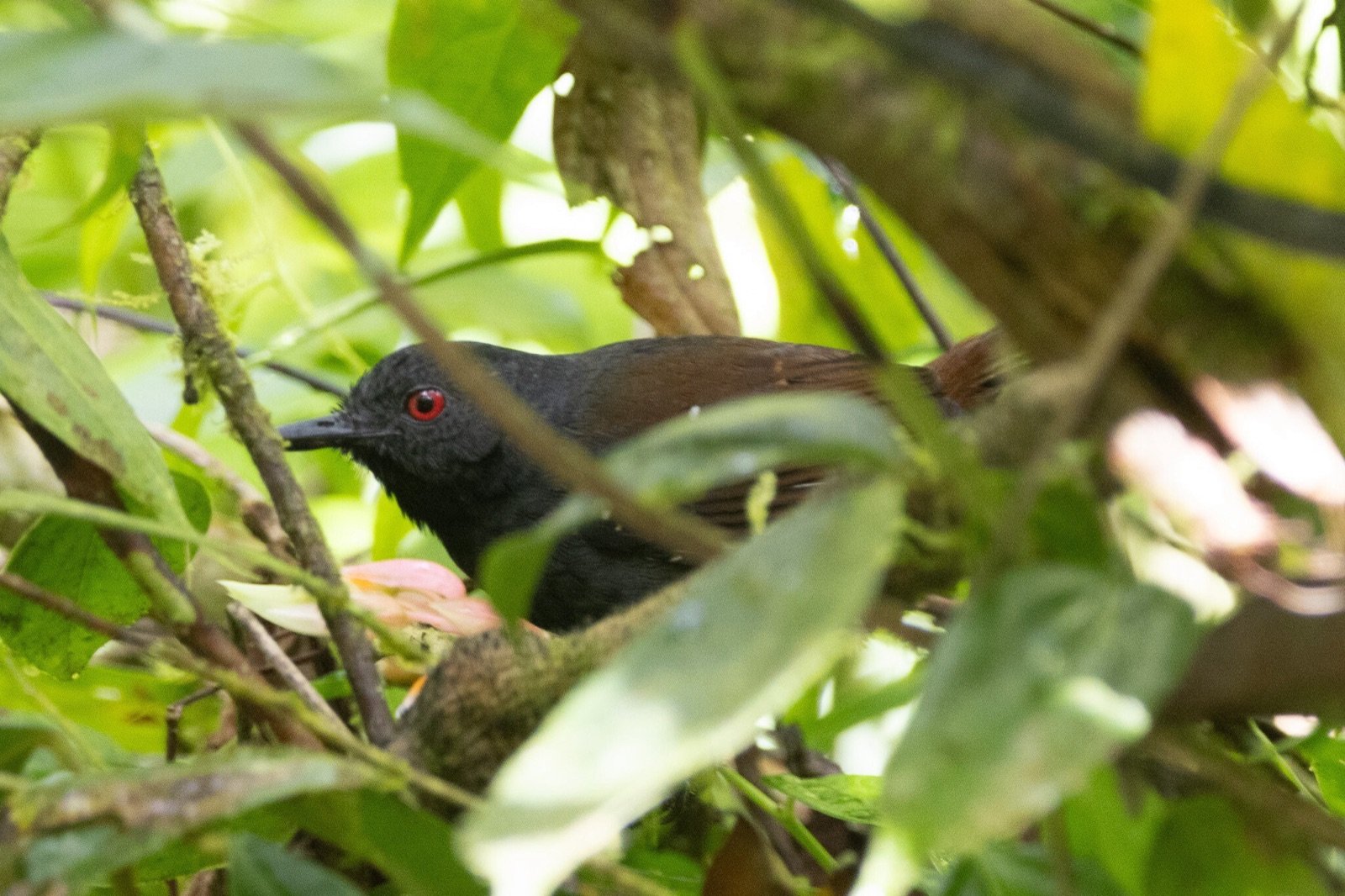
Family Thamnophilidae
Dull-mantled Antbird
Sipia laemosticta
In Spanish: Hormiguero Alimaculado
- Resident
Red-eyed skulker of dark Caribbean ravines and streamsides
The Dull-mantled Antbird (Hormiguero Alimaculado) is a small, red-eyed bird of the forest floor on Costa Rica's Caribbean slope. It is a locally common resident in a narrow foothill belt, about 300 to 750 m, and it is not found on the Pacific side.
Like most antbirds in Costa Rica it skulks, so listening is half the work. Shady streamsides and ravines are where to start, and on a trip we build around Turrialba or Braulio Carrillo National Park it is one of the birds to check along forest trails.
It is considered endemic to Costa Rica and western Panama, and Costa Rica holds the type locality, Tucurriqui, where the species was first described.
How to find it
Antbirds in Costa Rica are generally hard to find because they skulk, so listen first along shady streamsides and ravines in dense understory, and watch for the tail-bobbing habit. At Quebrada Gonzalez in Braulio Carrillo National Park it is regular, as it is at most Caribbean slope foothill sites. At a La Selva site a pair was drawn to a parking lot area by their churring calls, and at the trail entrance another pair sang and came in well to playback. Near Turrialba a guide reports it fairly often around San Rafael de Pavones, and the Tuis river valley gives many sightings, though usually only glimpses or calls. Birds stay shy, so slow, careful checking of the undergrowth helps.
How to recognise it
This is a small antbird, about 14 cm long and about 25 g. Look for these marks:
Male: brown above, small white spots on the wings, dark gray head and underparts, black throat, red eyes.
Female: similar, but the black throat is speckled with many white spots or bars.
Both sexes: red eyes and gray legs. A white patch between the shoulders is usually hidden, and it is smaller in females.
Young birds: brown eyes, a brown wash on the head and no black below.
In the dim light of the forest floor the bird can look all black, so the white wing spots are the clearest mark.
What it sounds like
Recording: David Rankin, CC BY 4.0, source, read 4 Nov 2026.
Behaviour and diet
It feeds on insects and spiders, alone, in pairs or in family groups, mostly on the ground and up to about 1 m above it. It usually watches tensely, then strikes directly at prey. It often beats its tail down and raises it slowly, a habit worth watching for. When fighting or squaring off, it raises its back feathers so the hidden white patch shows.
It seldom joins mixed flocks but sometimes visits army ant swarms to catch insects fleeing the ants. Breeding season is not well defined, but in Costa Rica it includes at least April and May.
Where it lives
It lives in the undergrowth and on the floor of wet evergreen forest, mainly below 700 m and locally to 1,000 m. It seems especially fond of dark ravines and streamsides.
In Costa Rica it is a locally common resident in a narrow belt, about 300 to 750 m, reaching 1,000 m in the southeast. It lives on the Caribbean slopes of the whole country, from the Cordillera de Guanacaste south.
When to see it
One birder found it fairly common and calling often at Hitoy Cerere in March and April, though that is one observer's account and not a seasonal rule.
Similar birds
The only other Costa Rican antbird once placed in the same genus is the Chestnut-backed Antbird, now Poliocrania exsul. That one is also common on the Pacific slope, which this species is not. Within the species, the speckled throat separates females from the plain-throated males.
Names and lore in Costa Rica
The official Costa Rican Spanish name is Hormiguero Alimaculado. Other Spanish names listed for the species elsewhere include Hormiguero Guardarribera and Hormiguero de Manto Descolorido.
Status and conservation
The official Costa Rican list (AOCR) includes it as a resident species, and the IUCN rates it Least Concern.
Photography tips
The birds are shy, so patience pays: settle near a shady stream or ravine and let the undergrowth come to life. Slow, careful checking of the understory helps. On one trip a male sat in the open for long minutes on bare twigs, singing, which is unusual for such a skulker, so keep a camera ready.
How we know this 17 sources, each read on the date shown
- Cornell Birds of the World read 2026-11-04
https://neotropical.birds.cornell.edu/Species-Account/nb/species/dumant1/overview - Wikipedia read 2026-11-04
https://en.wikipedia.org/wiki/Dull-mantled_antbird - Birda species guide read 2026-11-04
https://app.birda.org/species-guide/16178/Dull-mantled_Antbird - iNaturalist (Wikipedia text) read 2026-11-04
https://www.inaturalist.org/taxa/554089-Sipia-laemosticta - Flickr caption (Costa Rican natural history text) read 2026-11-04
https://www.flickr.com/photos/jobando/29008594493/ - Birds for Beer read 2026-11-04
https://birdsforbeer.com/2024/01/24/dull-mantled-antbird/ - AOCR Lista Oficial read 2026-11-04
https://listaoficialavesdecostarica.wordpress.com/lista-oficial/lista-oficial-online/ - Field Guides trip report, Rancho Naturalista II 2021 read 2026-11-04
https://fieldguides.com/triplists/crh21b.html - Birdingcraft read 2026-11-04
https://birdingcraft.com/wordpress/tag/quebrada-gonzalez/ - BirdForum, Birdingcraft patch thread read 2026-11-04
https://www.birdforum.net/threads/birdingcrafts-costa-rica-patch.131932/ - Tropical Birding read 2026-11-04
https://www.tropicalbirding.com/centralamericacostaricacomprehensive - Rancho Naturalista read 2026-11-04
https://ranchonaturalista.com/birdwatching/the-birds/ - Costa Rica Focus read 2026-11-04
https://www.costaricafocus.com/birding-san-jose-province-costa-rica-a-complete-guide/ - JungleDragon read 2026-11-04
https://www.jungledragon.com/image/143672/dull-mantled_antbird_sipia_laemosticta.html - Avibase read 2026-11-04
https://avibase.bsc-eoc.org/species.jsp?avibaseid=0145FE4C6D2A34B7 - iNaturalist Ecuador (from Wikipedia) read 2026-11-04
https://ecuador.inaturalist.org/taxa/554085-Sipia - Birding Craft read 2026-11-04
https://birdingcraft.com/wordpress/2023/12/13/costa-rica-birds-endemic-near-endemic-and-other-target-species/