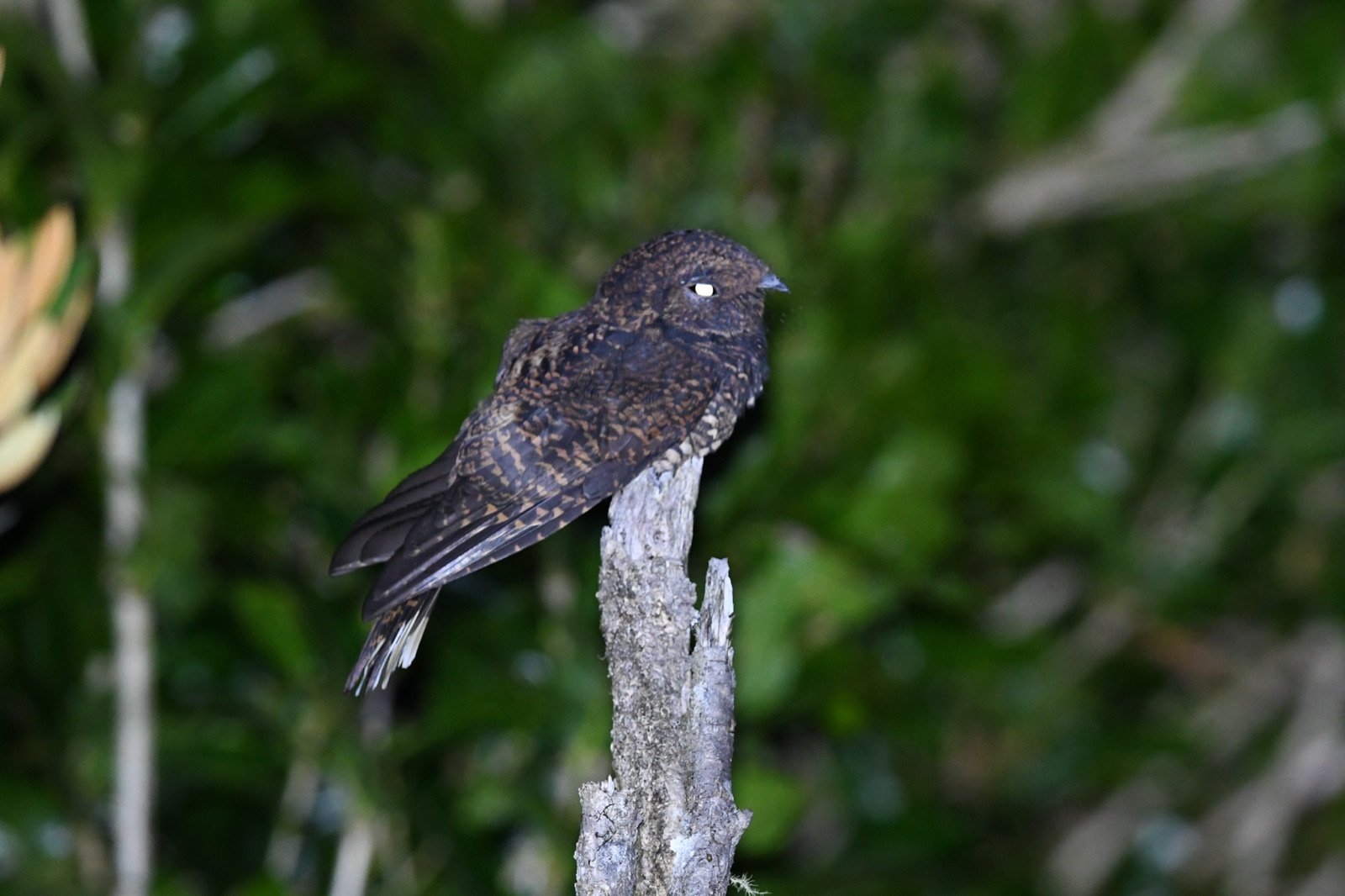
Family Caprimulgidae
Dusky Nightjar
Antrostomus saturatus
In Spanish: Chotacabras Sombrío (Tres Cobijas)
- Resident
- Regional endemic
A dark highland nightjar, found only in Costa Rica and western Panama.
The Dusky Nightjar (Chotacabras Sombrío, also called Tres Cobijas) is a resident regional endemic: it lives only in Costa Rica and western Panama. In Costa Rica it is locally common above about 2000 m in the Central Volcanic and Talamanca ranges.
It is strictly nocturnal, so meeting it means a night outing in the cold highlands. On a trip we build, the Cerro de la Muerte area is the usual base for the search, often alongside Bare-shanked Screech-Owl.
For a beginning birder this is a good first lesson in birding by ear. Nightjars are best identified by voice, since their plumage is so cryptic.
How to find it
Plan a night outing and listen first, because voice is the surest clue. Tour groups search for it at night in the Talamanca highlands, and the Cerro de la Muerte area is the usual base. Wet, misty nights are poor bets, since it calls only once or twice. Expect some effort: one birder heard it at dawn on the Providencia Road and got decent views there after a while, while a guided group at another site had only a poor flyover. One was also seen feeding under outdoor lights in the Talamanca highlands.
How to recognise it
This is a mid-sized, brownish nightjar with a buff band across the throat and no white wing patches. Across its range it is about 21 to 25 cm long.
The male:
- very dark, with little pattern
- thin buff-white throat band
- upperparts sooty black with fine reddish cinnamon spots and bars
- much of the face reddish cinnamon
- white tips on the outer tail feathers
The female:
- paler and more rufous
- throat band reduced or missing
- no white in the tail, where the tips are buff instead
What it sounds like
Recording: Tommy Andriollo, CC BY 4.0, source, read 4 Nov 2026.
Behaviour and diet
The Dusky Nightjar is strictly nocturnal. It starts calling and hunting after dusk and stops before dawn. In rain or mist it calls only once or twice after dusk and before dawn, so a wet night can be quiet.
It sits on open branches and stumps, rarely on the ground, and flies out to catch insects, mostly beetles and moths.
Where it lives
In Costa Rica it is widespread above about 2000 m in the Central Volcanic and Talamanca ranges, including the Dota area, and above about 1500 m in the Tilarán range. Named high mountains include Irazú and Turrialba volcanoes, La Estrella de Cartago and Escazú.
It prefers edges and canopy gaps of montane forest, including the forest-to-páramo transition, high pastures with scattered trees, and clearings. Across its whole range it lives between about 1,500 and 3,100 m, using the edges and openings of humid montane forest rather than the interior.
When to see it
Birds may start singing in December, which makes them easier to detect then. Breeding is reported in February, or March to April.
Similar birds
It is thought to be most closely related to the Eastern and Mexican whip-poor-wills, and is sometimes called the Dusky Whip-poor-will.
Names and lore in Costa Rica
The official AOCR list gives Chotacabras Sombrío, with Tres Cobijas added in brackets as a local name. Chotacabras Fuliginoso also appears, and Panama uses Tapacamino Sombrío. Old English names include Sooty Nightjar and Dusky Cheer-For-Will.
Status and conservation
The AOCR lists it as a resident regional endemic, found only in Costa Rica and western Panama, and it is locally common.
Photography tips
Between feeding sallies it often sits about 2 m above the ground, which can help once you have found a calling bird at dusk. It hunts mostly by flying out from a perch several meters up, so scan open branches and stumps at forest edges.
How we know this 16 sources, each read on the date shown
- Aves de Costa Rica (avesdecostarica.org) read 2026-11-04
https://www.avesdecostarica.org/caprimulgidae.html - Earthlife.net read 2026-11-04
https://earthlife.net/dusky-nightjars/ - Biosonidos UNED read 2026-11-04
https://biosonidos.uned.ac.cr/node/473 - Flickr (Costa Rican natural history notes) read 2026-11-04
https://www.flickr.com/photos/jobando/35216237115 - Wikipedia read 2026-11-04
https://en.wikipedia.org/wiki/Dusky_nightjar - Cornell Birds of the World read 2026-11-04
https://birdsoftheworld.org/bow/species/dusnig1/cur/introduction - Carolina Birds (Nightjars of the World) read 2026-11-04
https://carolinabirds.org/HTML/Nightjar_New_World.htm - AOCR Lista Oficial read 2026-11-04
https://listaoficialavesdecostarica.wordpress.com/lista-oficial/lista-oficial-online/ - Tropical Birding read 2026-11-04
https://tropicalbirding.com/product/comprehensive-costa-rica-birding-from-border-to-border/ - Birding Never Sleeps blog read 2026-11-04
https://birdingneversleeps.blogspot.com/2022/10/costa-rica-2022-cerro-de-la-muerte-to.html - Birdquest read 2026-11-04
https://www.birdquest-tours.com/birding-tours/costa-rica-ultimate/ - Field Guides trip list read 2026-11-04
https://fieldguides.com/triplists/cos20p.html - Macaulay Library read 2026-11-04
https://macaulaylibrary.org/asset/53962 - Avibase read 2026-11-04
https://avibase.bsc-eoc.org/species.jsp?avibaseid=67D59645BA3EBC4C - BirdForum Opus read 2026-11-04
https://www.birdforum.net/opus/Dusky_Nightjar - Animalia.bio (from Wikipedia) read 2026-11-04
https://animalia.bio/dusky-nightjar