Family Columbidae
Eared Dove
Zenaida auriculata
In Spanish: Paloma Torcaza
- A
A South American dove that only turns up in Costa Rica by accident.
The Eared Dove (Paloma Torcaza) is a bird to know about rather than to plan a trip around. The official Costa Rica list gives it status A, which means accidental: a vagrant from South America, not a resident.
Its one documented record comes from Wafer Bay in Isla del Coco National Park, found on 29 November 2015. Staff on the island found and photographed it, and that is how the species joined the national list.
For a beginning birder, its best use is as a lesson in look-alikes. The Mourning Dove is far more likely, so any grey-brown dove with dark wing spots deserves a careful second look.
How to find it
There is no reliable way to look for this dove in Costa Rica. Isla del Coco, where the one documented bird was found, is not a place to look for it. The practical approach is to check every grey-brown dove with dark wing spots with care. Compare the blue-black ear patch, the black line behind the eye and the grey crown. Then check tail shape, bill and neck sheen against the Mourning Dove, which is the likely answer.
How to recognise it
These marks describe the species across its South American range, not Costa Rican birds. They are the details to check if a dove ever seems out of place.
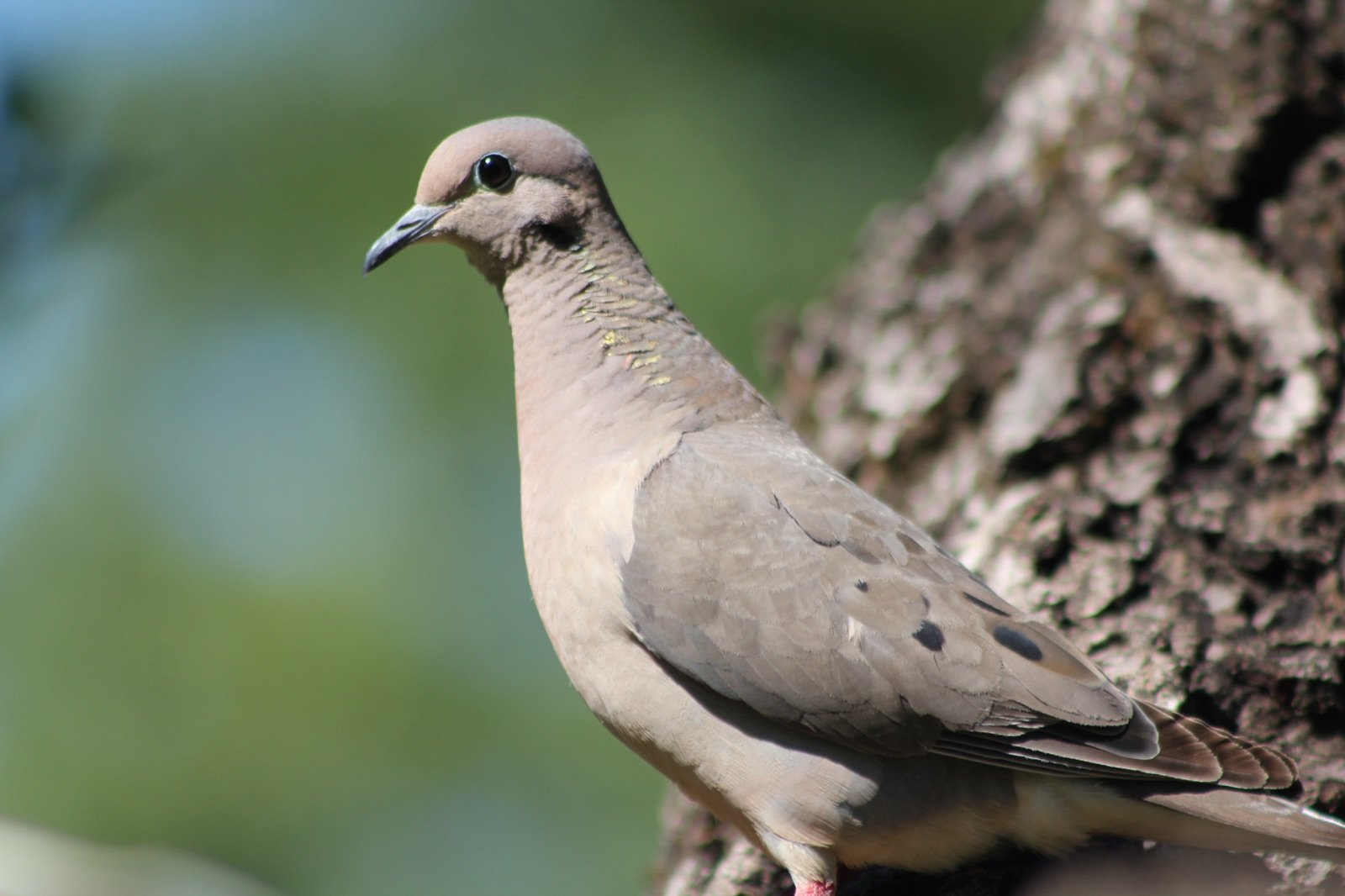
Adults are olive-brown above, with black spots on the wings.
The crown is grey.
A black line runs behind the eye.
A blue-black patch on the lower ear area gives the species its name.
The underparts are wine-pink.
The bill is heavier and black.
The sides of the neck carry a bronze iridescent sheen.
The tail is shorter and less tapered than a Mourning Dove's.
What it sounds like
Recording: Joaquín Krasuk, CC BY 4.0, source, read 4 Nov 2026.
Behaviour and diet
Across its range the Eared Dove eats mainly seeds and often feeds on the ground. It is sociable and often forms large flocks, especially in farmland.
Its flight is high, fast and direct, with regular wingbeats and an occasional sharp flick. In display, a male climbs steeply, then glides in a half circle back to his perch. It nests on the ground, in shrubs or in trees.
None of this has been documented in Costa Rica, where the species has turned up only as a stray.
Where it lives
In its normal South American range the Eared Dove uses open country, farmland, scrub and forest edge. It lives from the lowlands up to about 3400 m, and it has adapted well to towns and cities.
That range runs from Colombia to southern Argentina and Chile, and it also reaches offshore islands from the Grenadines southwards. Costa Rica lies well outside it. Here the dove has no habitat of its own, because it is accidental. The one documented bird was on Isla del Coco, a remote Pacific island.
When to see it
The only dated, documented Costa Rican record is from late November, on 29 November 2015 on Isla del Coco. There is no season when the species can be expected, because it is accidental.
Similar birds
The Mourning Dove (Paloma Rabuda) is the look-alike to check. It is both a resident and a migrant in Costa Rica, so it is far more likely than an Eared Dove. The Eared Dove is a close relative that replaces it in South America. It has a shorter, less tapered tail, a heavier black bill and a bronze sheen on the sides of the neck.
Names and lore in Costa Rica
The Costa Rican list gives the Spanish name Paloma Torcaza. In Argentina the species is also called Mediana and Paloma dorada, and other Argentine names include Torcaza, Tórtola, Abuelita and Palomita montera. These are South American names, not Costa Rican ones.
Status and conservation
The official Costa Rica list gives the Eared Dove status A, accidental, meaning a vagrant from South America and not a resident.
How we know this 14 sources, each read on the date shown
- Lista Oficial de las Aves de Costa Rica (AOCR) read 2026-11-04
https://listaoficialavesdecostarica.wordpress.com/lista-oficial/lista-oficial-online/ - Asociación Ornitológica de Costa Rica read 2026-11-04
https://www.avesdecostarica.org/columbidae.html - Wikipedia read 2026-11-04
https://en.wikipedia.org/wiki/Eared_dove - Animal Diversity Web read 2026-11-04
https://animaldiversity.org/accounts/Zenaida_auriculata/ - Oiseaux.net read 2026-11-04
https://www.oiseaux.net/en/oiseaux/eared.dove.html - Earthlife read 2026-11-04
https://earthlife.net/eared-doves/ - Wikipedia (Spanish) read 2026-11-04
https://es.wikipedia.org/wiki/Zenaida_auriculata - EcoRegistros read 2026-11-04
https://www.ecoregistros.org/sheet/Zenaida-auriculata - Lista Oficial de las Aves de Costa Rica (AOCR committee) read 2026-11-04
https://listaoficialavesdecostarica.wordpress.com/nuevos-registros/ - The Condor, Ecology of the Eared Dove in Argentina read 2026-11-04
https://digitalcommons.usf.edu/cgi/viewcontent.cgi?article=10616&context=condor - SINAVIMO Argentina read 2026-11-04
https://www.sinavimo.gob.ar/plaga/zenaida-auriculata - ArgentiNat read 2026-11-05
https://www.argentinat.org/taxa/3439-Zenaida-auriculata - Ciencia Amazónica (Peru) read 2026-11-05
https://ojs.ucp.edu.pe/index.php/cienciaamazonica/article/download/365/182/ - Wikipedia via thebiofiles read 2026-11-05
https://thebiofiles.com/info/11481