Family Tyrannidae
Eastern Phoebe
Sayornis phoebe
In Spanish: Mosquero Fibí
- A
A plain, tail-wagging flycatcher that reaches Costa Rica only as a vagrant.
The Eastern Phoebe, Mosquero Fibí in Costa Rica, is a tyrant flycatcher that sits upright on low, exposed perches and wags its tail. Once you spot one, that habit makes it easy to pick out.
In Costa Rica it is a true rarity, status A (accidental) on the AOCR list. The first documented record is a single bird photographed on Isla del Coco from 27 to 30 March 2013, an offshore Pacific national park that is not part of the mainland.
That makes it a bird to know about rather than one to plan a trip around. It is a good example of how lost migrants turn up far from where they belong, and a useful reminder to look carefully at any dull flycatcher.
How to find it
Look on fence wires or low tree branches, where the bird perches with its tail wagging. Its colors are plain, so watch for the upright posture and the tail movement rather than for color. Check any dull flycatcher for the lack of wing bars and eye ring. Listen for the sharp chip call. This is range-wide advice, and because the species is a rarity in Costa Rica, any sighting is worth documenting with photos and notes.
How to recognise it
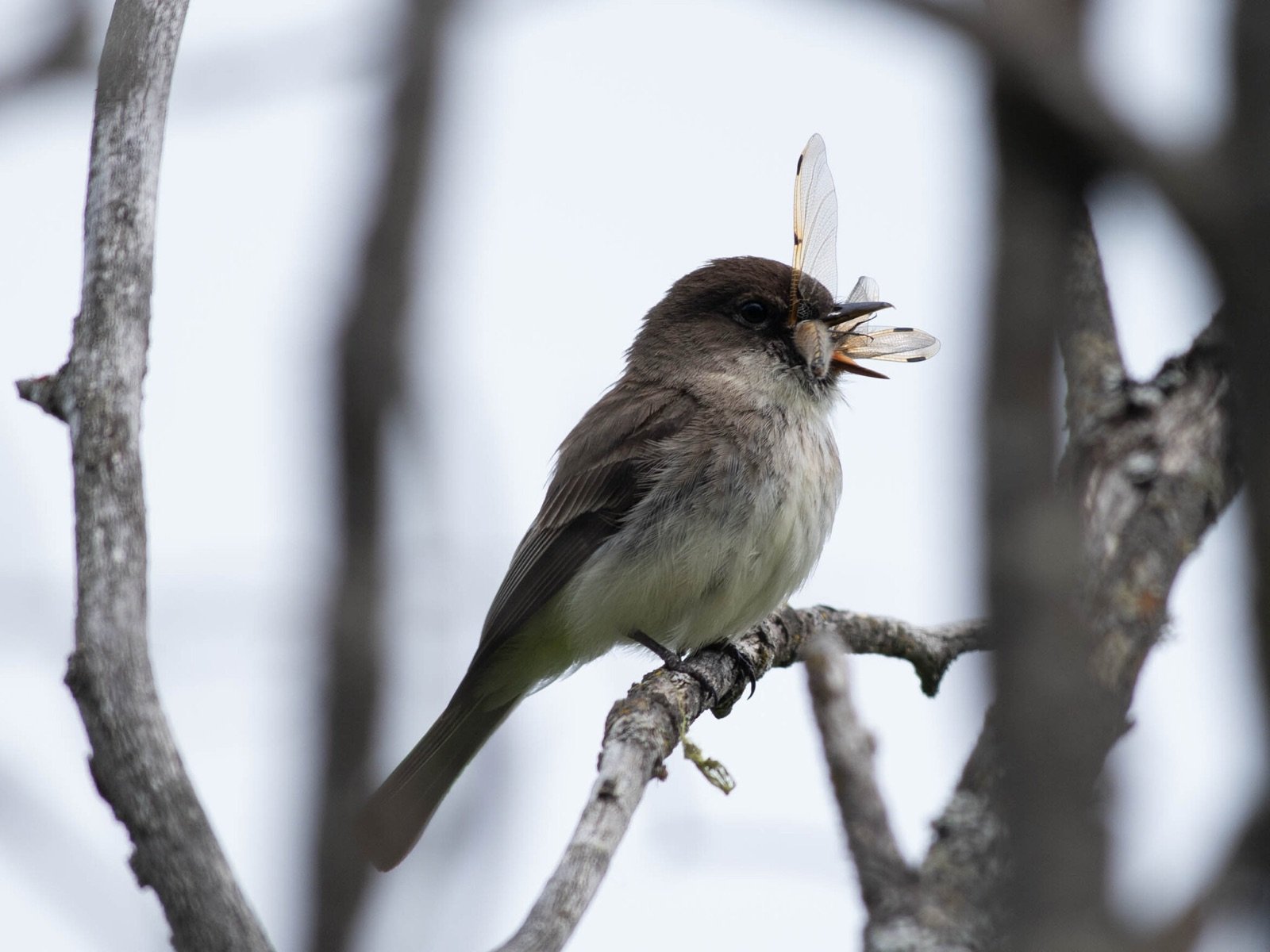
The Eastern Phoebe is a pale brownish gray flycatcher with plain colors and nothing bright to catch the eye.
The marks to look for:
- A sooty head with a darker bill.
- Pale underparts with a grayish or buffy breast.
- No wing bars on the adult.
- No eye ring on the adult.
- An upright posture and a tail that dips in a circle.
The lack of wing bars and eye ring is the quickest way to separate it from Empidonax flycatchers, which show both. The browner juvenile can show two weak cinnamon or buff wing bars, so judge the whole bird. The tail dipping in a circle also sets it apart from other dull flycatchers. It belongs to the tyrant flycatcher family, Tyrannidae.
What it sounds like
Recording: Senna Bryce Robeson, CC BY 4.0, source, read 4 Nov 2026.
Behaviour and diet
The Eastern Phoebe hunts by flycatching: it darts out from a perch to catch prey, and insects are its food. Between sallies it sits upright on a low, exposed perch and wags its tail, which is often the first thing that gives it away. Once you have spotted it, that posture makes it easy to keep track of. These habits are described for the species across its range, not for Costa Rica.
Where it lives
Across its range the Eastern Phoebe usually lives in open woodland. It is a migrant that winters from the southern United States into Central America. In Costa Rica the place that holds a documented record is Isla del Coco, an offshore Pacific national park that is not part of the mainland. The record comes from Wafer Bay, where park staff saw the bird.
When to see it
The only dated Costa Rican record is from late March (27 to 30 March 2013) on Isla del Coco, which is when that bird was photographed rather than a general season. Across its range, birds leave the breeding grounds around September and early October, so any arrival would fall after that.
Similar birds
The Black Phoebe is the Costa Rican resident phoebe. It is blackish with a bolder black and white contrast, is rarely found far from water, and is mostly seen between about 600 and 1850 m on both slopes. The Eastern Wood-Pewee, a regular migrant, looks and sounds very similar, but it shows clear contrasting wing bars and lacks the buff tone on the pale underparts.
Names and lore in Costa Rica
Costa Ricans call it Mosquero Fibí, the name on the AOCR 2025-2026 list. Other Spanish names used elsewhere are Bobito Americano, Papamoscas Fibí and Papamoscas Sombrío.
Status and conservation
The AOCR lists the Eastern Phoebe as status A, accidental, in Costa Rica, while across its range it is rated of low conservation concern.
How we know this 15 sources, each read on the date shown
- All About Birds, Cornell Lab of Ornithology read 2026-11-04
https://www.allaboutbirds.org/guide/Eastern_Phoebe/overview - Birds of the World, Cornell Lab of Ornithology read 2026-11-04
https://birdsoftheworld.org/bow/species/easpho/cur/introduction - Mexican Birds.org read 2026-11-04
https://www.mexican-birds.org/eastern-phoebe/ - Birds of Cuba read 2026-11-04
https://www.birds-of-cuba.com/Eastern_Phoebe.html - Museo Nacional de Costa Rica read 2026-11-04
https://www.museocostarica.go.cr/nuestro-trabajo/investigaciones/historia-natural/isla-del-coco/aves/ - Birding Craft read 2026-11-04
https://birdingcraft.com/wordpress/2022/04/13/puntarenas-costa-rica-a-hotspot-that-merits-a-bird-observatory/ - Avibase read 2026-11-04
https://avibase.bsc-eoc.org/species.jsp?avibaseid=62CA2AF81AF5B68D - Wikipedia read 2026-11-04
https://en.wikipedia.org/wiki/Eastern_phoebe - National Geographic read 2026-11-04
https://www.nationalgeographic.com/animals/birds/facts/eastern-phoebe - Friends of Woodland Park (Wikipedia text) read 2026-11-04
https://www.friendsofwoodlandpark.org/eastern-phoebe - A-Z Animals read 2026-11-04
https://a-z-animals.com/animals/eastern-phoebe/ - Aves de Costa Rica read 2026-11-04
https://www.avesdecostarica.com/Sayornis-nigricans.html - EcoRegistros read 2026-11-04
https://www.ecoregistros.org/ficha/Sayornis-phoebe - Lista Oficial de las Aves de Costa Rica (AOCR), new records read 2026-11-05
https://listaoficialavesdecostarica.wordpress.com/nuevos-registros/ - Lista Oficial de las Aves de Costa Rica (AOCR) read 2026-11-05
https://listaoficialavesdecostarica.wordpress.com/lista-oficial/lista-oficial-online/