Family Thraupidae
Emerald Tanager
Tangara florida
In Spanish: Tangara Orejinegra
- Resident
A small lime-green tanager of Caribbean foothill canopies and fruiting trees.
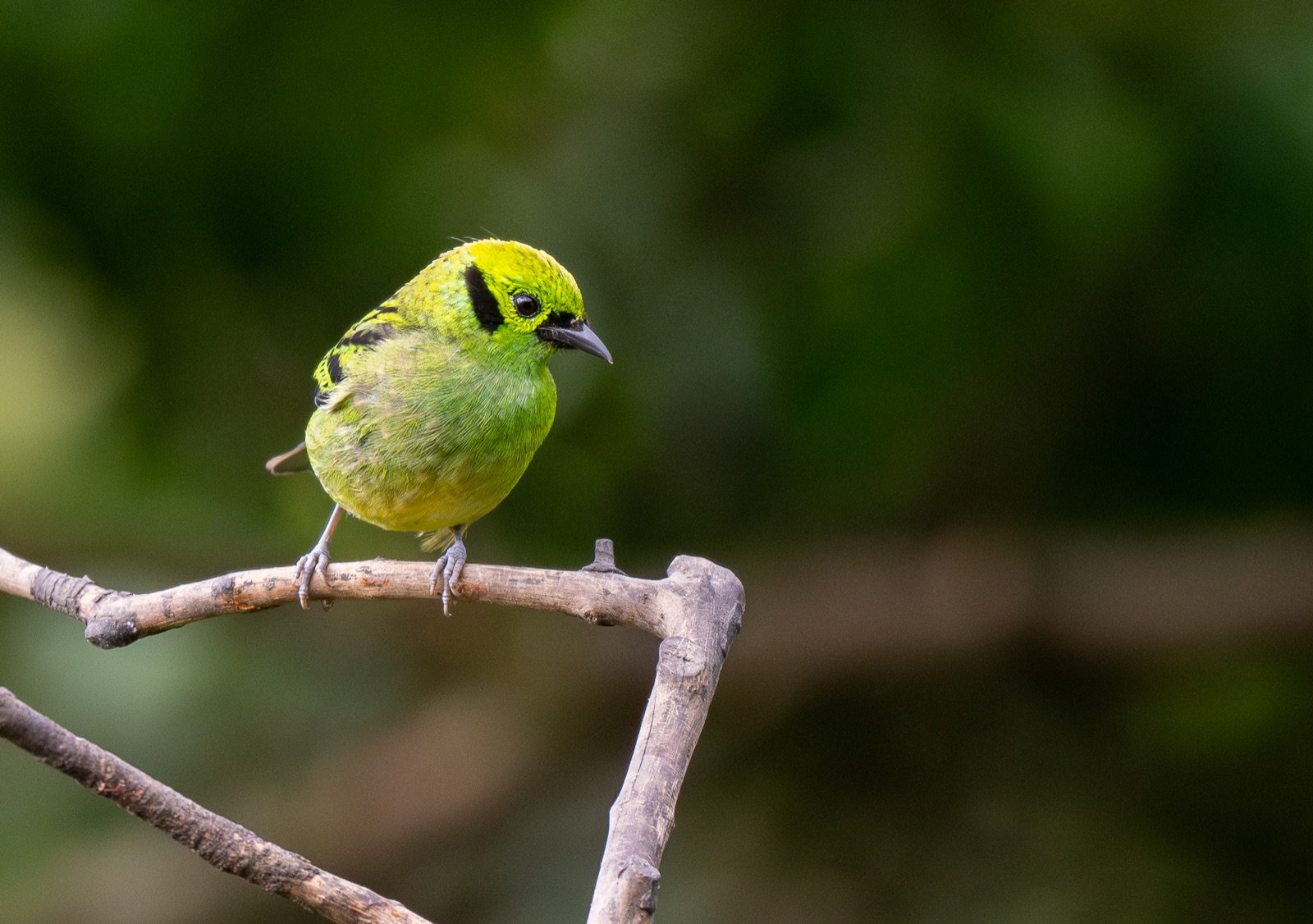
The Emerald Tanager (Tangara Orejinegra in Spanish) is a small, bright light green tanager, about 12 cm long, with a black-streaked back and a black patch on the ear. In Costa Rica it lives on the Caribbean slope, and the country is its type locality: the species was first described in 1869 from a female collected here by Julian Carmiol.
On a trip we build, it is a bird of the Caribbean foothills, where guides check mixed flocks crossing forest trails and fruiting trees at the forest edge. It rarely goes to the forest floor, so finding it mostly means looking up.
It is fairly common locally, yet it can slip past you, because it moves fast inside busy flocks of other tanagers.
How to find it
Look in the canopy and in fruiting trees at forest edges, and watch for mixed-species flocks high in the trees. Guides often check flocks that cross forest trails in the Arenal foothills, where it has appeared alongside Black-and-yellow and Bay-headed tanagers. At fruiting figs it may be only a couple of birds among many Bay-headed Tanagers, so scan patiently. Fruiting melastome bushes have drawn it too, along with other tanagers and many migrant warblers. Close views have come at bird feeders near Arenal, beside Silver-throated Tanager and Scarlet-thighed Dacnis.
How to recognise it
Look for a small, bright light green tanager, about 12 cm long.
The back is streaked with black. A black patch covers the ear and the base of the bill, and the ear patch is square. There is yellow on the crown and rump. The wings and tail are black with broad pale green edges. The bill is black and the legs are bluish-grey, which helps separate it from other green tanagers. Females are duller, with yellow-green on the head.
A Costa Rica bird site describes it as like a Golden Tanager, but lime green, a handy picture to carry into the field.
What it sounds like
Recording: Niels Krabbe, CC BY-SA 4.0, source, read 5 Nov 2026.
Behaviour and diet
The Emerald Tanager forages alone, in pairs, or in small groups of 3 to 7. These groups travel inside larger mixed flocks of tanagers, honeycreepers and warblers. It hops quickly through the branches, peering under them to catch insects and spiders, and often takes insects from moss in the treetops. Fruit is the main food, with insects and other arthropods, flowers and flower buds as well. In Costa Rica, arthropods make up more of the diet during the breeding season. The nest is a cup of moss on a moss-covered branch.
Where it lives
In Costa Rica this tanager lives on the Caribbean slope, in the canopy and at the edges of humid forest on mountain foothills. Across its range it is found between about 400 and 1200 m, and is most common at 500 to 900 m. A Costa Rican account gives about 350 to 1100 m, from the Cordillera de Guanacaste, north at least to Volcan Miravalles, and south to Panama. In the southeast it is found mostly above about 600 m. Its habitats include humid lowland forest, evergreen montane forest and secondary forest.
When to see it
In Costa Rica it breeds from March to May. Outside the breeding season, some birds make local moves down to lower elevations.
Similar birds
It can be confused with the Glistening-green Tanager, which has more intense plumage. The Blue-whiskered Tanager has a black face and throat and turquoise cheeks. The square black ear patch, the black-streaked back and the pale green edges on the black wings and tail help separate the Emerald Tanager.
Names and lore in Costa Rica
Besides the AOCR name Tangara Orejinegra, Spanish sources also call it tangara florida and tangara esmeralda. Orejinegra refers to the black ear patch. The genus name Tangara comes from a Tupi word meaning 'dancer', first used for brightly coloured birds.
Status and conservation
The AOCR list gives it as a resident (R), and the IUCN lists it as Least Concern, though the population is thought to be decreasing.
Photography tips
Lone fruiting trees or shrubs next to the forest give more open views than the forest canopy. Feeders and fruiting figs near Arenal have offered closer looks than the treetops.
How we know this 14 sources, each read on the date shown
- Wikipedia (Spanish) read 2026-11-04
https://es.wikipedia.org/wiki/Tangara_florida - iNaturalist (Wikipedia text) read 2026-11-04
https://www.inaturalist.org/taxa/9578 - Flickr (Jorge Obando, natural history text) read 2026-11-04
https://www.flickr.com/photos/jobando/24687769299 - Field Guides trip report 2015 read 2026-11-04
https://fieldguides.com/triplists/cr215.html - Eagle-Eye Tours trip report 2025 read 2026-11-04
https://www.eagle-eye.com/blog/costa-rica-caribbean-trip-report-oct-19-30-2025/ - Eagle-Eye Tours trip report 2025 read 2026-11-04
https://www.eagle-eye.com/blog/costa-rica-caribbean-mountains-to-coast-2025-trip-report-oct-1-12/ - Birds of Costa Rica (Tom Friedel) read 2026-11-04
https://www.birdsofcolombia.org/costarica/Tangara.html - Field Guides trip report March 2025 read 2026-11-04
https://fieldguides.com/triplists/cos25/ - Tropical Birding read 2026-11-04
https://tropicalbirding.com/product/comprehensive-costa-rica-birding-from-border-to-border/ - Aves y Plantas Costa Rica read 2026-11-04
https://avesyplantas.com/2024/09/23/ficus-secretos-e-intacciones-en-los-tropicos/ - Wikipedia read 2026-11-04
https://en.wikipedia.org/wiki/Emerald_tanager - Avibase read 2026-11-04
https://avibase.bsc-eoc.org/species.jsp?avibaseid=C8B9D4AEE55F0D17 - CRHoy read 2026-11-04
https://crhoy.com/la-foto-del-dia-habitante-del-bosque-nuboso/ - Birds & Breakfast read 2026-11-04
https://birdsandbreakfast.com/en/emerald-tanager/