Family Mimidae
Gray Catbird
Dumetella carolinensis
In Spanish: Pájaro-gato Gris
- Migrant
A slate-gray skulker that mews from Caribbean thickets all winter.
The Gray Catbird (Pájaro-gato Gris) breeds in North America and winters from the southern US through Central America, with Costa Rica among its wintering areas. Here it is mostly a bird of the Caribbean lowlands, and it stays from autumn until late April or early May.
It is a skulker that keeps to dense cover, so the best start is to listen. A cat-like mew coming out of a tangle of vines is usually the first clue, and following it is half the work.
On a trip we build in the Sarapiqui lowlands, a classic birding area on the Caribbean side, it is a bird worth listening for.
How to find it
Start in the Caribbean lowlands and listen for the mew before you look. Follow the call into thickets and vine tangles, then stand still, because this is a bird that stays in dense cover. Live fences, forest edges and secondary growth are the places to check. Dawn and dusk are the best times, when the birds may come out of hiding. A birder on the Comandancia Road in the Sarapiqui lowlands called one in, and it then gave its mewing calls. Even so, it is described as a tough bird to add to a Costa Rican year list, so allow some patience.
How to recognise it
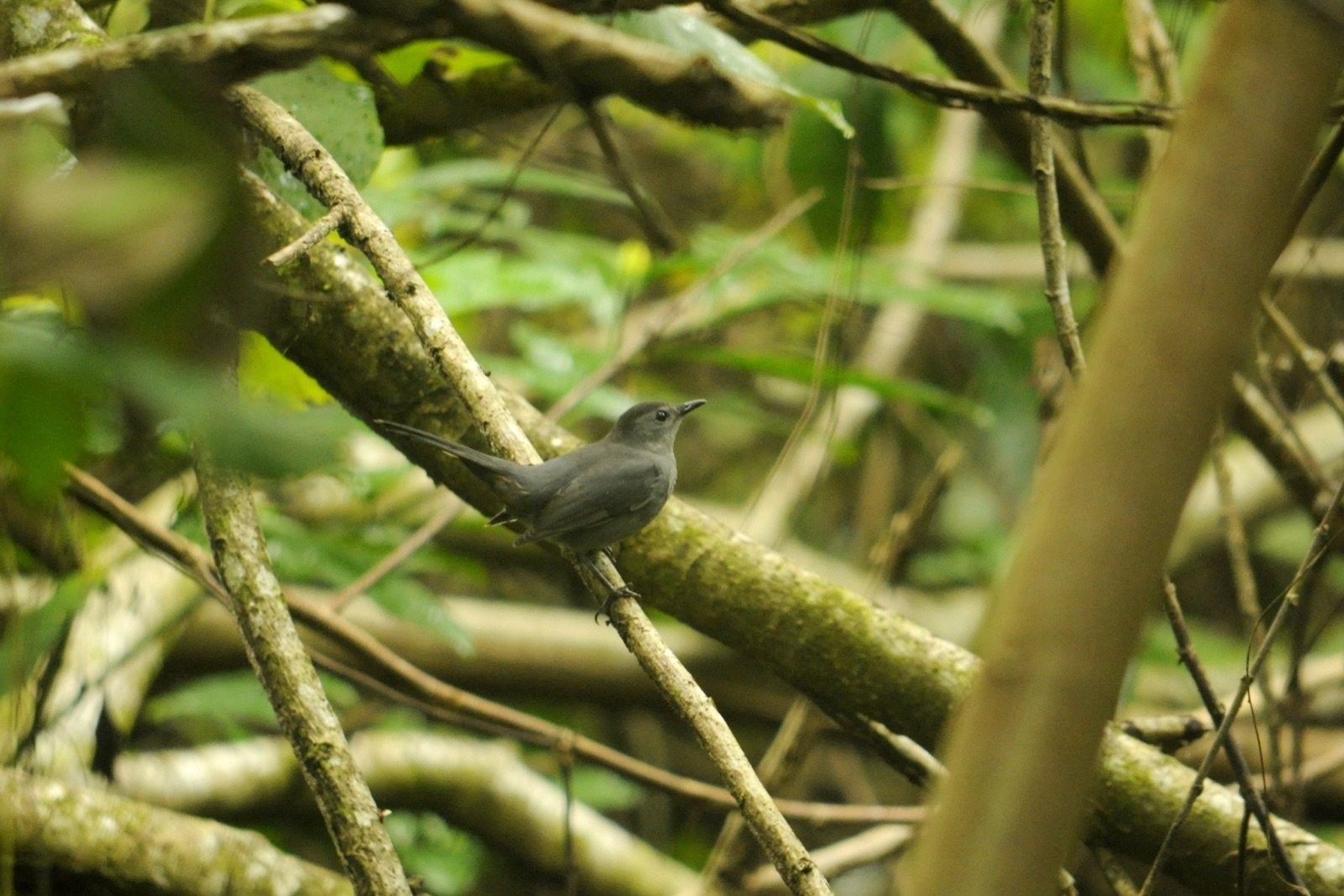
Look for a slim, plain slate-gray bird. Cornell describes it as somber gray, and there is very little colour on it apart from two details.
The field marks, in plain terms:
- Cap: black.
- Tail: black.
- Under the tail: a patch of bright rusty-chestnut feathers, the mark that confirms the bird when it turns away.
- Bill, eyes and legs: all black, so the face looks dark and plain.
The tail is long, and the bird jerks it when it moves out into the open. Its cat-like mew is easy to remember, and for many visitors the sound arrives long before the bird does.
What it sounds like
Recording: Donald Davesne, CC BY 4.0, source, read 4 Nov 2026.
Behaviour and diet
The catbird forages mostly on the ground in leaf litter, and also in shrubs and trees. In Costa Rica it hops on the ground with its tail raised and flicks its wings to flush insects from leaves. It moves slowly, sometimes twists its head to inspect, and stretches its neck to reach prey.
The birds are shy and cautious, though they may come out of hiding at dawn and dusk. Males and females each defend their own winter territory, which is unusual among migrants. Rivals may puff up the breast, spread the tail and point the bill skyward.
Where it lives
In Costa Rica it is mostly found in the Caribbean lowlands, below about 500 m, and in smaller numbers it reaches 1500 m. It lives in dense secondary growth, live fences and forest edges.
It is only occasional in the Central Valley and the southern Pacific slope, and rare around the Golfo Dulce lowlands. Across its winter range it also uses dense shrubs, small trees, vine tangles, suburban gardens and tropical forest, and on tropical wintering grounds it spends more time in forest than it does in North America.
When to see it
It is a fairly common but discreet fall migrant on the Caribbean side. It can arrive in early September, but only becomes common from mid-October to mid-November, and it stays until late April or early May. Spring passage is barely noticeable and happens only along the Caribbean coast.
Similar birds
Costa Rica has only two other mimids on the national list, the Tropical Mockingbird and the rare Northern Mockingbird. The catbird is a plain gray, black-capped skulker, so it is easy to tell from them.
Names and lore in Costa Rica
Besides the AOCR name Pájaro-gato Gris, Spanish names listed for this bird include Maullador Gris, Zorzal Gato and Sinsonte Maullador. They all refer to its cat-like mew, and they are general Spanish names, not clearly used only in Costa Rica. The genus name Dumetella comes from a Latin word for thicket, a nod to its life in dense scrub.
Status and conservation
The Gray Catbird is a migrant (M) on the AOCR list, and the IUCN rates the species Least Concern.
Photography tips
Patience matters more than gear. Follow the mew to the edge of a thicket, wait quietly at dawn or dusk when the birds may leave cover, and watch the ground in leaf litter, where it hops with its tail raised. The rusty patch under the tail shows best when the bird turns or jerks its tail.
How we know this 14 sources, each read on the date shown
- Birdfinding.info read 2026-11-04
https://birdfinding.info/gray-catbird/ - All About Birds, Cornell Lab of Ornithology read 2026-11-04
https://www.allaboutbirds.org/guide/Gray_Catbird/maps-range - Wikipedia read 2026-11-04
https://en.wikipedia.org/wiki/Gray_catbird - Smithsonian Migratory Bird Center read 2026-11-04
https://nationalzoo.si.edu/sites/default/files/documents/gray_catbird_1-12-12.pdf - Animal Diversity Web read 2026-11-04
https://animaldiversity.org/accounts/Dumetella_carolinensis/ - Flickr (Historia Natural text, Costa Rica) read 2026-11-04
https://www.flickr.com/photos/jobando/40537279593 - Birding Craft read 2026-11-04
https://birdingcraft.com/wordpress/2019/02/21/looking-for-catbirds-in-the-caribbean-lowlands/ - Flickr (Cimarron Mayor) read 2026-11-04
https://www.flickr.com/photos/cimarronmayor/21071772726 - A-Z Animals read 2026-11-04
https://a-z-animals.com/animals/gray-catbird/ - Audubon Field Guide read 2026-11-04
https://www.audubon.org/field-guide/bird/gray-catbird - Flickr (Cimarrón Mayor, photo taken at Rancho Naturalista) read 2026-11-04
https://www.flickr.com/photos/cimarronmayor/20909958220 - Diversidad Biológica UPN read 2026-11-04
https://diversidadbiologica1upn.wordpress.com/2018/05/05/dumetella-carolinensis/ - Cornell Lab, All About Birds read 2026-11-04
https://www.allaboutbirds.org/guide/Gray_Catbird/lifehistory - Avibase Costa Rica checklist read 2026-11-04
https://avibase.bsc-eoc.org/checklist.jsp?region=CR