Family Laridae
Gray Gull
Leucophaeus modestus
In Spanish: Gaviota Torero
- A
A rare Pacific wanderer from the Chilean desert, worth a sharp look among gulls.
The Gray Gull, Gaviota Torero in Spanish, is not a bird to plan a trip around, and it is worth saying so plainly. The AOCR list codes it A, accidental, while the Laughing Gull and Franklin's Gull beside it on the list carry the code for regular migrants.
What makes it special is where it comes from. It breeds inland in the very dry Atacama Desert of northern Chile, which is unusual for a gull. Costa Rica sits at the northern edge of its non-breeding range, so records here are of occasional wanderers along the Pacific shore.
For a beginning birder it is a good lesson in looking closely at the ordinary gulls in front of you, because the unusual one may be standing among them.
How to find it
Because it is a rare visitor, patient scanning works better than a targeted search. Work the Pacific shore, favoring sandy beaches, mudflats, river mouths and rocky shores. The Puntarenas lighthouse area, where Gulf of Nicoya currents meet, is described as a spot that turns up vagrant seabirds, gulls and terns, so it is a sensible place to scan gull flocks. Go through the Laughing Gulls, which are common here, for a single uniformly gray bird. When one stands out, check the black bill and legs, then watch for the black tail band in flight. Boats working the coast may also be worth watching, since it sometimes follows fishing boats.
How to recognise it
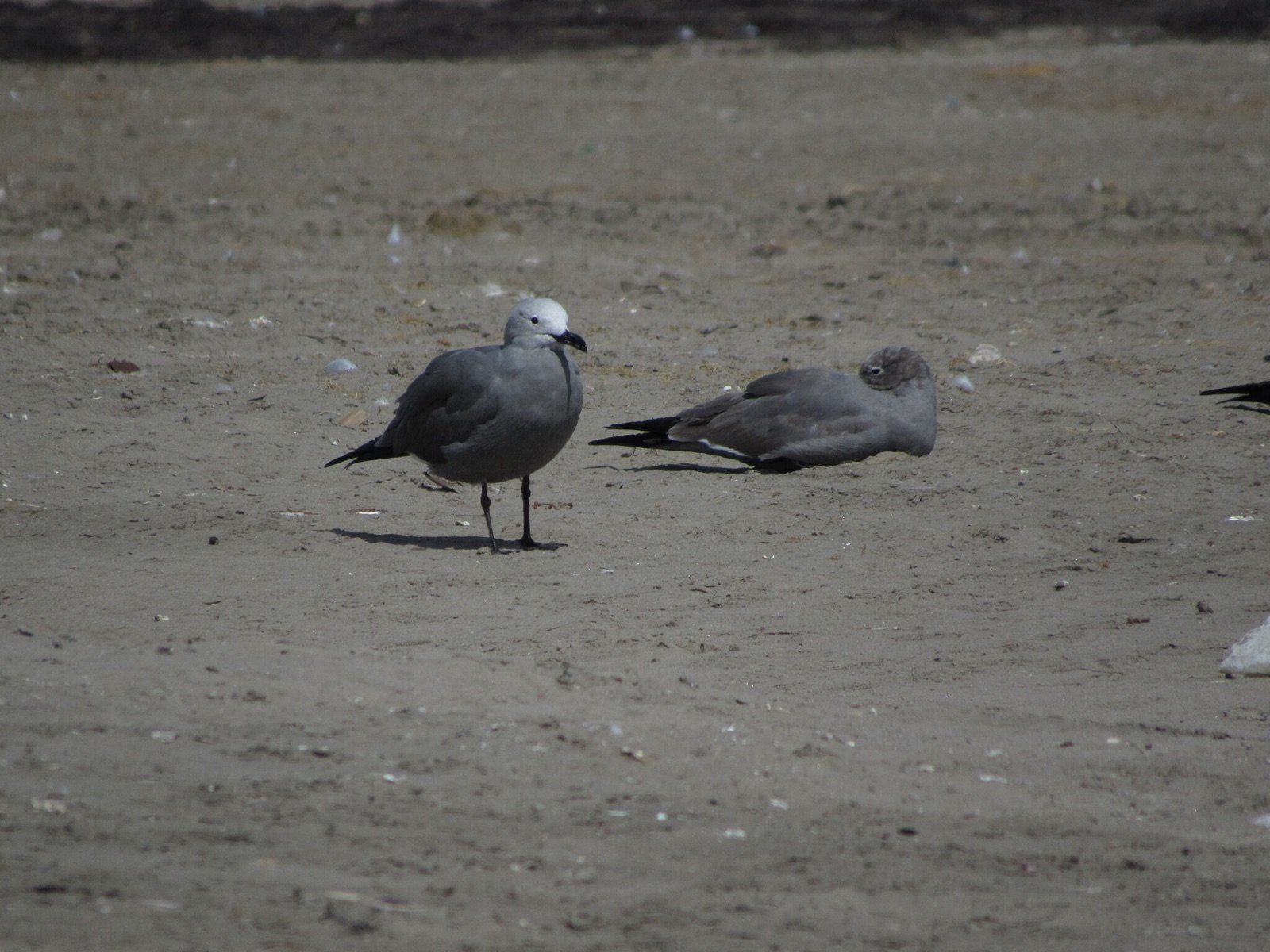
Start with the overall tone: a dull, uniformly gray gull. The body stays dull gray in both seasons, with a black bill and black legs.
Breeding adults have a white head. In winter the head turns brownish gray, neither white nor dark hooded, so it can be mistaken for a dark-headed gull.
In flight, adults show black flight feathers with white trailing edges. The gray tail carries a broad blackish band near the tip. That band, together with the plain gray body, is the check to make.
Young birds are plain brownish gray, with pale edges on the back feathers.
Behaviour and diet
Away from the nest it often travels alone or in small groups. It may join other gulls and seabirds where food is plentiful, so a lone gray gull among Laughing Gulls is the thing to look for.
It feeds by probing sand and mud for small prey, mainly mole crabs. It also eats fish and worms, scavenges offal, and sometimes follows fishing boats.
Where it lives
Away from the nest the Gray Gull favors sandy beaches and mudflats on the Pacific coast. It also uses river mouths and rocky shores.
In Costa Rica the records are of occasional wanderers along the Pacific shore, at the northern edge of a non-breeding range that runs down the Pacific coast of South America. A checklist that includes Cocos Island also lists it as rare or accidental.
Its nesting habitat is far from all this: the Atacama Desert of northern Chile. Outside the breeding season it spreads along much of South America's Pacific coast.
Similar birds
The Laughing Gull is a common Costa Rican gull whose call is similar to the Gray Gull's. Check the uniformly gray body and the black tail band. In winter the brownish gray head can suggest a dark-headed gull, so look at the body and tail rather than the head alone. The blackish flight feathers and the dark band near the gray tail's tip help separate it from other gulls.
Names and lore in Costa Rica
In Costa Rica the official Spanish name is Gaviota Torero, which the national bird committee kept as the single standard name when it standardized Spanish names in 2017 and 2018. Garuma and Torero are also listed as Costa Rican short names. Garuma is the usual name in Chile and Peru.
Status and conservation
The AOCR list for 2025-2026 codes the Gray Gull A, an accidental visitor, while the IUCN rates the species Least Concern worldwide.
How we know this 17 sources, each read on the date shown
- Wikipedia, List of birds of Costa Rica read 2026-11-04
https://en.wikipedia.org/wiki/List_of_birds_of_Costa_Rica - Avibase Costa Rica checklist read 2026-11-04
https://avibase.bsc-eoc.org/checklist.jsp?region=CR - Wikipedia, Grey gull read 2026-11-04
https://en.wikipedia.org/wiki/Grey_gull - Grokipedia, Grey gull read 2026-11-04
https://grokipedia.com/page/Grey_gull - Daniel's Animals read 2026-11-04
https://danielsanimals.com/animal-facts-2/birds/gray-grey-gull - Birds Colombia read 2026-11-04
https://birdscolombia.com/2020/03/24/gaviota-gris-gray-gull-leucophaeus-modestus/ - Avibase read 2026-11-04
https://avibase.bsc-eoc.org/species.jsp?avibaseid=804CCA3A1ECAF682 - Lista Oficial de las Aves de Costa Rica (AOCR) read 2026-11-04
https://listaoficialavesdecostarica.wordpress.com/nuevos-registros/ - Biodiversidad Arequipa read 2026-11-04
https://biodiversidadaqp.com/registro_det/60 - Especies Chilenas blog read 2026-11-04
http://especieschilenas.blogspot.com/2014/06/la-gaviota-garuma-leucophaeus-modestus.html - EcoRegistros read 2026-11-04
https://www.ecoregistros.org/site/articulos/EcoRegistros5_N5-Primer-registro-de-Gaviota-Garuma-Leucophaeus-modestus-en-Territorio-continental-argentino.pdf - EcoRegistros read 2026-11-04
https://www.ecoregistros.org/sheet/Leucophaeus-modestus - AOCR Lista Oficial Online read 2026-11-05
https://listaoficialavesdecostarica.wordpress.com/lista-oficial/lista-oficial-online/ - ResearchGate (First record of Grey Gull in Brazil) read 2026-11-05
https://www.researchgate.net/publication/335890377_First_record_of_Grey_Gull_Leucophaeus_modestus_in_Brazil - Journal of Field Ornithology read 2026-11-05
https://journal.afonet.org/vol97/iss3/art6/ - Birding Craft read 2026-11-05
https://birdingcraft.com/wordpress/2022/04/13/puntarenas-costa-rica-a-hotspot-that-merits-a-bird-observatory/ - Chile Ministerio del Medio Ambiente, species file read 2026-11-05
https://clasificacionespecies.mma.gob.cl/wp-content/uploads/2019/12/Larus-modestus_16RCE_PAC.pdf