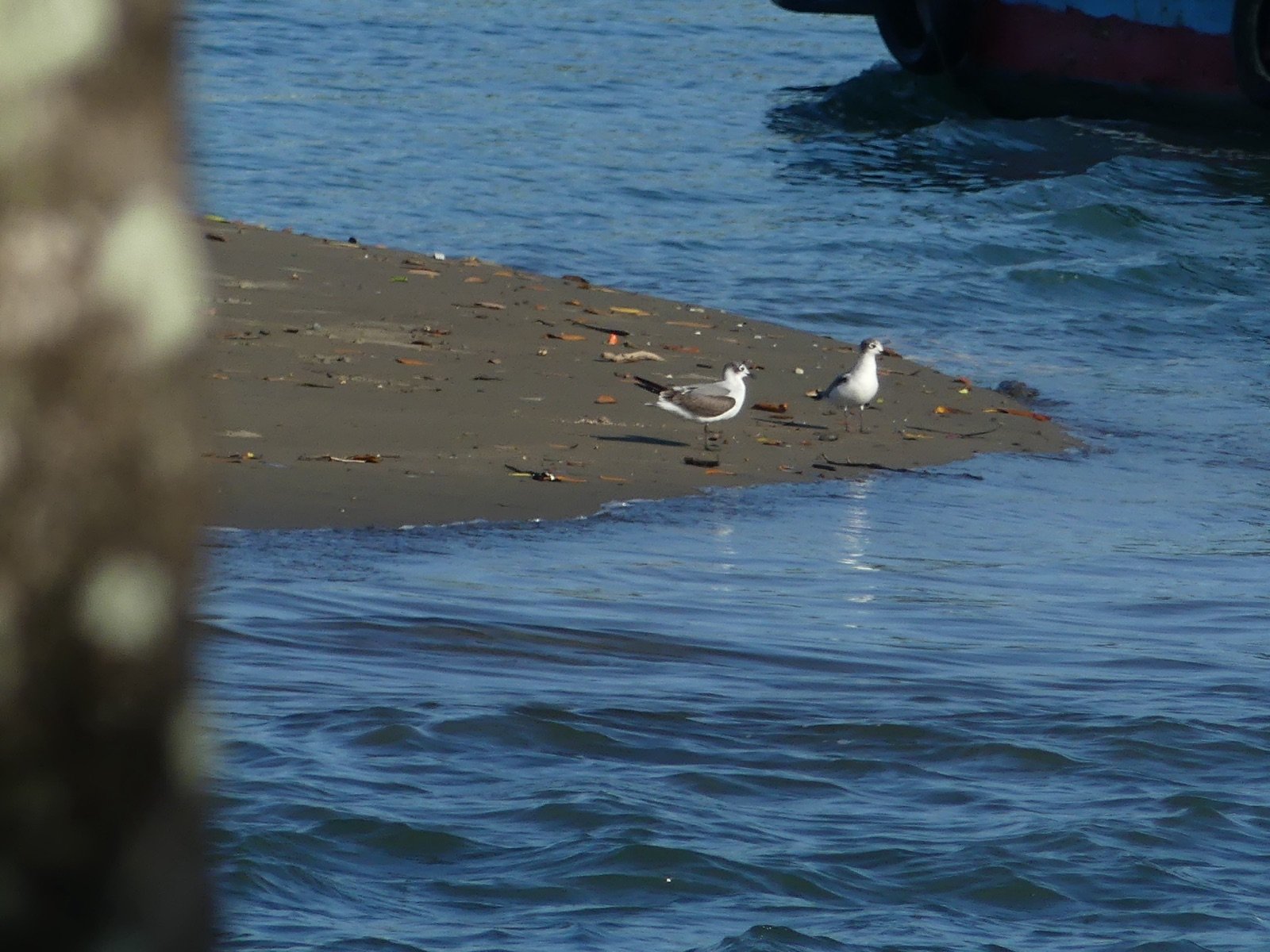
Family Laridae
Laughing Gull
Leucophaeus atricilla
In Spanish: Gaviota Reidora
- Migrant
The gull most visitors meet, at ports, docks and river mouths
The Laughing Gull is the only gull most visitors to Costa Rica will probably see, with Franklin's Gull the other regular one. A Costa Rican tour site names it the most common gull in the country, and it can be seen on both coasts.
It is a winter resident, and the biggest numbers gather at the ports of Puntarenas and Limón. On a trip we build, a morning river boat ride at Tárcoles on the Central Pacific coast lets you check the river mouth for gulls.
How to find it
Start at the ports, where the biggest numbers are. Puntarenas is a good place for seawatching: watch from the point near the lighthouse, where Laughing Gulls and Royal Terns pass or rest on the choppy water. The mouth of the Tárcoles creek can draw gulls, but not at busy weekend times when people are playing in the water. A Tárcoles river boat ride is a good morning outing and lets you check the river mouth. Docks and fishing boats are worth a look along either coast.
How to recognise it
This is a medium-sized gull, about 36 to 41 cm long.
Breeding adults have a black hood, dark grey back and wings, a long red bill and a white body. The wingtips are black. The wings are darker grey than those of almost any gull of similar size, except the smaller Franklin's Gull.
In winter the black hood is mostly lost, leaving a white head. Young birds take about three years to reach full adult plumage.
First-year birds are grey below with a paler head. Their all-black tail band gives the species name atricilla. In the first winter, look for a darker mottled head, dusky patches on the breast and flanks, a broad blackish band near the tail tip, and a blackish bill and legs.
What it sounds like
Behaviour and diet
The Laughing Gull is an opportunistic omnivore and scavenger, and it adapts well to people. It follows fishing boats and gathers at docks and picnic spots for handouts, and big groups gather at docks in Costa Rica.
In Costa Rica it is also seen catching small fish and shrimp in shallow water, chasing crabs over mud and taking insects in flight. It tries to steal catches from pelicans.
Where it lives
Across its range this is a coastal bird of salt marshes, estuaries, coastal bays and beaches, and it also uses farm fields near the coast.
In Costa Rica it is found on both coasts but is more numerous on the Pacific side, especially the Gulf of Nicoya. The biggest numbers are at the ports of Puntarenas and Limón. It is only occasional on Isla del Coco, mostly young birds in autumn.
When to see it
In Costa Rica it is a winter resident, and some non-breeding young birds also stay through the northern summer. Autumn migration runs mainly from late September to November, and spring migration from early April to mid May.
Similar birds
Franklin's Gull is the one to compare. The Laughing Gull is larger, longer billed and has less white in the wingtip. Franklin's is stockier and shows a clean white band between its black wingtip and grey wing, a white crescent the Laughing Gull lacks.
Names and lore in Costa Rica
The Costa Rican Spanish name is Gaviota Reidora. Elsewhere you may hear gaviota guanaguanare and gaviota reidora americana.
Status and conservation
The official Costa Rican bird list gives it the status code M, the migrant category, and the IUCN lists it as Least Concern.
Photography tips
It is not afraid of tourists and picks up scraps left on the beach, so it is easy to approach at docks and beaches.
How we know this 17 sources, each read on the date shown
- AOCR Lista Oficial de las Aves de Costa Rica read 2026-11-04
https://listaoficialavesdecostarica.wordpress.com/lista-oficial/lista-oficial-online/ - Wikipedia read 2026-11-04
https://en.wikipedia.org/wiki/Laughing_gull - Bird Identifier read 2026-11-04
https://birdidentifier.com/encyclopedia/laughing-gull - Vorstman's Guide to the Birds of Australia and New Zealand read 2026-11-04
https://vorstman.com/vogelgids-aunz/en/species/laughing-gull.html - Cornell Birds of the World read 2026-11-04
https://birdsoftheworld.org/bow/species/laugul/cur/introduction - Animalia.bio (Wikipedia-based text) read 2026-11-04
https://animalia.bio/laughing-gull?property=102 - Birda read 2026-11-04
https://app.birda.org/species-guide/6945/Laughing_Gull - Flickr (Historia Natural text, Gaviota Reidora, Manzanillo, Puntarenas) read 2026-11-04
https://www.flickr.com/photos/jobando/33320981631 - Birding Craft read 2026-11-04
https://birdingcraft.com/wordpress/2022/04/13/puntarenas-costa-rica-a-hotspot-that-merits-a-bird-observatory/ - Birding Craft read 2026-11-04
https://birdingcraft.com/wordpress/2024/02/06/birding-in-costa-rica-at-ceiba-de-orotina-and-tarcoles-highlights-and-tips/ - Birding Craft read 2026-11-04
https://birdingcraft.com/wordpress/2023/03/27/costa-rica-birding-news-march-and-april-2023/ - Biodiversidad Campeche read 2026-11-04
https://bio.campeche.gob.mx/especies/leucophaeus-atricilla-linnaeus-1758/ - BirdNET+ Taxonomy (Cornell) read 2026-11-04
https://birdnet.cornell.edu/taxonomy/species/Leucophaeus%20atricilla - Marine Ornithology (Bonilla et al. 2014) read 2026-11-04
https://www.marineornithology.org/PDF/42_1/42_1_3-4.pdf - Costa Rica Birding Trips read 2026-11-04
https://costaricabirdingtrips.com/laridae/laughing-gull-leucophaeus-atricilla - Wikipedia (Spanish) read 2026-11-04
https://es.wikipedia.org/wiki/Leucophaeus_atricilla - 10,000 Birds read 2026-11-04
https://www.10000birds.com/gullmania-in-costa-rica.htm