Family Laridae
Franklin's Gull
Leucophaeus pipixcan
In Spanish: Gaviota de Franklin
- Migrant
A small, pigeon-like migrant gull to scan for off the Pacific coast.
Franklin's Gull (Gaviota de Franklin) is a small gull that passes through Costa Rica as a migrant. The official Costa Rica bird list marks it M, the list's code for a migrant, so you meet it on its way through rather than at a nest.
It is a long-distance traveller. It breeds in central Canada and the northern USA and winters in the Caribbean, Peru, Chile and Argentina, so Costa Rica sits along its route.
On a coastal drive toward Cabuya on the Nicoya Peninsula, stops to scan the ocean found over 300 of them resting in one big raft just offshore. That is the kind of stop we plan on a trip we build along the Pacific side.
How to find it
Look to the Pacific side and to open water. Seawatching from the Puntarenas point near the lighthouse can turn up gulls and terns, and a birder there once saw two migrating Franklin's Gulls fly past. Currents from the inner and outer Gulf of Nicoya meet at this spot. On the coastal road toward Cabuya on the Nicoya Peninsula, stop often to scan the ocean, because resting flocks can sit in a raft just offshore. Check river mouths along the Pacific coast too. Scan any gull flock slowly for the white eye arcs and the rounded, short-tailed shape.
How to recognise it
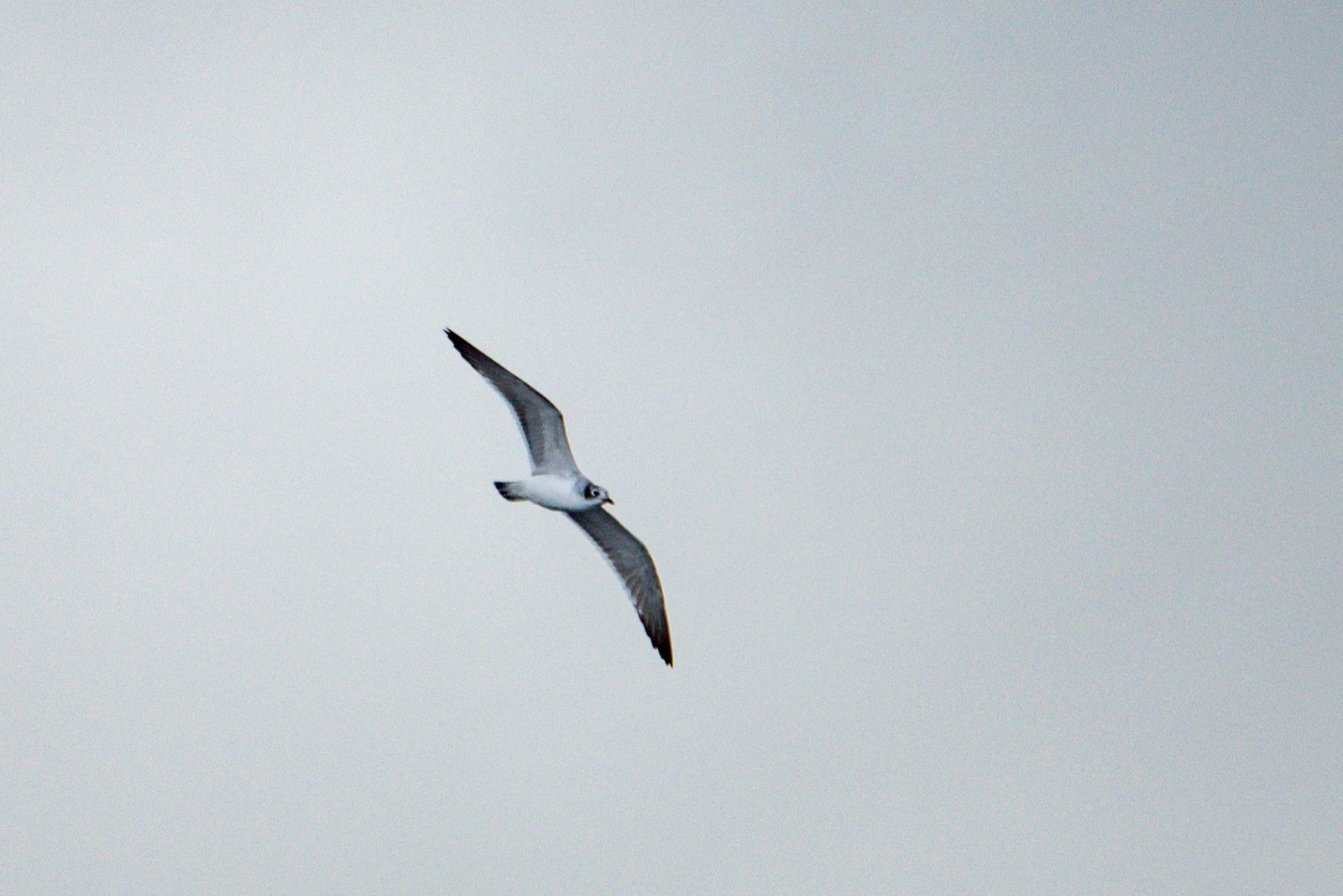
Franklin's Gull is a small gull, about 32 to 36 cm long. These marks are worth learning in order.
In summer the adult has a black hood, a dark gray back and wings, and black wingtips with a white band next to them. Breeding adults also show a bright red bill and legs.
A bold, partly white eye-ring is one of the key marks.
The shape is rather pigeon-like, with a rounded head and body and a short tail.
The flight is light and buoyant.
Outside the breeding season the black hood shrinks to a dark half-hood on the back of the head, and white crescents above and below the eye nearly meet behind it. Unlike most gulls, it molts fully twice a year, so the bird gets fresh plumage for each long trip.
What it sounds like
Recording: Mary Krieger, CC BY 4.0, source, read 4 Nov 2026.
Behaviour and diet
Franklin's Gull eats mostly insects and earthworms. It also takes small fish, especially in winter.
It travels in flocks. Southbound birds leave the breeding colonies in early August, cross the southern Great Plains to the Pacific coast of Central America, and in late August fly on to Peru and Chile. Off the Nicoya Peninsula a large group sat together on the water as one raft, then the whole flock lifted into the air and carried on migrating north.
Where it lives
On its breeding grounds Franklin's Gull nests inland on freshwater prairie marshes in Canada and the northern USA. In winter it is more coastal and is often seen at river mouths along the Pacific coast.
In Costa Rica, the places we have for it are on the Pacific side: the Puntarenas point at the Gulf of Nicoya, and the ocean just off the Nicoya Peninsula coast.
When to see it
A seawatch at the Puntarenas point in mid-April 2022 recorded two flying past on migration, which fits a spring passage. Further north, on the Isthmus of Tehuantepec in Mexico, northbound birds were found from late March to early May, peaking in late April.
Similar birds
Laughing Gull is the other black-hooded gull on Costa Rica's Pacific coast, and the species most likely to be confused with it. Franklin's is slightly smaller, with a shorter, thinner bill with less hook at the tip. Its white eye arcs and white wingtip spots are more obvious, and on the closed wing the spots form a checkered pattern. Compared with Bonaparte's Gull, Franklin's is larger and has a red bill in breeding plumage, where Bonaparte's is black.
Names and lore in Costa Rica
Spanish sources also call it gaviota pipizcan, gaviota pipixcan or gaviota chica. The species name pipixcan is a Nahuatl word that Mexican Indigenous people used for a kind of gull.
Status and conservation
The official Costa Rica list marks it M, a migrant, and across its range the population is increasing and it is rated Least Concern.
How we know this 14 sources, each read on the date shown
- Lista Oficial de las Aves de Costa Rica (AOCR) read 2026-11-04
https://listaoficialavesdecostarica.wordpress.com/lista-oficial/lista-oficial-online/ - Wikipedia read 2026-11-04
https://en.wikipedia.org/wiki/Franklin's_gull - Cornell Birds of the World read 2026-11-04
https://birdsoftheworld.org/bow/species/fragul/cur/appearance - Planet of Birds read 2026-11-04
https://planetofbirds.com/charadriiformes-laridae-franklins-gull-leucophaeus-pipixcan/ - Costa del Sol Málaga species sheet read 2026-11-04
https://static.costadelsolmalaga.org/malaga/subidas/descargas/archivos/1/4/351341/gaviota-de-franklin.-especie-rara.-leucophaeus-pipixcan.pdf - Birding Craft read 2026-11-04
https://birdingcraft.com/wordpress/2022/04/13/puntarenas-costa-rica-a-hotspot-that-merits-a-bird-observatory/ - Birding Craft read 2026-11-04
https://birdingcraft.com/wordpress/2021/04/21/lifer-benefits-of-birding-costa-rica-in-cabuya/ - Wikipedia (es) read 2026-11-05
https://es.wikipedia.org/wiki/Leucophaeus_pipixcan - Birding Craft (Costa Rica birding news) read 2026-11-05
https://birdingcraft.com/wordpress/2023/03/27/costa-rica-birding-news-march-and-april-2023/ - ScienceDirect (Tehuantepec wind power study) read 2026-11-05
https://www.sciencedirect.com/science/article/abs/pii/S1617138115000400 - Beeville Bee-Picayune read 2026-11-05
https://www.southtexasnews.com/beeville_bee_picayune/news/features/franklin-s-gulls-have-a-long-way-to-go/article_6d490f7e-4e1f-11e8-aaff-2b7d1c42797f.html - Costa Rican natural history text (Laughing Gull account) read 2026-11-05
https://www.flickr.com/photos/jobando/33320981631 - Aves del Perú (Gaviota de Franklin) read 2026-11-05
https://jp1008.tripod.com/gaviota_defranklin.htm - Animal Diversity Web read 2026-11-05
https://animaldiversity.org/accounts/Larus_pipixcan/