Family Cracidae
Great Curassow
Crax rubra
In Spanish: Pavón Grande (Pavón, Granadera)
- Resident
A turkey-sized forest bird with a yellow bill knob and a deep dawn boom.
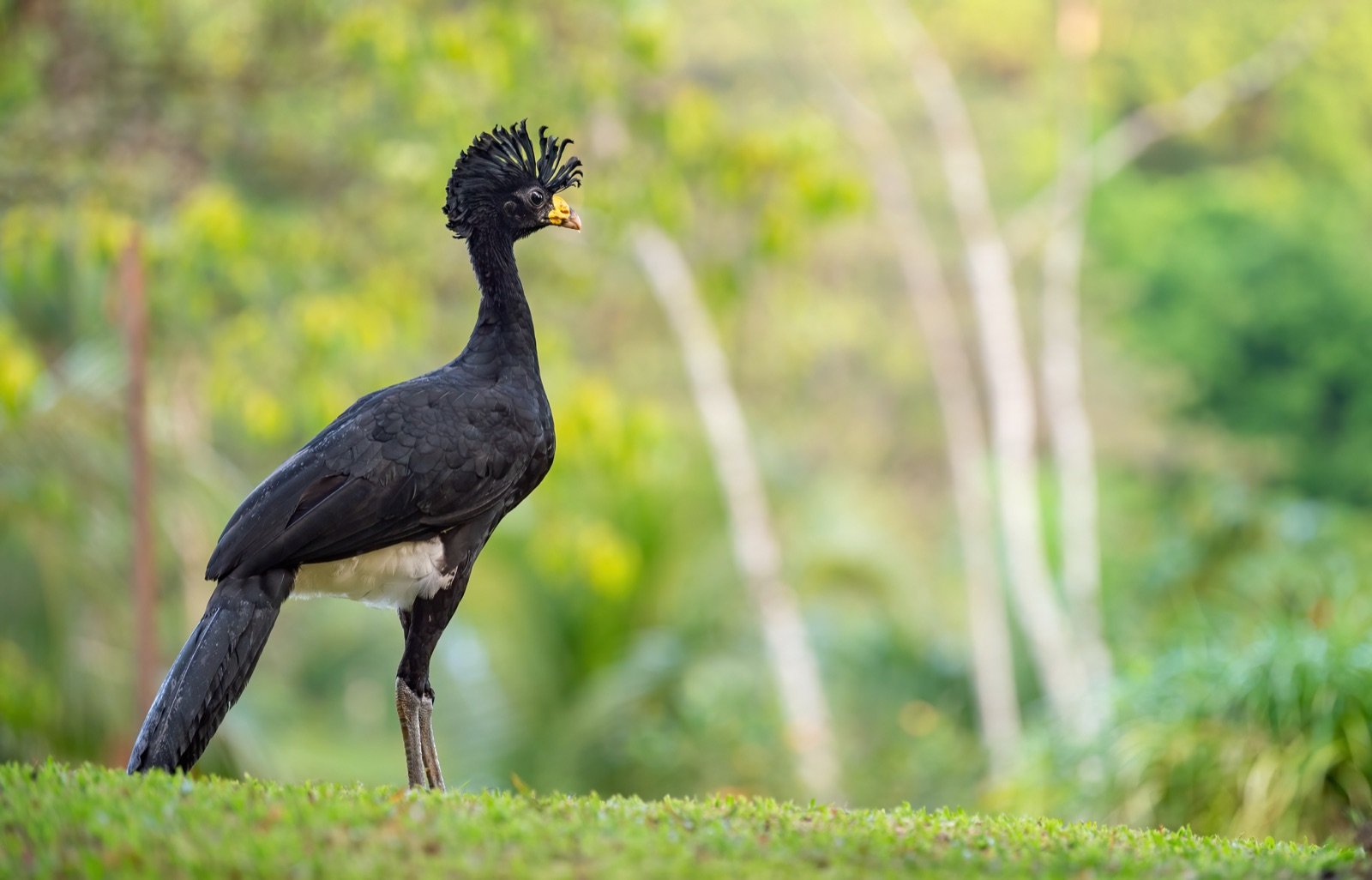
The Great Curassow is about the size of a turkey, and the male is almost completely black with a big yellow knob on the bill. It is Costa Rica's only cracid considered Vulnerable by the IUCN, because of habitat loss and heavy hunting.
One birder says it is much easier to see in Costa Rica than anywhere else in its range. On the Arenal trips we build, it is one of the birds we list for the lodge's trails, alongside Lovely Cotinga, Bare-necked Umbrellabird and Yellow-eared Toucanet.
Where to see it
How to find it
Listen for the male's deep booming in the early morning, since it carries far through the forest. Booming often starts well before dawn and is strongest around dawn and the following hours. Long bouts of calling last about 35 minutes on average, which helps you locate the bird. It is shy and hard to find in most places because of hunting, so protected areas and big forests give your best chance. At some lodges curassows will stroll near buildings or come to fruit feeders by a restaurant deck.
How to recognise it
Males are glossy black with a white belly, a curly crest and a big yellow knob on the bill. In Costa Rica they look almost completely black, and the whole bird is about the size of a turkey.
Females lack the yellow knob and come in three colour types.
The most common female type is mostly brown, with a black-and-white barred crest. She is bright brown with a blackish neck and a barred grey head, and her knob is grey, not yellow.
The barred female type is uncommon in Costa Rica. A rusty-brown type is also described.
What it sounds like
Recording: keesgroenendijk, CC BY 4.0, source, read 4 Nov 2026.
Behaviour and diet
It feeds mainly on the ground, eating fruit, seeds and arthropods, and scratching around for insects. It sleeps on tree branches, and when frightened it runs off or hops between branches to take flight.
Camera traps in northeastern Costa Rica showed activity peaks in the early morning (6 to 7 am) and late afternoon (4 to 5 pm), though that may not hold everywhere.
Males court by tilting the tail up, dropping a pebble and flapping with a whistle, then crouch and give a rumbling call. At some lodges the birds are used to people and stroll near buildings.
Where it lives
In Costa Rica it is uncommon in primary and secondary forest across the country, up to roughly 1200 m elevation. It lives in humid lowland and second-growth forest, on lowlands and slopes of both the Caribbean and Pacific sides. It mostly lives in wet forest but sometimes turns up in dry areas.
In a northeastern corridor, curassows were more likely at sites far from villages and with more forest cover. Lodge grounds and forest roads in that habitat are worth watching.
When to see it
Breeding is reported between February and June, and cracids generally breed at the start of the rainy season in Costa Rica. In northwest Costa Rica males boomed from February to June, peaking in late April and early May.
Similar birds
The Crested Guan is smaller and slimmer, with a red throat patch and no yellow knob on the bill. Crested Guans are common and often sit high in the morning canopy, while curassows stay mostly on the ground and are quiet.
Names and lore in Costa Rica
Costa Rican names include Pavón Grande, Pavón Norteño, Pavón, Granadera and Hocofaisán. The Cabécar name is Du siálí and the Guaymí name is iriwi.
Status and conservation
The AOCR lists it as a resident (R), but it is Vulnerable under the IUCN and threatened under Costa Rican wildlife law.
Photography tips
At several lodges the curassow poses for photos on trails and in garden areas. Birds walk confidently along trails and clearings, usually in small groups, and early morning is best.
Trips that find it
- Carara, the Osa and the Quetzal11 nightsSee the trip
- Costa Rica Classic Birding, All Inclusive8 nightsSee the trip
- Coast to Coast Birding, Tortuguero to the Osa18 nightsSee the trip
- The Grand Birding Circuit16 nightsSee the trip
Tell us when you are travelling and our team in Costa Rica builds the trip around the birds you want to see.
Plan my birding tripHow we know this 23 sources, each read on the date shown
- Área de Conservación Guanacaste read 2026-11-04
https://www.acguanacaste.ac.cr/paginas-de-especies/insectos-2/744-cracidae/6144-i-crax-rubra-i-cracidae - The Nature Admirer read 2026-11-04
https://thenatureadmirer.com/2017/08/31/great-curassow-crax-rubra/ - ResearchGate (camera trap study abstracts) read 2026-11-04
https://www.researchgate.net/publication/318284236_Camera_traps_provide_valuable_data_to_assess_the_occurrence_of_the_Great_Curassow_Crax_rubra_in_northeastern_Costa_Rica - Aves de Costa Rica read 2026-11-04
https://www.avesdecostarica.org/cracidae.html - Birding Craft read 2026-11-04
https://birdingcraft.com/wordpress/2010/02/12/seeing-curassows-guans-and-chachalacas-when-birding-costa-rica/ - Whitehawk Birding read 2026-11-04
https://www.whitehawkbirding.com/great-curassow/ - Retired in Costa Rica read 2026-11-04
https://www.charliedoggett.net/tag/crax-rubra/ - EcoRegistros read 2026-11-04
https://www.ecoregistros.org/site/especie.php?id=4110 - Taylor & Francis (camera trap study) read 2026-11-04
https://www.tandfonline.com/doi/full/10.1080/23766808.2017.1346548 - Área de Conservación Guanacaste (after Stiles & Skutch) read 2026-11-04
https://www.acguanacaste.ac.cr/bosque_seco_virtual/bs_web_page/paginas_de_especies/crax_rubra.html - Journal of Field Ornithology (Baldo et al. 2011) read 2026-11-04
https://onlinelibrary.wiley.com/doi/abs/10.1111/j.1557-9263.2011.00328.x - Everyday Earth read 2026-11-04
https://everydayearth.ai/species/great-curassow - TikTok (user video description) read 2026-11-04
https://www.tiktok.com/discover/el-pavo-costa-rica - Naturalista Costa Rica read 2026-11-04
https://costarica.inaturalist.org/taxa/2052-Crax-rubra - Project Noah read 2026-11-04
https://projectnoah.org/spottings/great-curassow-6 - Birding Field Guides read 2026-11-04
https://birdingfieldguides.com/wp/what-are-the-top-ten-birds-of-costa-rica/ - Destination: Wildlife read 2026-11-04
https://www.destinationwildlife.com/blog/costa-rica-birds - Birding Craft read 2026-11-04
https://birdingcraft.com/wordpress/tag/great-curassow/ - Copa de Arbol read 2026-11-04
https://www.copadearbol.com/most-popular-birds-of-costa-rica/ - Trek Zone read 2026-11-04
https://trek.zone/en/costa-rica/animals/great-curassow - El Jornal CR read 2026-11-04
https://eljornalcr.com/el-pavon-es-una-especie-amenzada-en-nuestros-bosques/ - Reino das Aves read 2026-11-04
https://www.reinodasaves.club/grande-curassow/ - 10,000 Birds read 2026-11-04
https://www.10000birds.com/the-turkeys-of-costa-rica.htm