Family Cuculidae
Greater Ani
Crotophaga major
In Spanish: Garrapatero Mayor
- A
A rare, white-eyed, blue-black ani of mangroves and waterside thickets.
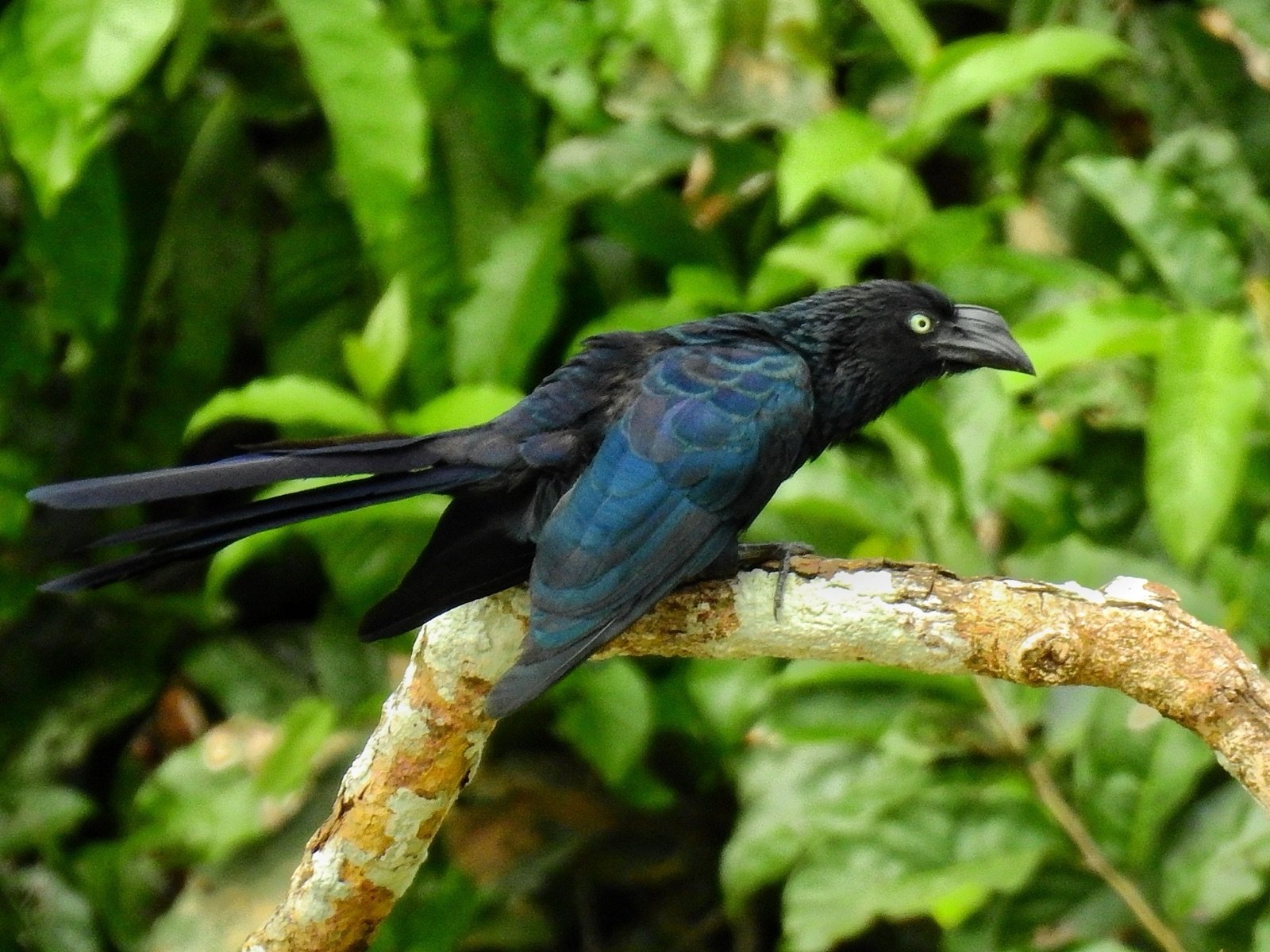
The Greater Ani (Garrapatero Mayor, Crotophaga major) is a glossy blue-black cuckoo about 48 cm long, with a long tail, a huge ridged bill and a white eye. It is the largest of the three anis in its genus.
In Costa Rica this is a bird to know about rather than to expect. The official list gives it status A, accidental, so it is not a regular resident and any sighting would be a rare event.
Costa Rica sits at the northern edge of its range, and the nearest regular birds live well to the east in Panama. Learning its marks pays off because two common anis can look similar at first glance.
How to find it
Look for it in thick vegetation over water, along rivers, lake edges, marshes and mangroves. Because it is so noisy, listen first for croaks, gobbling calls and the harsh alarm note. It may move into clearings but seldom goes far into forest, so stay near the water's edge. After feeding in wet vegetation it dries off with wings and tail spread and feathers fluffed in the sun, which makes it easy to notice. Before calling one, check eye colour and bill size, because the common anis are far more likely.
How to recognise it
Adults are glossy blue-black with a long tail, a black bill and a white eye. Young birds have a dark eye, so a pale-eyed bird is an adult.
The bird is about 48 cm long, and nearly half of that is tail.
The bill is huge, ridged along its length, somewhere between a crow's and a toucan's. The upper bill is arched up into a hump.
Adult males have green edges on the neck, upper back and shoulders, a purple shine on the long tail, and black legs and feet.
What it sounds like
Recording: Raquel Mondino, CC BY 4.0, source, read 4 Nov 2026.
Behaviour and diet
The Greater Ani is very sociable and always lives in noisy groups. Groups usually have three to four pairs, though some flocks reach dozens of birds, and they live far from human settlements.
Several pairs share one communal nest, usually in a tree 2 to 5 m up. Several females lay blue eggs in it and share incubation.
It eats large insects, lizards and small frogs. It also wades in shallow water to fish, and sometimes follows army ants.
Where it lives
It lives in mangroves, swamps and forest edges near water. It usually stays along streams and rivers with low banks that are partly flooded, and it is common in gallery forest, lake shores, swamps and mangroves.
Across its whole range it occurs from sea level up to about 2,600 m.
For Costa Rica, a paper written in Panama says it now ranges across Panama and west into Costa Rica, but it names no parks. In Panama its range runs from Darién to the west of Colón province.
Similar birds
Costa Rica has two regular anis, both residents: the Smooth-billed Ani (garrapatero piquiliso) and the Groove-billed Ani (garrapatero piquiestriado). The Groove-billed is resident across the country from the coasts up to about 2300 m, so it is the ani you are most likely to see. A black ani with a white eye and a humped bill would point to the Greater Ani instead. Young Greater Anis have a dark eye, so judge size and bill shape too.
Names and lore in Costa Rica
The official name is Garrapatero Mayor. Other Spanish names across its range include garrapatero grande, anó grande and pirincho negro grande. 'Tijo' belongs to the Groove-billed Ani on the official list, so do not use it for this bird.
Status and conservation
The official Costa Rican list gives the Greater Ani status A, accidental, and the IUCN lists the species as Least Concern.
Photography tips
Watch for a bird perched with wings and tail spread to dry in the sun, when it is easy to notice. Look over water in thick vegetation, and let the noisy calls lead you to the group.
How we know this 15 sources, each read on the date shown
- Bird Watching Costa Rica read 2026-11-04
https://www.birdwatchingcostarica.com/ave/greater-ani/ - Wikipedia (Spanish) read 2026-11-04
https://es.wikipedia.org/wiki/Crotophaga_major - Scientia (Universidad de Panamá) read 2026-11-04
https://revistas.up.ac.pa/index.php/scientia/article/download/4574/3710/7347 - Observatorio Ambiental de Bogotá read 2026-11-04
https://oab.ambientebogota.gov.co/fauna/garrapatero-mayor/ - Scientia (via ResearchGate) read 2026-11-04
https://www.researchgate.net/publication/377258864_Primer_Registro_de_depredacion_del_Garrapatero_Mayor_Crotophaga_major_sobre_la_rana_Trachycephalus_tiphonius_Santa_Ana_Los_Santos_Panama - Kidadl read 2026-11-04
https://kidadl.com/facts/animals-nature/greater-ani-facts - Oiseaux-birds.com read 2026-11-04
https://www.oiseaux-birds.com/card-greater-ani.html - Aves de Costa Rica read 2026-11-04
https://avesdecostarica.com/Crotophaga-major.html - iNaturalist Mexico read 2026-11-04
https://mexico.inaturalist.org/taxa/1970-Crotophaga-major - Birds Colombia (Wikipedia text) read 2026-11-04
https://birdscolombia.com/2017/02/20/garrapatero-grande-crotophaga-major/ - Lista Oficial de las Aves de Costa Rica (AOCR) read 2026-11-05
https://listaoficialavesdecostarica.wordpress.com/lista-oficial/lista-oficial-online/ - Asociación Ornitológica de Costa Rica, Cuculidae read 2026-11-05
https://avesdecostarica.weebly.com/cuculidae.html - Scientia (Universidad de Panamá) read 2026-11-05
https://revistas.up.ac.pa/index.php/scientia/article/view/4574 - Planet of Birds read 2026-11-05
https://planetofbirds.com/cuculiformes-cuculidae-greater-ani-crotophaga-major/ - Native Alimentos Biodiversidade read 2026-11-05
https://www.nativealimentos.com.br/es/sostenibilidad/biodiversidad/animales/aves/garrapatero-mayor/797