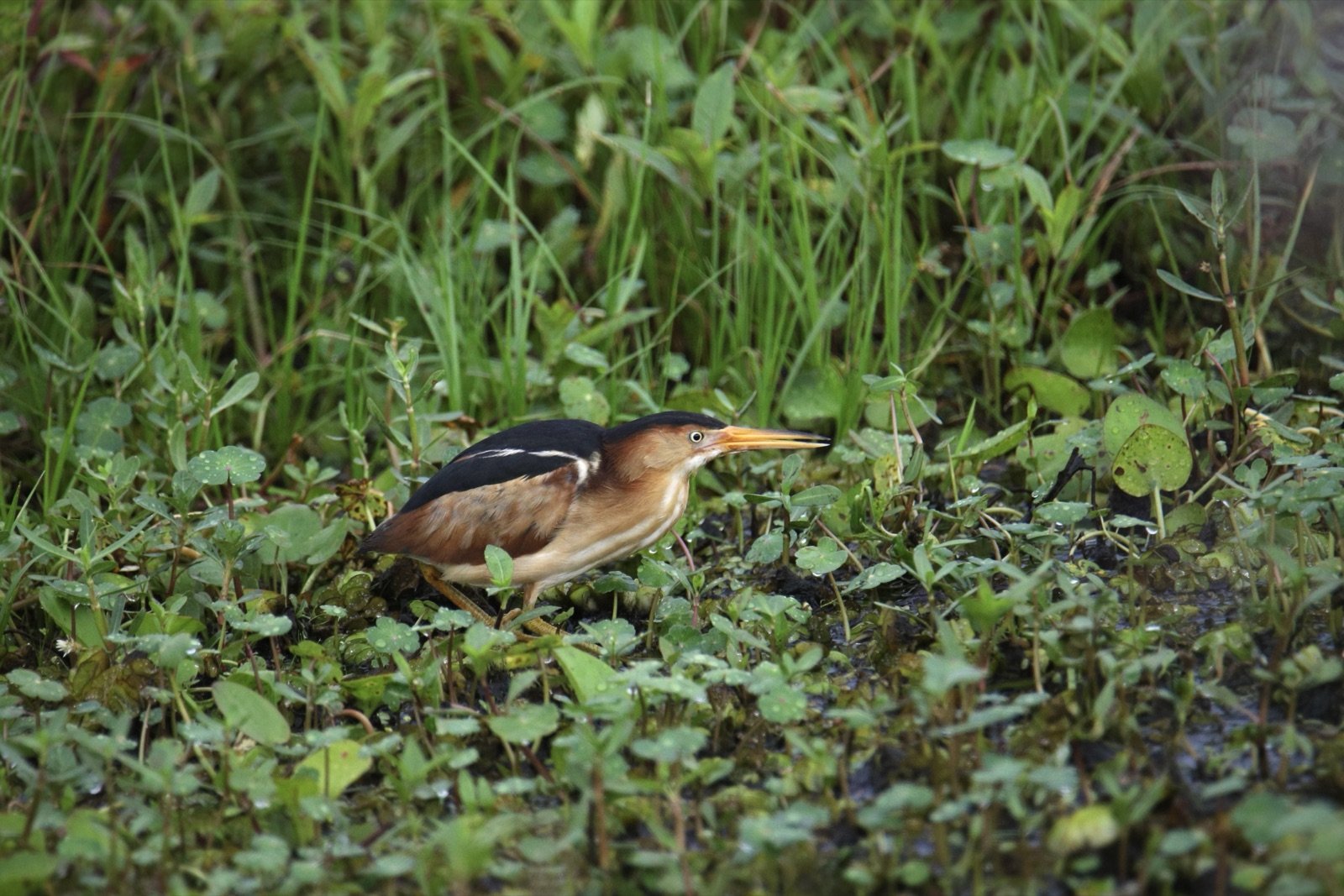
 Least Bittern
Family Ardeidae
Least Bittern
Botaurus exilis
In Spanish: Avetorillo Pantanero (Mirasol)
- Resident
Tiny, shy marsh heron, best found by boat at Medio Queso
The Least Bittern is a tiny, colourful heron about 30 cm long, and in Costa Rica it is one of the most local birds of the marshes. A Costa Rican birder calls it the smallest and most local heron in the country.
Medio Queso marsh, near Los Chiles in the north, is described as about the only place in Costa Rica where it can be seen reliably, and birders usually pair it with a boat trip on a neighbouring wetland. On a trip we build, that boat ride is the heart of the plan.
For a beginning birder it makes a rewarding target: the wing pattern is distinctive, and the habitat makes sense once you are floating among the reeds.
How to find it
Boat trips at Medio Queso are the usual way to see it, and one report says the boatman there knows where to find it, along with crakes and Spotted Rail. A birder who reached the marsh without a boat ride could only bird the dike, which kept Least Bittern out of reach, so the boat matters. Calls are most frequent at dawn and dusk, and sometimes at night, so early or late outings make sense. One late afternoon ride gave fine views, and another began at 6:45 am with a bird perched on a reed at the canal edge. Across its range it is usually seen only when it flies, so watch for the buff wing patches.
How to recognise it
This is a tiny, colourful heron, about 30 cm long. The field marks are easy to line up:
Males have a glossy black back and cap.
Females are chestnut.
Both have a white line along the shoulder.
Both have large buff patches on the wings.
Those buff wing patches are the key mark, because no other small heron or rail in Costa Rica has this wing pattern. The immature is like the female, with paler, buff-flecked upperparts and a streaked underside.
What it sounds like
Recording: Benoit Renaud, CC BY 4.0, source, read 4 Nov 2026.
Behaviour and diet
The Least Bittern is usually solitary, shy and elusive. It climbs reed stems and grips them with long toes, and it hunts small fish and insects from perches just over the water. When alarmed, it freezes with its bill pointed up, and it may also sway like marsh plants moving in the wind. That stillness is why it is so easy to miss, and why patience pays.
Where it lives
Across its range it lives in freshwater and brackish marshes with tall, dense reeds or cattails and open water. In Costa Rica it is rare to common in certain places on both slopes, mostly in the lowlands. It sometimes climbs as high as about 1400 m. Breeding has been confirmed only at the Tempisque plain (Palo Verde National Park), the Río Frío region and Westfalia in Limón, though it may nest more widely. A photographed bird was also recorded at the Medio Queso wetland near Los Chiles, in the north of the country.
When to see it
Costa Rican birds breed from June to September, and some northern birds probably come to winter from October to March. Birds also move seasonally with changes in water levels. At Medio Queso, marsh birds are reported most reliable when water is low, in March, especially April, and early May.
Similar birds
The buff wing patches are the key mark, since no other small heron or rail has this wing pattern. The American Bittern is more than twice as large. Rails have short necks and lack the sharp contrast of buff and chestnut inner wings against dark outer wings. The Pinnated Bittern is much bigger and paler, described by a Costa Rican site as a huge Least Bittern crossed with a tiger-heron, so size separates the two.
Names and lore in Costa Rica
The official list gives Avetorillo Pantanero, with Mirasol in brackets as the name commonly used in Costa Rica. Pantano means swamp or marsh, so the name points to the places where the bird lives.
Status and conservation
The official Costa Rican list marks it as R,M?, a resident that may also include migrants, and the Costa Rican population mixes year-round residents with migrants from North America.
Photography tips
A boat is the best way to get close. A tour operator says boat trips in the Los Chiles area give close chances to see and photograph birds. Go early: one Medio Queso trip began at 6:45 am and found a bird perched on a reed at the canal edge, giving good looks. A bird sitting motionless may stay long enough for a steady shot.
How we know this 28 sources, each read on the date shown
- Flickr post quoting Aves de Costa Rica text read 2026-11-04
https://www.flickr.com/photos/jobando/26977619280 - Aves de Costa Rica read 2026-11-04
http://www.avesdecostarica.com/Ixobrychus-exilis.html - Lista Oficial de las Aves de Costa Rica (AOCR) read 2026-11-04
https://listaoficialavesdecostarica.wordpress.com/lista-oficial/lista-oficial-online/ - Museo Nacional de Costa Rica read 2026-11-04
https://www.museocostarica.go.cr/nuestro-trabajo/investigaciones/historia-natural/cahuita/aves/ - Missouri Department of Conservation read 2026-11-04
https://mdc.mo.gov/discover-nature/field-guide/least-bittern - Birds of the World (Cornell Lab) read 2026-11-04
https://birdsoftheworld.org/bow/species/leabit/cur/introduction - All About Birds (Cornell Lab) read 2026-11-04
https://www.allaboutbirds.org/guide/Least_Bittern/overview - Michigan Natural Features Inventory read 2026-11-04
https://mnfi.anr.msu.edu/species/description/10877/Botaurus-exilis - Audubon Field Guide read 2026-11-04
https://www.audubon.org/field-guide/bird/least-bittern - NYSDEC read 2026-11-04
https://dec.ny.gov/nature/animals-fish-plants/least-bittern - quetzalbycar.com read 2026-11-04
https://www.quetzalbycar.com/locations/cano-negro - Birding Craft read 2026-11-04
https://birdingcraft.com/wordpress/2019/01/17/cano-negro-birding-in-costa-rica-delivers-the-goods/ - 10,000 Birds read 2026-11-04
https://www.10000birds.com/easy-bonus-birding-at-cano-negro-costa-rica.htm - 10,000 Birds read 2026-11-04
https://www.10000birds.com/the-birding-is-always-good-at-cano-negro-costa-rica.htm - Hotel de Campo Caño Negro read 2026-11-04
https://www.hoteldecampo.com/category/birdwatching-in-costa-rica/ - Aves de Perú read 2026-11-04
https://avesdeperu.org/ardeidae/mirasol-leonado-ixobrychus-exilis/ - Birdwatching in Costa Rica (AOCR list) read 2026-11-04
https://birdwatchingincostarica.com/bird-lists/ - Museo Nacional de Costa Rica read 2026-11-04
https://www.museocostarica.go.cr/wp-content/uploads/Investigaciones/historia-natural/garzas/diversidad/catalogo-garzas-cr-mncr.pdf - Birding Craft read 2026-11-04
https://birdingcraft.com/wordpress/2023/12/ - Birding Craft read 2026-11-04
https://birdingcraft.com/wordpress/category/costa-rica-bird-finding-guide/ - Manuel Antonio Birding read 2026-11-04
https://manuelantoniobirding.wordpress.com/2018/04/12/birding-medio-queso-and-cano-negro/ - Ecosistemas de Costa Rica read 2026-11-04
https://ecosistemasdecostarica.blogspot.com/2012/08/aves.html - Birds by Bijs read 2026-11-04
https://birdsbybijs.com/costa-rica-northern-region-birding-tour/ - Birding Craft read 2026-11-04
https://birdingcraft.com/wordpress/tag/pinnated-bittern/ - Aves de Costa Rica read 2026-11-04
https://www.avesdecostarica.com/Ixobrychus-exilis.html - Cornell Birds of the World read 2026-11-04
https://birdsoftheworld.org/bow/species/leabit/cur/sounds - Field Guides Birding Tours read 2026-11-04
https://fieldguides.com/triplists/cr220.html - Blue Eyed Birder read 2026-11-04
https://blueeyedbirding.blogspot.com/2022/04/costa-rica-day-6-18th-march-2022.html