Family Anatidae
Lesser Scaup
Aythya affinis
In Spanish: Porrón Menor (Pato)
- Migrant
A small winter diving duck, regular only in Guanacaste.
The Lesser Scaup (Porrón Menor) is a small North American diving duck that breeds from Alaska across Canada and winters south to Central America. In Costa Rica it is an uncommon to rare winter visitor, and it is regular only in Guanacaste.
Elsewhere it turns up now and then in small numbers, in the lowlands and mid elevations on both the Caribbean and Pacific slopes. Its numbers here have clearly dropped, so a sighting is something to enjoy.
For a beginning birder it is a good lesson in patience and lookalikes, because the duck you are likelier to find on the same water is the Ring-necked Duck.
How to find it
Start in Guanacaste, the one region where it is regular. Scan open, clear freshwater at least a metre deep, since that is where it prefers to feed. Watch for a duck that keeps diving and resurfacing, and for a splashing run across the water at takeoff. Check any Ring-necked Ducks carefully, as the scaup is usually scarcer and may be mixed in. Expect small groups, pairs or single birds rather than big flocks.
How to recognise it
Start with two marks: a short white stripe in the wing and a yellow eye.
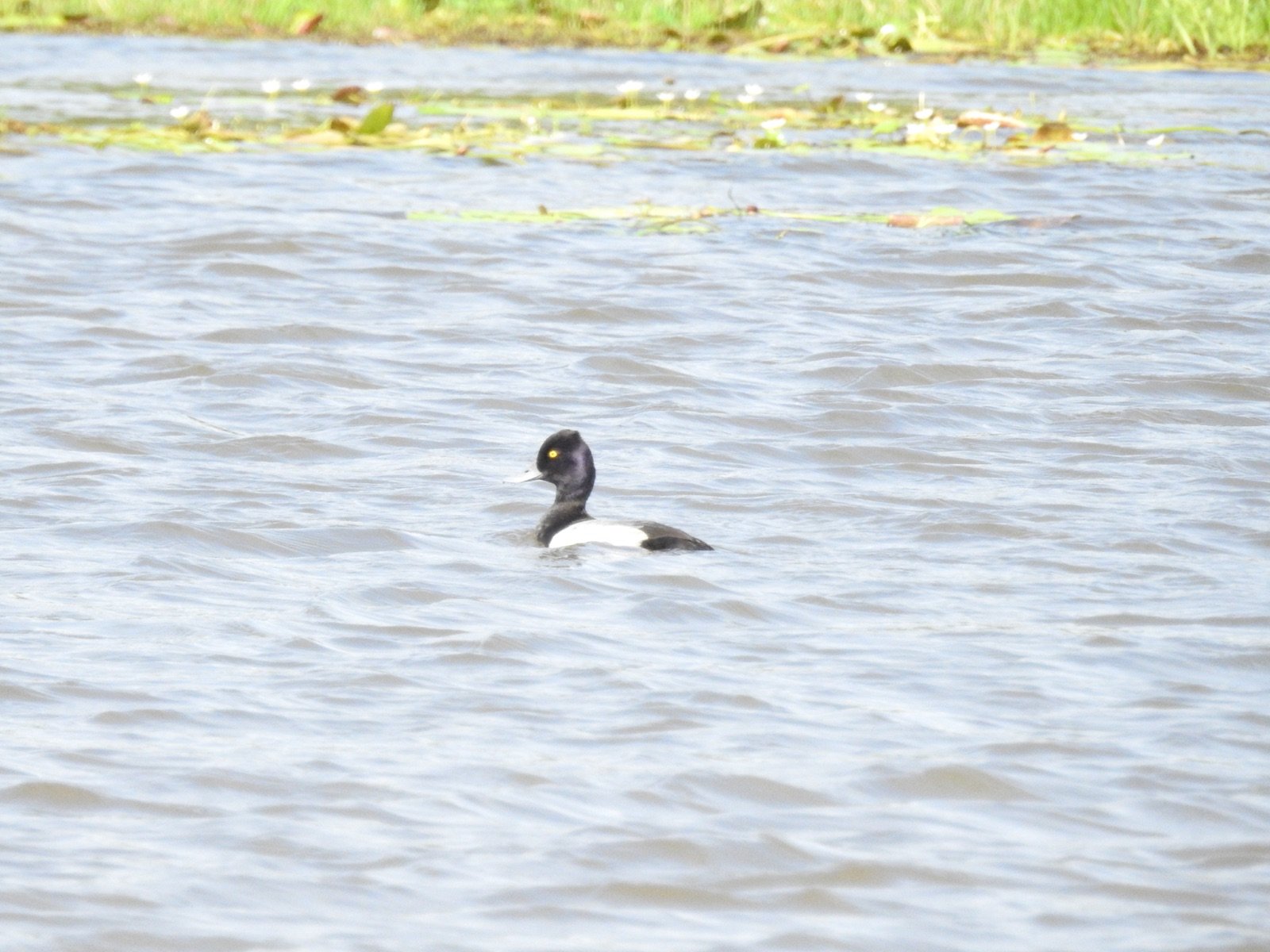
The male has a black head with a purple gloss and a clearly peaked crown. His breast and tail are black, and his body is mostly white.
The female is mostly dull dark brown with a darker head and a dark grey patch around the bill base. Her belly is white.
Both sexes have a blue-grey bill with a small black tip, and grey feet. It is a small diving duck, so think compact rather than large.
Behaviour and diet
It is a very active duck that dives and resurfaces again and again while feeding. It dives for aquatic plants, snails, insects and small fish.
In Costa Rica it is seen only now and then, in small groups, pairs or alone. When it takes off, it splashes along the water.
It tends to stay on open freshwater, so scan lakes and ponds rather than wooded edges.
Where it lives
It prefers freshwater ponds, lakes and lagoons with clear water at least one metre deep.
In Costa Rica it is regular only in Guanacaste. Elsewhere it appears occasionally in small numbers, in the lowlands and mid elevations on both the Caribbean and Pacific slopes.
A Costa Rican natural history account lists the conservation areas where it occurs: Tempisque, Guanacaste, Arenal, Tortuguero, Osa, Pacífico Central, Cordillera Volcánica Central, Huetar Norte and Amistad Caribe and Pacífico.
When to see it
Arrivals have been seen in mid to late November, with some also arriving in February or March. It is a winter visitor.
Similar birds
In Costa Rica the likeliest lookalike is the Ring-necked Duck, which is the more numerous of the two. The scaup has a short white wing stripe and a yellow eye, and the male's crown is clearly raised.
The Greater Scaup is hard to separate, but it is only an accidental visitor on the official list. Head shape is the best clue: the Lesser has a peak toward the back of the crown and a slightly smaller bill, and in flight its white wing stripe reaches only about halfway out the wing. A greenish gloss can occur on either species, so do not rely on colour alone.
Names and lore in Costa Rica
Costa Rican sources call it Porrón Menor. The official list adds Pato in brackets, so it is also known simply as a pato (duck).
Status and conservation
The official Costa Rican list gives it status M, a migrant, and it is an uncommon to rare winter visitor that is usually scarcer than the Ring-necked Duck.
How we know this 15 sources, each read on the date shown
- Flickr (Costa Rican natural history account, Spanish) read 2026-11-04
https://www.flickr.com/photos/jobando/38058302622 - Wikipedia (es), Aves de Costa Rica read 2026-11-04
https://es.wikipedia.org/wiki/Aves_de_Costa_Rica - AOCR Lista Oficial Online read 2026-11-04
https://listaoficialavesdecostarica.wordpress.com/lista-oficial/lista-oficial-online/ - Wikipedia read 2026-11-04
https://en.wikipedia.org/wiki/Lesser_scaup - Animal Diversity Web read 2026-11-04
https://animaldiversity.org/accounts/Aythya_affinis/ - Cornell Birds of the World read 2026-11-04
https://birdsoftheworld.org/bow/species/lessca/cur/introduction?lang=es - Audubon Field Guide read 2026-11-04
https://www.audubon.org/field-guide/bird/lesser-scaup - Guide to Boreal Birds read 2026-11-04
https://www.borealbirds.org/bird/lesser-scaup - Luis Lopez, Aves de Costa Rica read 2026-11-04
https://luislopezweb.es.tl/Aves-de-Costa-Rica.htm - Museo Nacional de Costa Rica, Catálogo de Aves de la GAM read 2026-11-04
https://www.museocostarica.go.cr/wp-content/uploads/Investigaciones/historia-natural/gam/datos-biodiversidad/aves/catalogo/catalogo_aves_gam_2.pdf - AOCR Lista Oficial update 2015 (Dialnet) read 2026-11-04
https://dialnet.unirioja.es/servlet/articulo?codigo=7516661 - iNaturalist guide, Tortuguero checklist (US Forest Service) read 2026-11-04
https://www.inaturalist.org/guides/3606 - Rescate Wildlife Rescue Center read 2026-11-04
https://rescatewildlife.org/our-wildlife/ - Birdzilla read 2026-11-04
https://www.birdzilla.com/bird-identification/id-skill-development/bird-families/waterfowl-identification/duck-identification/identification-of-diving-ducks/comparison-of-greater-and-lesser-scaup/ - Chicago Ornithological Society read 2026-11-04
https://www.chicagobirder.org/blog/2021/12/9/dans-feathursday-feature-lesser-scaup-greater-scaup