Family Thraupidae
Lesson's Seedeater
Sporophila bouvronides
In Spanish: Espiguero de Lesson
- A
A South American seedeater recorded once, at Tortuguero in June 2022.
Lesson's Seedeater (Espiguero de Lesson) is a small South American bird, and in Costa Rica it is a rarity of the first order. The only record comes from Tortuguero, in the Caribbean lowlands of Pococí, Limón province, where one bird was feeding under a tropical almond tree near the beach.
It was first seen on 25 June 2022, and nobody had reported the species in the country before that. It has no resident population here, so this page is less a guide to finding it than the story of a surprise visitor and how to recognise another.
For a beginning birder the useful lesson is a habit: look carefully through flocks of common seedeaters, because an odd one may be hiding among them.
How to find it
Do not plan a trip around this bird, because it has just one Costa Rican record. If you are at Tortuguero, look near the beach and under trees such as tropical almond, where the one bird fed. Go through flocks of common seedeaters slowly and watch for an odd one. Compare any suspect with the Variable Seedeaters beside it. Check males for a solid black crown and a smudgy breast.
How to recognise it
This is a small bird, about 10.5 to 11 cm long.
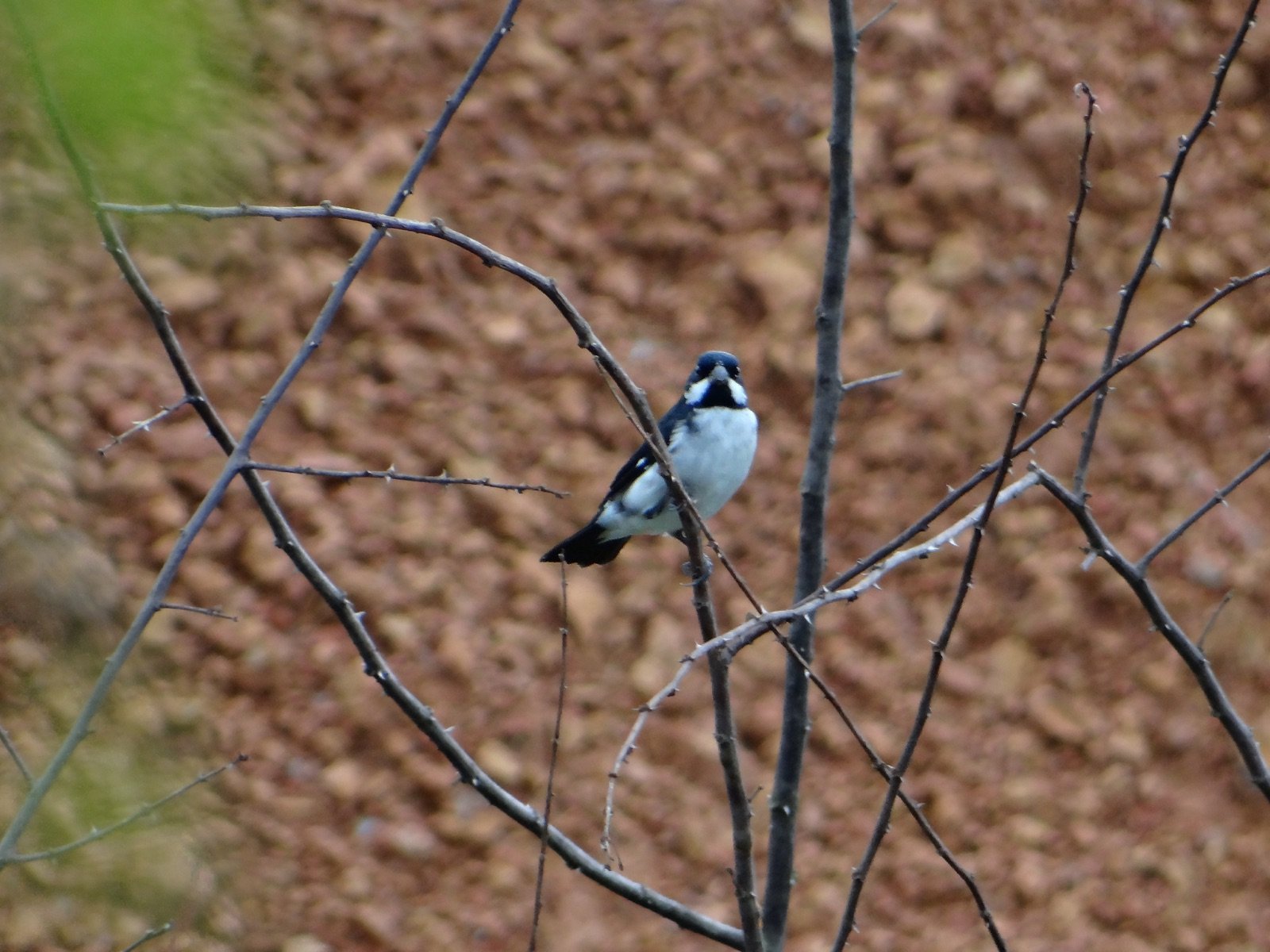
The male has a mostly black head with a large white whisker mark, seen as a white cheek patch. The upperparts are otherwise black, with a white wing patch and a white band across the rump. The underparts are dingy white, with specks on the breast and sides, so the breast looks smudgy and stained. In Costa Rica the crown is solid black, which is the mark to check first.
The female is paler on the belly and has a lighter bill. She has an olive-brown back, a pale yellowish belly and a dull yellow bill. Females are identical to female Lined Seedeaters and cannot safely be told apart without a male nearby.
Behaviour and diet
The Costa Rican bird was with a flock of Variable Seedeaters, and it was photographed beside a male of that species. That suggests it joined the common birds here rather than keeping apart, so the way to look for it is to go through flocks of common seedeaters and watch for an odd one.
Away from Costa Rica it is found in pairs or flocks. It feeds low in grass and perches in bushes and trees, and it is sometimes seen in flocks eating grass seeds.
The nest is a thin cup of dry grass in low scrub, usually under 3 m up, with a clutch of 2 to 3 eggs.
Where it lives
In its normal range it lives in open marshy areas and disturbed places with long grass, especially near water. Across its range it is described as uncommon to fairly common, and it is usually found in shrubby habitats close to water.
Its usual breeding range is northern South America, including northern Colombia and Venezuela. It is a long-distance migrant, and its non-breeding range is in Amazonia.
In Costa Rica the single record is from the Caribbean lowlands, at Tortuguero in Pococí canton, Limón province, close to the beach.
When to see it
The only Costa Rican record dates from 25 June 2022. Elsewhere it is a non-breeding visitor, for example in Peru from October to May and in Bolivia from November to May.
Similar birds
The male looks like a Lined Seedeater but has no white stripe on the crown. Lined Seedeater is the only other Costa Rican seedeater with a white stripe down the middle of the crown, while Lesson's has a solid black crown. A male Lined also has a clean white breast, where Lesson's is dingy and speckled. A male Lined Seedeater was found on the Pacific slope in October 2013, also a vagrant.
Names and lore in Costa Rica
The Spanish name on the Costa Rican list is Espiguero de Lesson, also used in Peru, Colombia and Ecuador. Other Spanish names listed for the species elsewhere are Semillero de Lesson, and Venezuelans call the bird Bengalí. The scientific name means resembling the Lined Seedeater, from a French name for that bird plus a Greek ending meaning 'like'.
Status and conservation
It is a vagrant on the Costa Rican list (status A), recorded once, and the IUCN lists the species as Least Concern.
Photography tips
Photograph the crown and breast, since those marks separate it from a Lined Seedeater. Try to frame it beside a common Variable Seedeater, as the first Costa Rican bird was documented, so its plumage can be compared directly.
How we know this 13 sources, each read on the date shown
- Bulletin of the British Ornithologists' Club (BioOne) read 2026-11-04
https://bioone.org/journals/bulletin-of-the-british-ornithologists-club/volume-142/issue-4/bboc.v142i4.2022.a11/First-record-of-Lessons-Seedeater-Sporophila-bouvronides-in-Costa-Rica/10.25226/bboc.v142i4.2022.a11.full - Universidad de Costa Rica (Kérwá), Gatgens-García et al. 2022 read 2026-11-04
https://www.kerwa.ucr.ac.cr/items/0a7956b2-979d-4fb2-a1aa-bfa834226084 - Academia.edu copy of Gatgens-García et al. 2022 read 2026-11-04
https://www.academia.edu/99515741/First_record_of_Lessons_Seedeater_Sporophila_bouvronides_in_Costa_Rica?uc-sb-sw=59662081 - Wikipedia read 2026-11-04
https://en.wikipedia.org/wiki/Lesson's_seedeater - Dibird read 2026-11-04
https://dibird.com/species/lesson-s-seedeater/ - Peru Aves read 2026-11-04
https://www.peruaves.org/thraupidae/lessons-seedeater-sporophila-bouvronides/ - Birds of Bolivia read 2026-11-04
https://birdsofbolivia.org/species-fact-sheets-2/tanagers-and-allies-tangaras-y-afines/sporophila-bouvronides/ - Zenodo (Figure 2, Bull. BOC) read 2026-11-04
https://zenodo.org/records/20292299 - Bulletin of the British Ornithologists' Club read 2026-11-04
https://bioone.org/journals/bulletin-of-the-british-ornithologists-club/volume-142/issue-4/bboc.v142i4.2022.a11/First-record-of-Lessons-Seedeater-Sporophila-bouvronides-in-Costa-Rica/10.25226/bboc.v142i4.2022.a11.pdf - Cornell Birds of the World read 2026-11-05
https://birdsoftheworld.org/bow/species/lessee2/cur/introduction - iNaturalist (Wikipedia text) read 2026-11-05
https://mexico.inaturalist.org/taxa/9490 - Birds Colombia read 2026-11-05
https://birdscolombia.com/2020/08/30/espiguero-de-lesson-lessons-seedeater-sporophila-bouvronides/ - Planet of Birds read 2026-11-05
https://planetofbirds.com/passeriformes-emberizidae-lessons-seedeater-sporophila-bouvronides/