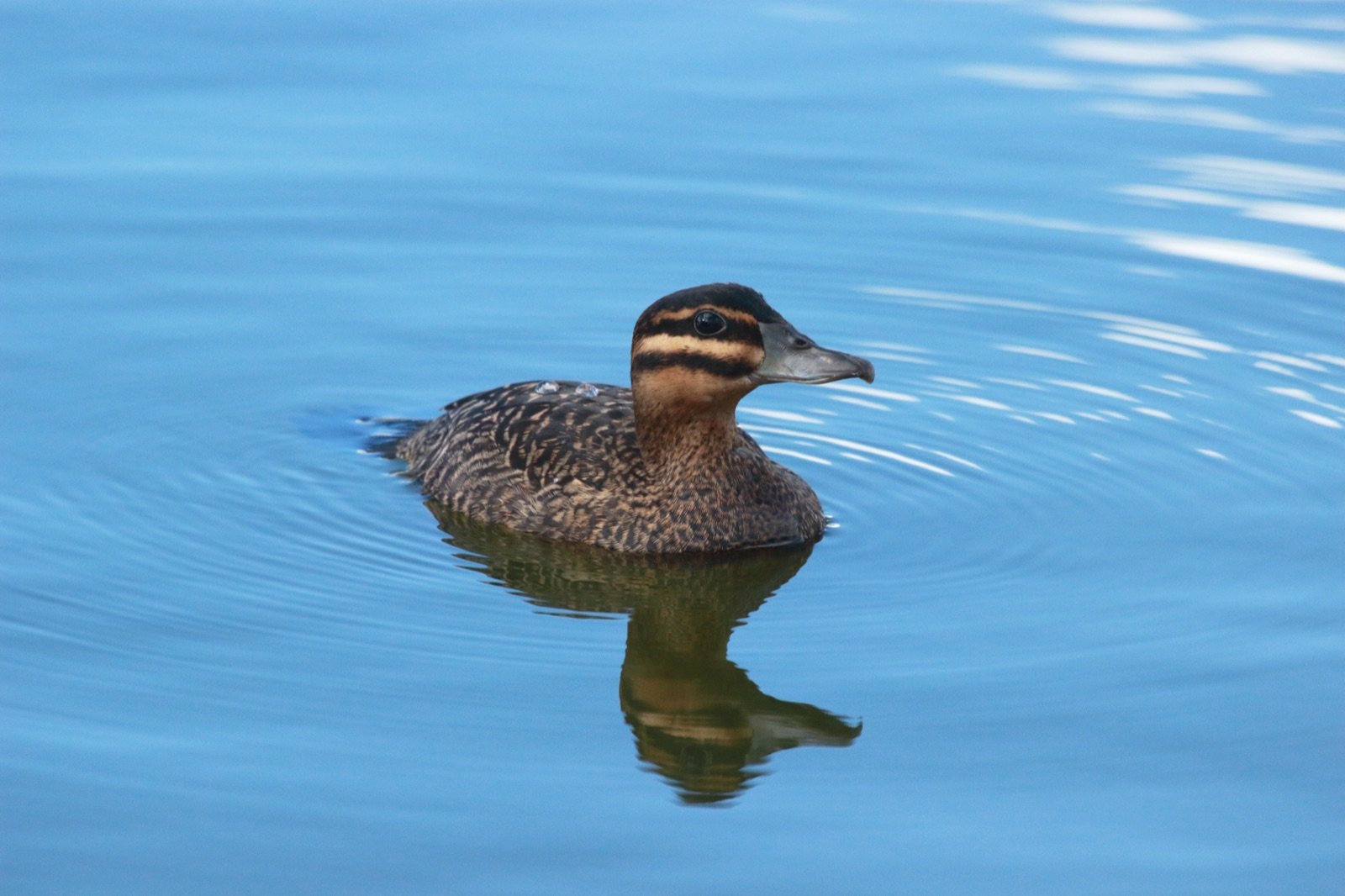
 Masked Duck
Family Anatidae
Masked Duck
Nomonyx dominicus
In Spanish: Pato Enmascarado
- Resident
A small, shy stiff-tailed duck that hides in dense pond plants.
The Masked Duck (Pato Enmascarado) is a small, chunky duck that lives behind a curtain of floating plants. The official Costa Rican list gives it a status of R, resident, and it is the regular stiff-tailed duck here, because the Ruddy Duck is only an accidental visitor.
It is also a bird for patient pond watchers. It is shy, it spends much of its time in dense marsh growth, and where it appears depends on food and water, so a pond that holds one this year may be empty next year.
Records come from the Valle Central, the Tempisque basin of Guanacaste, the Río Frío area and a single pond near San Vito.
How to find it
Look for ponds with plenty of floating plants, especially water hyacinth, because the duck is very hard to see and spends much time in dense marsh growth. Scan mud banks in very shallow water as well as the edges of the vegetation. Go slowly and watch for a head or tail tip showing as a bird sinks quietly. Pairs are the usual sight, so one find may lead to another. Because the birds follow water and food, a pond that held ducks one year may be empty the next, so keep several wetlands on the plan.
How to recognise it
A breeding male is easy to name:
- black face and crown
- chestnut neck and chest
- back scalloped black and rusty
- bright blue bill
Females and young birds are barred brownish gray, with two dark stripes across the buff face, one through the eye and one below it.
Masked Ducks are small, about 30 to 35 cm long, and chunky, with a stiff gray tail. Both sexes show a white patch on the dark gray wing, easiest to see in flight. A Costa Rican description places the white on the secondaries and greater coverts. It also says the long black tail is usually held low and dragged on the water, not cocked up, although elsewhere in the range the tail is often held up.
Behaviour and diet
The Masked Duck is shy and reserved. In Costa Rica it is usually seen in pairs, and sometimes in groups of 10 to 20 birds. It hides in dense plants and floats half submerged. It can dive fully and swim underwater to escape danger, and it takes off straight from the water without a running start. It is a stronger flier than other stiff-tailed ducks. It is said to be more active at night. At the edges of its range it is a nomad rather than a true migrant.
Where it lives
In Costa Rica it lives in calm, shallow water with water hyacinth and other low, dense water plants. It often sits on mud banks in very shallow water, and it also uses ponds, lakes and lagoons. Across its range it favors water usually under 1 m deep, with dense floating and emergent plants, tolerates nutrient-rich water and prefers thick cover along the edges. Costa Rican records come from the Valle Central, mostly around Cartago, the Tempisque basin in Guanacaste, the Río Frío region and other lowland sites, plus a pond near San Vito in the south.
When to see it
Costa Rican sources say Masked Ducks breed in the middle and late part of the rainy season and make strong seasonal moves linked to changing water levels. At the San Vito pond, ducks have turned up in late January, February, March or April, staying a few weeks or a few months. Arrival is unpredictable.
Similar birds
The Ruddy Duck also has a blue bill, but it is only an accidental visitor in Costa Rica. The Masked Duck is smaller, only the front half of its head is black, and its reddish body is densely spotted and streaked with black. Other stiff-tailed ducks lack its large white wing patch, the key mark. It also takes off from the water more easily.
Names and lore in Costa Rica
Costa Rican sources use Pato Enmascarado, the official list name. Other Spanish names across its range include Pato Fierro, Pato Criollo and Malvasía Enmascarada.
Status and conservation
The official Costa Rican list gives the Masked Duck a status of R, resident, while the IUCN lists it as Least Concern because its range is very wide.
How we know this 15 sources, each read on the date shown
- Foto Diarist (citing Stiles & Skutch) read 2026-11-04
https://fotodiarist.com/2015/10/24/a-secretive-nomad-the-masked-duck/ - Lista Oficial de las Aves de Costa Rica (AOCR) read 2026-11-04
https://listaoficialavesdecostarica.wordpress.com/lista-oficial/lista-oficial-online/ - Bird Watching Costa Rica read 2026-11-04
https://www.birdwatchingcostarica.com/ave/masked-duck/ - Birda species guide read 2026-11-04
https://app.birda.org/species-guide/536/Masked_Duck - Aves de Perú read 2026-11-04
https://avesdeperu.org/anatidae/pato-enmascarado-nomonyx-dominicus/ - Wikipedia (Spanish) read 2026-11-04
https://es.wikipedia.org/wiki/Nomonyx_dominicus - Museo Nacional de Costa Rica read 2026-11-04
https://www.museocostarica.go.cr/nuestro-trabajo/investigaciones/historia-natural/gam/aves/ - Flickr (Costa Rican natural history entry, Pato enmascarado) read 2026-11-04
https://www.flickr.com/photos/jobando/37904973256/ - El Salvador Birds (Julio Acosta, X) read 2026-11-04
https://x.com/ElSalvadorBirds/status/1744705583364595739 - Cornell Birds of the World read 2026-11-04
https://birdsoftheworld.org/bow/species/masduc/cur/introduction - Audubon Field Guide read 2026-11-04
https://www.audubon.org/field-guide/bird/masked-duck - South Dakota Birds and Birding read 2026-11-04
https://www.sdakotabirds.com/species/masked_duck_info.htm - Birds of Colombia read 2026-11-04
https://birdsofcolombia.com/pages/masked-duck - Avibase read 2026-11-04
https://avibase.bsc-eoc.org/species.jsp?avibaseid=98C6F8857AF96C4D - Exotic Birding read 2026-11-04
https://www.exoticbirding.com/costarica/cano-negro/checklist.html