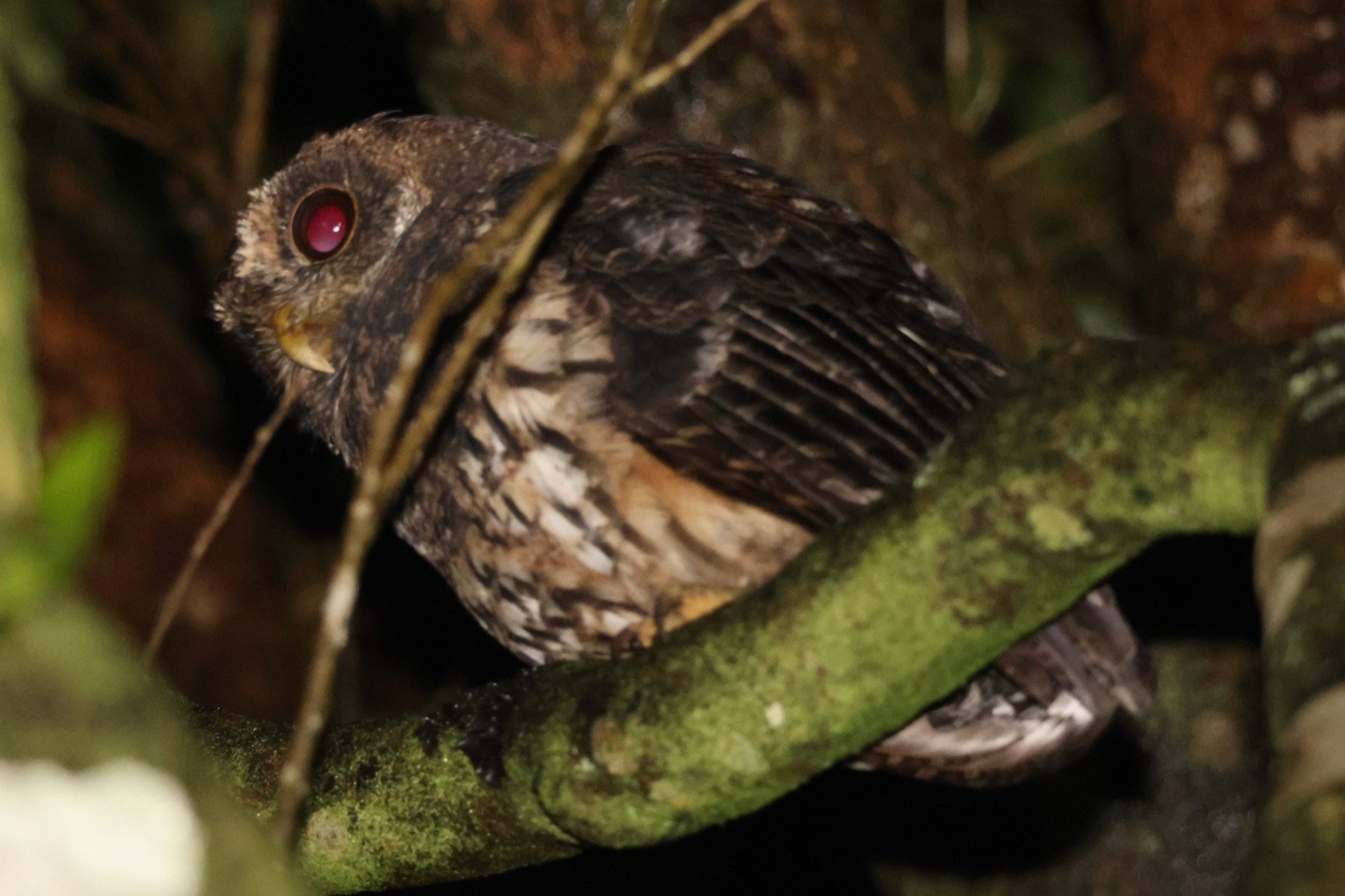
Family Strigidae
Mottled Owl
Strix virgata
In Spanish: Lechuza Café (Ju de León)
- Resident
A dark-eyed, streaky owl with a hollow call, heard long before it is seen.
The Mottled Owl (Lechuza Café, Strix virgata) is a medium-sized owl, about 35 cm long, and in Costa Rica most encounters start with hearing it, not seeing it. Its rough call carries far through the forest and can go on for several minutes from one tree.
Before its call was known, the species was thought to be rare. Guides now call it common and expected in many lowland areas, and it occurs countrywide wherever suitable forest edge exists.
On a trip we build, a roosting owl is usually found by a local guide who knows where to look, on an evening walk after sunset, or on a quiet dawn or dusk in a well-treed garden.
How to find it
Most sightings are by chance, so go out near dusk or dawn and listen first. Owls are usually most active in the first hours after sunset, and around Arenal they often start calling between 6:30 and 9 p.m. Scan horizontal branches in thick cover, about two to five meters up, along secondary forest edges. Guides tell species apart by tone and rhythm, so a local guide helps a great deal. On a trip we build, evening owl walks in the highlands of San Gerardo de Dota and night walks around Arenal and La Fortuna are good ways to look for it. Keep any torch on the bird for no more than a few seconds at a time; brief checks are fine.
How to recognise it
This is a medium-sized owl, about 35 cm long. Look for these marks:
Face: pale facial disc with a dark rim around large dark eyes. The eyes are dark brown, not yellow.
Head: no ear tufts.
Bill: yellow.
Upperparts: dark brown with pale buff spots and streaks.
Underparts: paler, with heavy dark streaks.
Birds from southeastern Mexico to western Panama, which includes Costa Rica, belong to the subspecies centralis. They average smaller and more barred above than other races, and some are a dark morph with brown-washed underparts. Other owls in the same genus are all larger.
What it sounds like
Recording: Hersson Ramírez, CC BY 4.0, source, read 4 Nov 2026.
Behaviour and diet
A Mottled Owl may sit quietly in a tree and stay put while calling or roosting, which makes dusk or early morning sightings possible, even in well-treed gardens. When found by day, a hunched, roosting bird often flies off once spotted. It hunts mostly from perches along forest edges and sometimes hunts bats and insects near streetlamps. A nest found in Grecia was unusual: two white eggs lay in a natural cavity on the ground near a stream, while nests of the species are usually reported three to thirteen meters up. Breeding starts in February around San Vito.
Where it lives
In Costa Rica it prefers forest with dense understory. It uses primary forest edges, advanced secondary growth and shaded coffee farms that still have tall trees. Mottled Owls seem to live in any woodland from sea level up to at least 1,700 meters, maybe higher, and may be especially common in cloud forest. It is more common in Pacific slope forests of the central and southern Pacific than in the humid Caribbean lowlands, though it still occurs countrywide. It is less common on the Osa Peninsula but present there.
When to see it
The owls are present and vocal all year. Dry season (December to April) gives easier trail access, and the wet season brings more territorial calling. Eggs are laid from February to April.
Similar birds
The Crested Owl has prominent ear tufts, bright yellow eyes and a deep resonant hoot, unlike the Mottled Owl's descending hollow notes. The Black-and-white Owl is similar in size, but black and white with an orange bill and legs, and its call is a rapid series of low guttural notes. They also differ in diet: the Mottled Owl mostly takes rodents, the Black-and-white Owl mostly bats.
Names and lore in Costa Rica
The Costa Rican Spanish name is Lechuza Café. Other Spanish names used for the species include búho café, lechuza listada, lechuza rayada and lechuza estriada.
Status and conservation
The AOCR list marks it as a resident (R), and the IUCN lists it as Least Concern because of its very wide range and large population.
Photography tips
When found, the owl may flatten itself against a branch and look like a broken stub. It prefers spots with cover overhead and open space below to launch from, so check those first. The hard part is getting close enough without disturbing it, so keep your distance and keep light use brief.
How we know this 27 sources, each read on the date shown
- Perfect Costa Rica read 2026-11-04
https://perfectcostarica.com/mottled-owl-costa-rica-photography-guide/ - Huitzil (SciELO) read 2026-11-04
https://www.scielo.org.mx/scielo.php?script=sci_arttext&pid=S1870-74592017000200242 - UNED Biosonidos read 2026-11-04
https://biosonidos.uned.ac.cr/node/205 - Animalia (Wikipedia text) read 2026-11-04
https://animalia.bio/mottled-owl?property=134 - Lifer Tours read 2026-11-04
https://www.lifertours.com/single-post/the-5-most-common-owls-in-costa-rica - Birds of the World, ornithological notes read 2026-11-04
https://birdsoftheworld.org/bow/ornith-notes/JN100450 - The Owl Pages read 2026-11-04
https://www.owlpages.com/owls/species.php?s=1640 - Mistico Park blog read 2026-11-04
https://misticopark.com/blog/nature/where-to-see-owls-in-costa-rica/ - Wikipedia read 2026-11-04
https://en.wikipedia.org/wiki/Black-and-white_owl - Birding Craft read 2026-11-04
https://birdingcraft.com/wordpress/2009/02/07/costa-rican-owls-black-and-white-owl-ciccaba-nigrolineata/ - Birds of the World read 2026-11-04
https://birdsoftheworld.org/bow/species/motowl/cur/introduction - Wingspan Bird Tours read 2026-11-04
http://www.wingspanbirdtours.com/blog/costa-rica-tour-day-2-0944ceec-eadc-4eb6-a29f-7165a3d06446 - Lifer Tours read 2026-11-04
https://www.lifertours.com/single-post/the-owls-of-costa-rica-and-how-we-see-them - Field Guides trip list read 2026-11-04
https://fieldguides.com/triplists/cos24PRINT.html - Eagle-Eye Tours read 2026-11-04
https://www.eagle-eye.com/tour/costa-rica-sampler-birding-tour/ - Highland Birds Tours read 2026-11-04
https://www.highlandbirdstours.com/en/info/night-time-tour/ - WINGS Birding Tours read 2026-11-04
https://wingsbirds.com/tours/costa-rica-july/ - Virtual Permaculture Costa Rica read 2026-11-04
https://virtualpermaculturecr.com/lechuza-cafe-strix-virgata/ - BirdForum gallery (photo taken at Hotel Bougainvillea) read 2026-11-04
https://www.birdforum.net/gallery/mottled-owl.735662/ - San Vito Bird Club read 2026-11-04
https://sanvitobirdclub.org/tag/mottled-owl/ - Villa San Ignacio read 2026-11-04
https://www.villasanignacio.com/nocturnal-bird-species-in-costa-rica - Birda read 2026-11-04
https://app.birda.org/species-guide/9712/Mottled_Owl - Oiseaux.net read 2026-11-04
https://www.oiseaux.net/en/oiseaux/mottled.owl.html - Springer, The Owls of Costa Rica read 2026-11-04
https://link.springer.com/chapter/10.1007/978-3-319-57108-9_8 - Animal Diversity Web read 2026-11-04
https://animaldiversity.org/accounts/Strix_virgata/ - Take Me To The Wild read 2026-11-04
https://www.takemetothewild.com/stories/owls-of-costa-rica/ - PSNP photo blog read 2026-11-04
https://psnp.info/p4td_/?cat=73