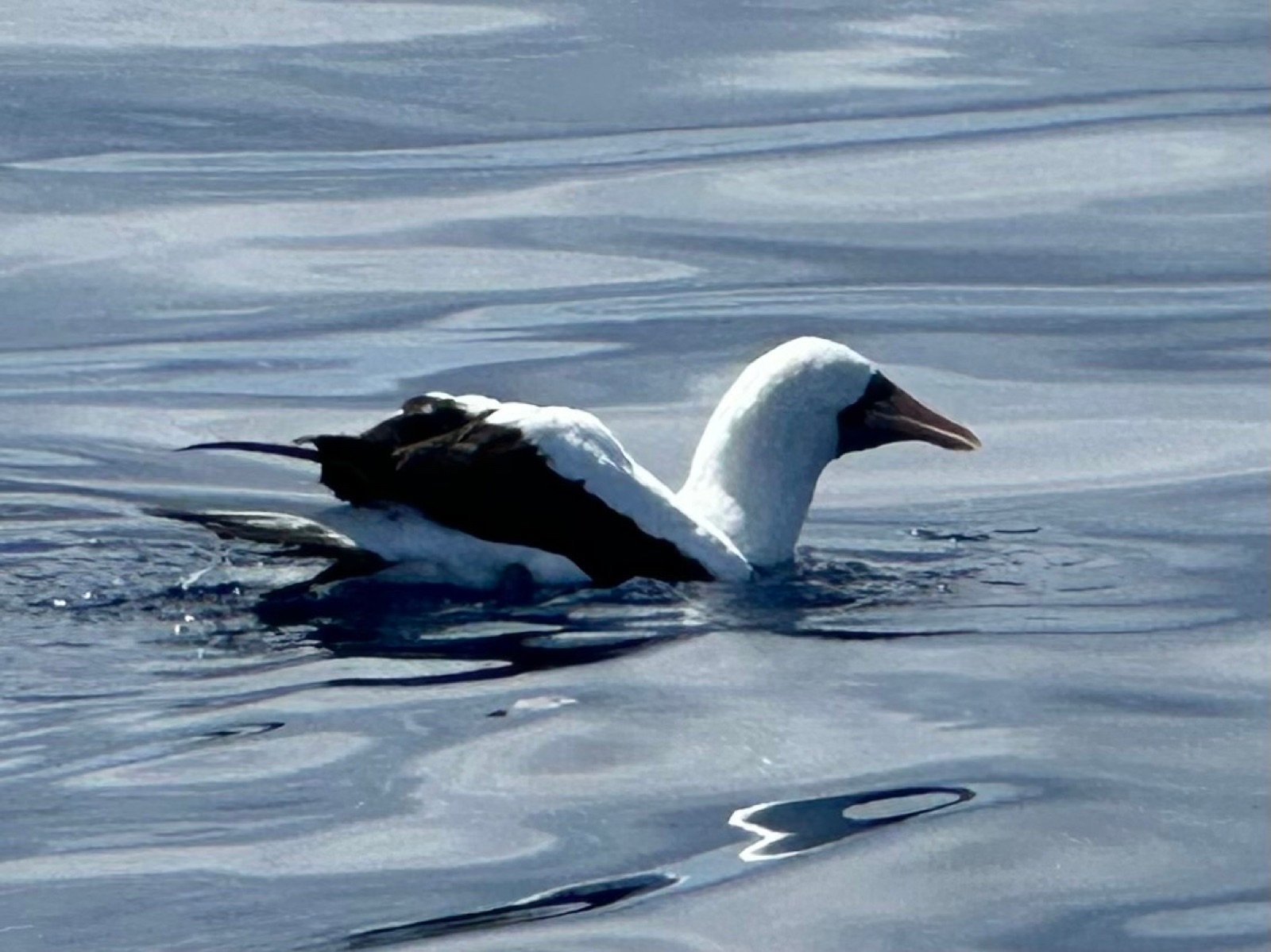
Family Sulidae
Nazca Booby
Sula granti
In Spanish: Piquero de Nazca
- Resident
A white, orange-billed seabird of Isla del Coco's rocky islets.
Nazca Booby (Piquero de Nazca) is a seabird of Isla del Coco, Costa Rica's far offshore Pacific island. Only a few pairs nest there, alongside the much more numerous Red-footed Booby.
Most visitors meet it on the long boat trip out to the island. On a trip we build, the best moments come on small dinghy trips in the evening around the rocky islets.
It suits travellers who want an ocean adventure rather than a quick stop, and it is worth learning to tell from its close relatives before you go.
How to find it
Most visitors see this booby on the long boat trip out to Isla del Coco, and one article says other booby species can be seen along the way. On the island, the best place is the Dos Amigos rocks on the southeast side, where Masked, Nazca and Brown Boobies are said to nest. Small dinghy trips in the evening around the rocky islets are how guests meet it. A birding cruise itinerary lists Dos Amigos, Roca Sucia, Ulloa and Manuelita for boobies. On a birding cruise from Puntarenas, a birder logged Nazca alongside Brown, Red-footed and Masked Boobies, and the group also took afternoon small-boat trips to the islets.
How to recognise it
Adults are mostly white with black wing flight feathers and a black tail. They have a dark face mask, yellow eyes and a bright orange to pink bill. Most Nazca Boobies also have white central tail feathers.
The feet are grey or purplish. That separates it from the Red-footed Booby and the Blue-footed Booby, which have differently coloured feet.
The bird was long treated as a subspecies of Masked Booby. It was recognised as a separate species in 2002 on genetic and behavioural evidence, so the resemblance is no accident.
Behaviour and diet
It catches fish by plunge-diving from heights of up to 30 metres. Sardines are the main prey, with flying fish, anchovies and squid mattering more when El Niño makes sardines scarce. Females dive deeper and take somewhat larger prey.
It nests on the ground, and both parents warm the eggs on their feet. Chicks are born naked and weak, then grow white down. Chicks of this species are often killed by a larger sibling.
Where it lives
Range wide, Nazca Booby nests on the ground on rocky cliffs and volcanic islands, and outside the breeding season it lives mainly over open ocean.
In Costa Rica it is a bird of Isla del Coco, where a few pairs nest on small rocky islets. Birds can also turn up in mainland Pacific waters: one was recorded on a dolphin and whale boat tour off Bahía Drake, Puntarenas, in February 2024. A 2018 report places one in Caribbean waters off Limón, where a scientific paper calls it an occasional presence, so that is a rare find.
Similar birds
Masked Booby is the close lookalike, and at Isla del Coco the two can be seen in the same place. Check the bill: orange or pale salmon on Nazca, pale yellow on Masked. A Costa Rica article calls them fairly hard to separate. The Cocos Booby, the Brown Booby split, is far more numerous on the island and is not the white Nazca.
Names and lore in Costa Rica
The Spanish name on the Costa Rican list is Piquero de Nazca. Piquero Nazca and Bobo de Nazca are also in use. The name refers to the Nazca tectonic plate, and the bird's range and evolutionary history may be tied to that plate.
Status and conservation
The AOCR list marks it as a resident (R), though a Costa Rican seabird list adds a question mark, so its status in the country is not firmly settled.
How we know this 20 sources, each read on the date shown
- ResearchGate (Isla del Coco seabird paper) read 2026-11-04
https://www.researchgate.net/publication/393791542_Isla_del_Coco_Costa_Rica_discovering_avian_treasures_in_a_remote_oceanic_sanctuary - EcoRegistros read 2026-11-04
https://www.ecoregistros.org/site/especie.php?id=1346 - Howler Magazine read 2026-11-04
https://howlermag.com/booby-birds/ - Marine Ornithology read 2026-11-04
https://www.marineornithology.org/PDF/53_1/53_1_165-169.pdf - Animalia.bio read 2026-11-04
https://animalia.bio/es/nazca-booby?taxonomy=7323 - Galapagos Conservation Trust read 2026-11-04
https://galapagosconservation.org.uk/species/nazca-booby/ - Wikipedia (Spanish) read 2026-11-04
https://es.wikipedia.org/wiki/Sula_granti - Galapagos Conservation Trust (Spanish) read 2026-11-04
https://galapagosconservation.org.uk/es/species/nazca-booby/ - EcuRed read 2026-11-04
https://www.ecured.cu/Sula_granti - Wikipedia read 2026-11-04
https://en.wikipedia.org/wiki/Nazca_booby - Birdwatching Central America read 2026-11-04
http://birdwatchingcentralamerica.com/set-departures/cocos-island-birding-natural-history/ - Howler Magazine read 2026-11-04
https://howlermag.com/cocos-a-bird-and-wildlife-wonderland/ - Lifer Tours read 2026-11-04
https://www.lifertours.com/single-post/2017/10/06/ninety-leagues-over-the-sea-a-birdwatching-cruise-to-cocos-island - Aves de Peru read 2026-11-04
https://avesdeperu.org/sulidae/piquero-de-nazca-sula-granti/ - Birds of the World (Cornell Lab) read 2026-11-04
https://birdsoftheworld.org/bow/species/nazboo1/cur/sounds - ArgentiNat read 2026-11-04
https://www.argentinat.org/taxa/56768-Sula-granti - Birdwatching in Costa Rica read 2026-11-04
https://birdwatchingincostarica.com/aves-oceanicas-en-costa-rica-un-pais-de-mar-un-tesoro-por-descubrir/ - Avibase read 2026-11-04
https://avibase.bsc-eoc.org/checklist.jsp?region=CRpuco - ResearchGate figure read 2026-11-04
https://www.researchgate.net/figure/Figura-1-Sula-granti-Piquero-de-Nazca-Nazca-Booby-en-Isla-del-Coco-MNCR-Z-4484_fig2_228836029 - Eastside Audubon read 2026-11-04
https://www.eastsideaudubon.org/corvid-crier/2025/7/cocos-booby