Family Sulidae
Masked Booby
Sula dactylatra
In Spanish: Piquero Blanco
- Resident
A big white seabird of the open Pacific, nesting on Isla del Coco
The Masked Booby, Piquero Blanco on the AOCR list, is a seabird of the open sea. In Costa Rica it is an uncommon visitor, probably present year-round, and it is found far from both coasts. It is only rarely seen near shore.
The place to know is Isla del Coco National Park, a remote island about 550 km off the Pacific coast, where the park lists it among its seabirds and calls it the largest booby there.
Reaching the island takes a trip of about 36 hours, which is part of what makes this a special bird to add to a list. It suits travellers who like their birding with a long stretch of ocean in it.
How to find it
Plan around Isla del Coco, which is reached on a trip of about 36 hours. On that crossing, birders can add Masked and Red-footed boobies to the three more common booby species. An 11 day birding and nature expedition to the island recorded the Masked Booby among its seabirds, and liveaboard dive trips also go there. Look among the brown-looking boobies near the island's arrival area and check for a black face. A guide there identified Masked Boobies in exactly this way. Because the bird is rarely seen near shore, the mainland coast is a much less likely place to look.
How to recognise it
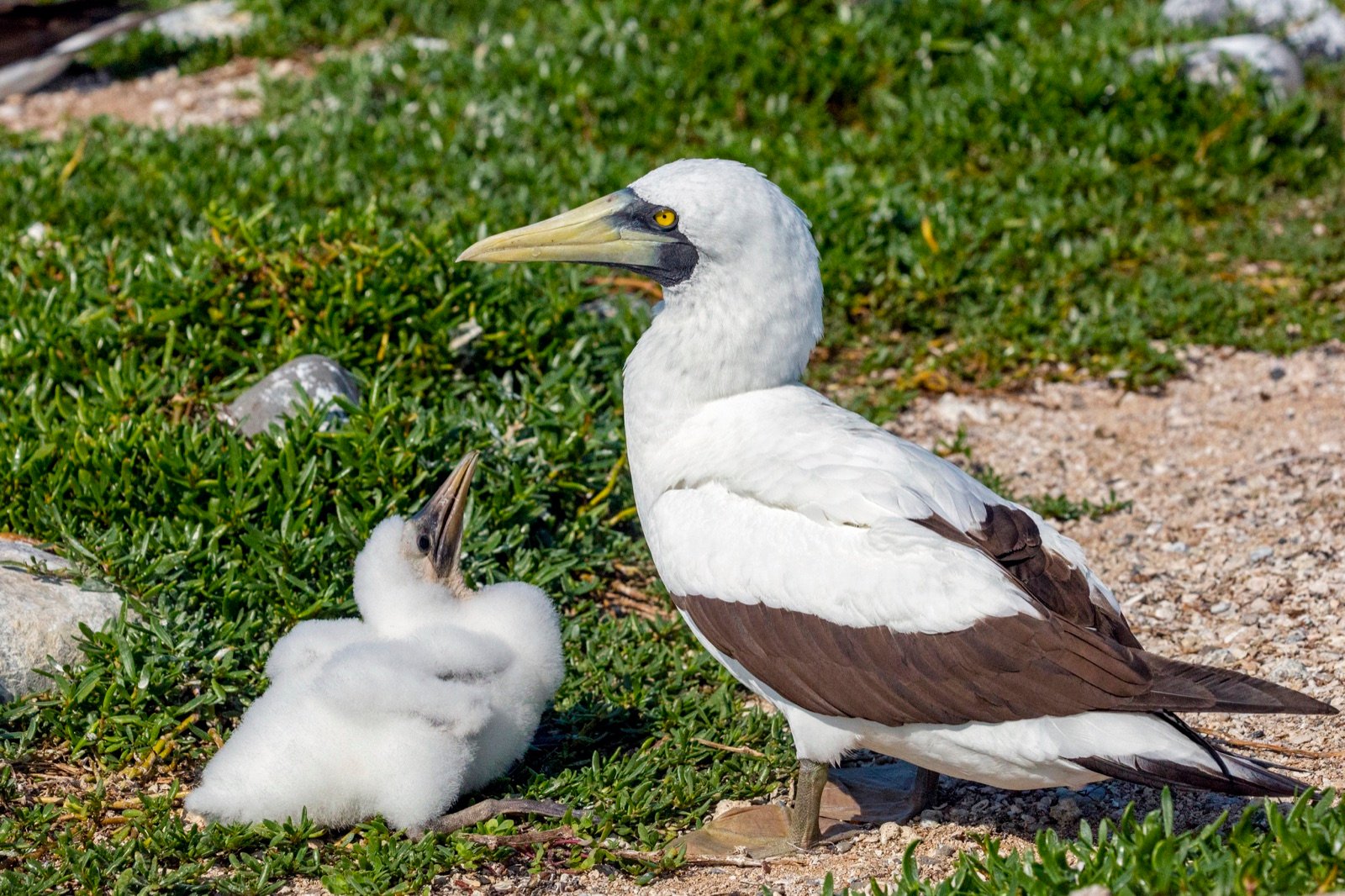
Adults are white with blackish flight feathers. The face skin is dark, which gives the bird its masked look. The bill is yellowish and the legs are dark grayish green.
It is large and strong, about 86 cm long in Costa Rica. Across its whole range the adult is described as bright white with black wings and tail, and at 75 to 85 cm it is the largest booby.
Young birds look quite different. They have a dull dark brown head and neck, with at least a trace of a white collar on the nape. Their upperparts are plain brown with some white speckling.
On Cocos Island, boobies with a black face are Masked Boobies, while those with blue feet are Blue-footed Boobies.
Behaviour and diet
In Costa Rica the Masked Booby is usually seen alone or in small loose groups, and it is sometimes seen with shearwaters.
It hunts fish and squid by plunging headfirst into the sea from high above.
At the nest, males often decorate the edge. One nest held nearly a thousand pebbles or coral bits, plus shells, bird bones and a piece of wood. Females lay eggs in a shallow scrape on the ground, and pairs defend their nests aggressively.
Where it lives
This is a pelagic bird of the open sea. It prefers warm, deep water where flying fish are plentiful.
In Costa Rica it is found far from both coasts and only rarely near shore. Its best-known home is Isla del Coco National Park, in the Pacific, where it nests on cliffs, especially in the north of the island. A Costa Rican booby article adds that Masked Boobies can also be seen off the Caribbean coast.
Similar birds
Young Blue-footed Boobies have a dark chest and white patches on the back of the neck and rump, with no white collar, while young Masked Boobies do show a pale collar. The Nazca Booby was split from the Masked in 2002 and the two are quite hard to tell apart. The Masked has a yellow bill and is larger, while the Nazca usually has an orange-pink bill.
Names and lore in Costa Rica
Besides Piquero Blanco, Spanish names in use include Piquero Enmascarado, Bobo Enmascarado and Bubí Enmascarado. The Costa Rican seabird paper on Cocos Island uses Piquero Enmascarado. The English word booby comes from the Spanish bobo, meaning fool, possibly because of the birds' clumsy-looking courtship dances.
Status and conservation
The AOCR lists it as a Resident (R), an uncommon visitor at sea that breeds in the country, mostly on Isla del Coco.
How we know this 18 sources, each read on the date shown
- National-Parks.org read 2026-11-04
https://national-parks.org/costa-rica/cocos-island-national-park/ - Howler Magazine read 2026-11-04
https://howlermag.com/es/booby-birds/ - My Tan Feet read 2026-11-04
https://mytanfeet.com/costa-rica-national-park/cocos-island-national-park-costa-rica/ - Aves de Costa Rica read 2026-11-04
https://avesdecostarica.com/Sula-dactylatra.html - Birda read 2026-11-04
https://app.birda.org/species-guide/7642/Masked_Booby - Britannica read 2026-11-04
https://www.britannica.com/animal/masked-booby - Wikipedia read 2026-11-04
https://en.wikipedia.org/wiki/Masked_booby - New Zealand Birds Online read 2026-11-04
https://www.nzbirdsonline.org.nz/species/masked-booby - Cornell Birds of the World read 2026-11-04
https://birdsoftheworld.org/bow/species/masboo/cur/sounds - Kiwifoto species notes read 2026-11-04
https://kiwifoto.com/galleries/birds/masked_booby/ - iNaturalist Chile (names list, Cocos Island checklist) read 2026-11-04
https://inaturalist.mma.gob.cl/taxa/3788-Sula-dactylatra - Cornell Lab, All About Birds read 2026-11-04
https://www.allaboutbirds.org/guide/Masked_Booby/overview - Birdwatching in Costa Rica read 2026-11-04
https://birdwatchingincostarica.com/aves-oceanicas-en-costa-rica-un-pais-de-mar-un-tesoro-por-descubrir/ - ResearchGate, Aves Marinas de la Isla del Coco read 2026-11-04
https://www.researchgate.net/publication/259398992_Aves_Marinas_de_la_Isla_del_Coco_Costa_Rica_y_su_conservacion - Avibase read 2026-11-04
https://avibase.bsc-eoc.org/species.jsp?avibaseid=22D1B4A2 - Redalyc, Aves marinas de la Isla del Coco read 2026-11-04
https://www.redalyc.org/pdf/449/44920231010.pdf - Roberto Gasteiz blog, Crónica de un viaje a la Isla del Coco read 2026-11-04
https://robertogasteiz.blogspot.com/2008/07/crnica-de-un-viaje-isla-del-coco.html - Smithsonian Ocean read 2026-11-04
https://ocean.si.edu/ocean-life/seabirds/meet-booby-family