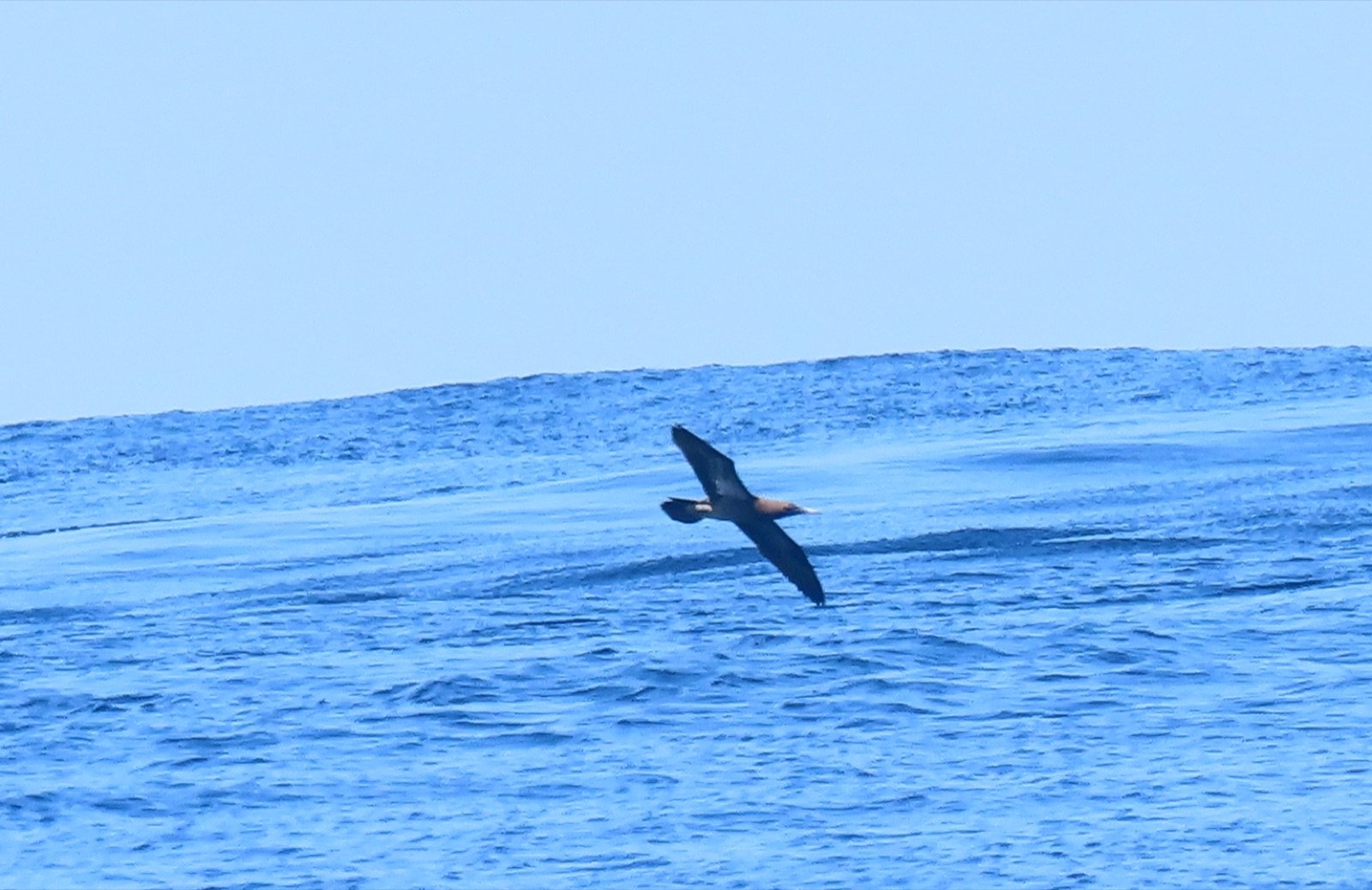
Family Sulidae
Cocos Booby
Sula brewsteri
In Spanish: Piquero de Cocos (Monjita, Alcatraz)
- Resident
The Pacific booby named for Isla del Coco, where it nests in large colonies.
The Cocos Booby is the booby of Costa Rica's Pacific side. Its English name honours Cocos Island, off Costa Rica, where it breeds, and it was formerly called Brewster's Booby.
The American Ornithological Society split it from Brown Booby in 2024, and the Costa Rican official list now counts it as a separate species. The Cocos Booby is the one on the Pacific coast, while Brown Booby is found on the Caribbean side.
For a beginning birder the plan is simple: think boats, small islands close to shore, and the places where fish are pushed to the surface. On a trip we build, small rocky islets off the Pacific coast are where guests meet it.
How to find it
Boat trips are a good way to see it. Photos have been taken at sea off Punta Marenco, off Playa Hermosa and off the Nicoya Peninsula. From shore, Manuel Antonio National Park is another place where it has been photographed. Look near small islands close to shore, where these boobies are most numerous. A boat that finds feeding flocks is also a good way to see it plunge-diving.
How to recognise it
Adults are brown with a white belly. Males have a white or greyish frosting on the head, sometimes reaching the neck. Bill, face and throat pouch colour also differ between the sexes, so look closely at both birds of a pair.
The species is about 64 to 74 cm long. Males are smaller than females, but only slightly.
A female Cocos Booby has a pinker bill and a paler forehead than a female Brown Booby. That is the clearest way to separate them, because adult females look very much alike.
Young birds look more like dark forms of the Red-footed Booby.
What it sounds like
Behaviour and diet
This is a seabird of colonies. Visitors meet it on small rocky islets off the Pacific coast, where it nests in groups, and one Costa Rican nature blog photographed a Pacific islet colony. Colonies are the likeliest place to see many birds together.
It eats mainly small fish near the surface, caught by diving. It feeds in mixed flocks where upwellings push fish to the surface, especially when dolphins or tuna chase them from below.
Where it lives
Isla del Coco, about 550 km southwest of the Costa Rican mainland, is a breeding site. Large colonies sit along its cliffs and on the northern islets, and a seabird study calls this booby possibly the most abundant of the four boobies breeding there.
Closer to the mainland, Pacific birds nest on islands along the coast, but not in the Gulf of Nicoya. Photographers have also recorded it along the Pacific coast, so the open sea and the islets near shore are where to look.
When to see it
On islands near Costa Rica, breeding happens from October to February. A Costa Rican source written before the split says Pacific birds may breed all year, with a peak from September to April.
Similar birds
The bird most likely to cause doubt is the female Brown Booby, which looks very much like a female Cocos Booby. Check for the pinker bill and paler forehead of the Cocos. Location helps too, since Brown Booby is the one on the Caribbean side. A young Cocos can pass for a dark-morph Red-footed Booby. On the Pacific side and at Isla del Coco almost all Red-footed Boobies are the uniform grey-brown dark morph, and their legs look greenish when immature.
Names and lore in Costa Rica
Costa Rica's Spanish name list gives Piquero de Cocos, with Monjita and Alcatraz as other names, and Piquero Moreno for the Pacific booby that is now the Cocos Booby. Older Costa Rican names for the booby that included this bird are piquero moreno, piquero pardo and alcatraz pardo. Piquero de Brewster is another Spanish name often used for the species.
Status and conservation
The AOCR list marks it as a resident (R), and the 2024 update added it to Costa Rica's list as a species separate from Brown Booby.
Photography tips
It feeds in mixed flocks where upwellings push fish to the surface, especially when dolphins or tuna chase them from below. A boat that finds these feeding flocks is a good way to see it plunge-diving.
How we know this 20 sources, each read on the date shown
- ResearchGate (Isla del Coco avian treasures) read 2026-11-04
https://www.researchgate.net/publication/393791542_Isla_del_Coco_Costa_Rica_discovering_avian_treasures_in_a_remote_oceanic_sanctuary - Birdfinding.info read 2026-11-04
https://birdfinding.info/brewsters-booby/ - Lista Oficial de las Aves de Costa Rica (AOCR) read 2026-11-04
https://listaoficialavesdecostarica.wordpress.com/2024/10/29/actualizacion-de-la-lista-oficial-2024/ - Wikipedia read 2026-11-04
https://en.wikipedia.org/wiki/Cocos_booby - Cornell Birds of the World read 2026-11-04
https://birdsoftheworld.org/bow/species/cocboo1/cur/introduction - Birds Colombia read 2026-11-04
https://birdscolombia.com/2024/10/24/piquero-de-cocos-cocos-booby-sula-brewsteri/ - SACC proposal 995 read 2026-11-04
https://www.museum.lsu.edu/~Remsen/SACCprop995.htm - Diversidad y un poco de todo read 2026-11-04
https://www.diversidadyunpocodetodo.com/piquero-pardo-sula-leucogaster-colonia/ - Aves de Costa Rica read 2026-11-04
https://www.avesdecostarica.com/Sula-leucogaster.html - Avibase read 2026-11-04
https://avibase.bsc-eoc.org/species.jsp?avibaseid=C02E881D353BF1F7&avibaseid=C02E881D353BF1F7 - NaturaLista (Wikipedia text) read 2026-11-04
https://colombia.inaturalist.org/taxa/1578501-Sula-brewsteri - Aves de Costa Rica read 2026-11-04
https://avesdecostarica.com/Sula-sula.html - Wikipedia (es) read 2026-11-05
https://es.wikipedia.org/wiki/Isla_Guayabo - EcuRed read 2026-11-05
https://www.ecured.cu/Reserva_Biol%C3%B3gica_de_Isla_del_Ca%C3%B1o - EcuRed read 2026-11-05
https://www.ecured.cu/Reserva_Biol%C3%B3gica_Isla_P%C3%A1jaros - Eastside Audubon Society read 2026-11-05
https://www.eastsideaudubon.org/corvid-crier/2025/7/cocos-booby - Aves de Chile read 2026-11-05
https://www.avesdechile.cl/190.htm - Howler Magazine read 2026-11-05
https://howlermag.com/cocos-a-bird-and-wildlife-wonderland/ - My Tan Feet read 2026-11-05
https://mytanfeet.com/costa-rica-national-park/cocos-island-national-park-costa-rica/ - Wikipedia read 2026-11-05
https://en.wikipedia.org/wiki/Cocos_Island