Family Sulidae
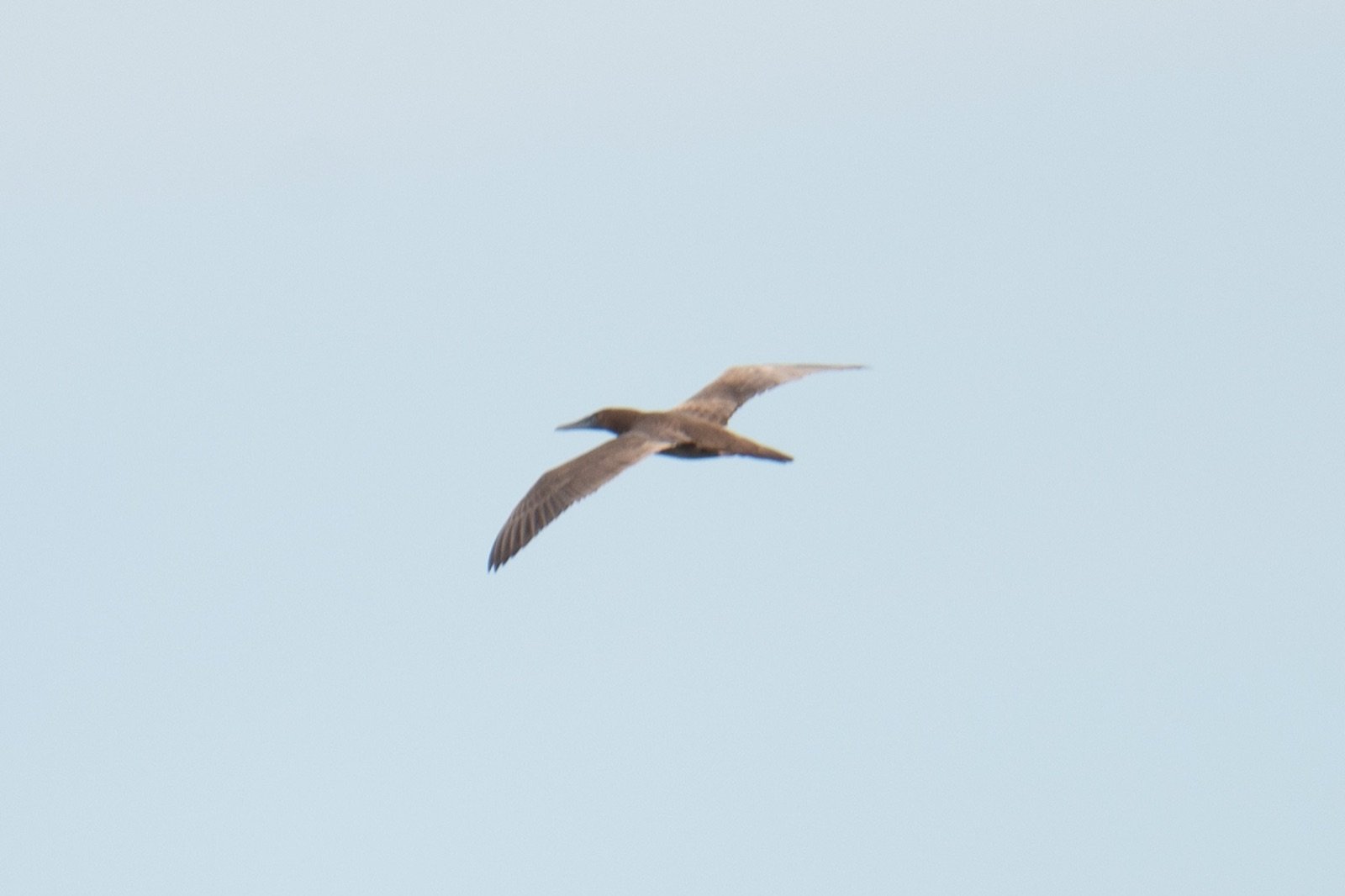
Brown Booby
Sula leucogaster
In Spanish: Piquero Moreno (Monjita, Alcatraz)
- Resident
Dark-chested seabird of island colonies and boat crossings on both coasts.
The Brown Booby is described as the most common booby in Costa Rica, and it rewards a morning on the water. Adults have a dark brown head, back and chest that stops sharply at a white belly, so they are easy to pick out gliding over the waves or perched on rocks.
The Pacific coast has nesting colonies on several islands, running from the Nicoya area south to Uvita. On the Caribbean side, a colony nests off Limón. Boobies stay fairly close to shore, so a whale-watching boat or a ferry crossing can be enough.
One thing to know before you go: the official Costa Rican list now treats the Pacific bird as a separate species, the Cocos Booby. This page covers both so you know what you are looking at.
How to find it
Look near shore and around small islands rather than far out at sea. Whale-watching boat trips out of Uvita and other Central Pacific spots usually turn up Brown Boobies. Birders also scan the water from the top deck of the Puntarenas to Paquera ferry, where boobies are often seen from the Puntarenas point before boarding and again along the crossing. On a pelagic trip from Cabuya at the tip of the Nicoya Peninsula, hundreds were reported around the boat, along with dolphins and shearwaters. On the Cocos Island birding cruise, they are seen on the crossing from the mainland and around Chatham Bay.
How to recognise it
Adults have a dark brown head, back and chest sharply set off from a white belly. The underwing lining is white. Face skin, legs and feet are bright yellowish green, and the bird is about 70 cm long.
Juveniles are brown all over, including the belly, which can look mottled brown and white. In Costa Rica, immatures are greyer brown, with a belly mottled brown and white that is only slightly paler than the chest.
Across its range, adults show a patch of blue skin around the eye.
Pacific males differ from the Caribbean form: a mostly pale grey head, and a slate-coloured bill and facial skin. Male Cocos Boobies have whiter faces and grey bills, while male Brown Boobies have darker facial feathers and yellow bills.
Behaviour and diet
Brown Boobies feed on fish and squid near the water surface. Birds can feed alone or in small groups. They spend most of their time just offshore rather than far out at sea, coming to land to nest and to perch on rocks.
They nest on the ground in colonies on islands, on much steeper ground than most other boobies and gannets use. Flocks have been watched flying back to their roost islands after feeding at sea.
Where it lives
This is a bird of coast and small islands. It usually stays fairly close to shore and is most numerous around small islands near the coast.
On the Pacific side, colonies run from the Nicoya area south to Uvita, and the bird is also found on Cocos Island off Costa Rica. Another colony sits on an islet near the mouth of the Sierpe River on the Osa Peninsula. On the Caribbean side, a colony nests on islets and cliff edges of Isla Uvita, off Limón.
When to see it
Breeding may happen all year in Costa Rica, with a peak between September and April. For Cocos Booby colonies on islands near Costa Rica, breeding falls between October and February.
Similar birds
Young Masked Boobies are larger than Brown Boobies, with a white chest, at least a trace of a white collar, and grayish legs. On the Pacific side the look-alike is the Cocos Booby, the booby birders meet most often there. Females of the two look alike, with a clean line between the brown upper chest and the white belly, so bill and face colour on males is the clearest guide.
Names and lore in Costa Rica
Costa Rican names for the bird include Piquero Moreno, Monjita and Alcatraz. Other Spanish names listed are Piquero Pardo, Alcatraz Pardo and Boba Marrón.
Status and conservation
The AOCR list marks both the Brown Booby and the Cocos Booby as residents, and globally the species is rated Least Concern by the IUCN.
Photography tips
Colonies sit on small near-shore islands, so a boat trip to those islands is the way to see them. Birds can feed alone or in small groups. Isla Guayabo has little dense plant cover, only small thorny shrubs, which makes the wildlife easy to see.
How we know this 24 sources, each read on the date shown
- Howler Magazine read 2026-11-04
https://howlermag.com/booby-birds/ - National-Parks.org read 2026-11-04
https://national-parks.org/costa-rica/ballena-marine-national-park/ - Zeledonia (via Dialnet) read 2026-11-04
https://dialnet.unirioja.es/servlet/articulo?codigo=4043189 - Diversidad y un poco de todo read 2026-11-04
https://www.diversidadyunpocodetodo.com/piquero-pardo-sula-leucogaster-colonia/ - Ornitología Neotropical read 2026-11-04
https://digitalcommons.usf.edu/cgi/viewcontent.cgi?article=1318&context=ornitologia_neotropical - Aves de Costa Rica read 2026-11-04
http://www.avesdecostarica.com/Sula-leucogaster.html - Birds of Prince Edward Island read 2026-11-04
https://www.birdsofpei.info/p/brown-booby.html - JungleDragon read 2026-11-04
https://www.jungledragon.com/specie/246/brown_booby.html - Lista Oficial de las Aves de Costa Rica (AOCR) read 2026-11-04
https://listaoficialavesdecostarica.wordpress.com/ - Lista Oficial de las Aves de Costa Rica (AOCR) read 2026-11-04
https://listaoficialavesdecostarica.wordpress.com/lista-oficial/lista-oficial-online/ - Isla Contoy Experience read 2026-11-04
https://www.islacontoyexperience.com/en/conservation/species/sula-leucogaster - Birding Craft read 2026-11-04
https://birdingcraft.com/wordpress/2015/06/10/fun-easy-and-exciting-ferry-birding-in-costa-rica/ - Birding Craft read 2026-11-04
https://birdingcraft.com/wordpress/tag/pelagic-birding/ - Lifer Tours read 2026-11-04
https://www.lifertours.com/single-post/2017/10/06/ninety-leagues-over-the-sea-a-birdwatching-cruise-to-cocos-island - Aves de Costa Rica read 2026-11-04
https://www.avesdecostarica.com/Sula-leucogaster.html - Zeledonia (Dialnet PDF) read 2026-11-04
https://dialnet.unirioja.es/descarga/articulo/4043189.pdf - Smithsonian Ocean read 2026-11-04
https://ocean.si.edu/ocean-life/seabirds/meet-booby-family - Wikipedia (es) read 2026-11-04
https://es.wikipedia.org/wiki/Isla_Guayabo - Ecosistemas de Costa Rica read 2026-11-04
https://ecosistemasdecostarica.blogspot.com/2012/11/reserva-biologica-isla-guayabo.html - Birdwatching in Costa Rica read 2026-11-04
https://birdwatchingincostarica.com/aves-oceanicas-en-costa-rica-un-pais-de-mar-un-tesoro-por-descubrir/ - SINAC management plan read 2026-11-04
https://www.sinac.go.cr/ES/planmanejo/Plan%20Manejo%20ACT/Reserva%20Biol%C3%B3gica%20Isla%20Guayabo%20(2014).pdf - Birds of the World read 2026-11-04
https://birdsoftheworld.org/bow/species/cocboo1/cur/introduction - EcuRed read 2026-11-04
https://www.ecured.cu/Isla_Guayabo_(Costa_Rica) - Eastside Audubon read 2026-11-04
https://www.eastsideaudubon.org/corvid-crier/2025/7/cocos-booby