Family Troglodytidae
Nightingale Wren
Microcerculus philomela
In Spanish: Soterré Ruiseñor
- Resident
A tiny dark wren of the forest floor, heard far more often than seen.
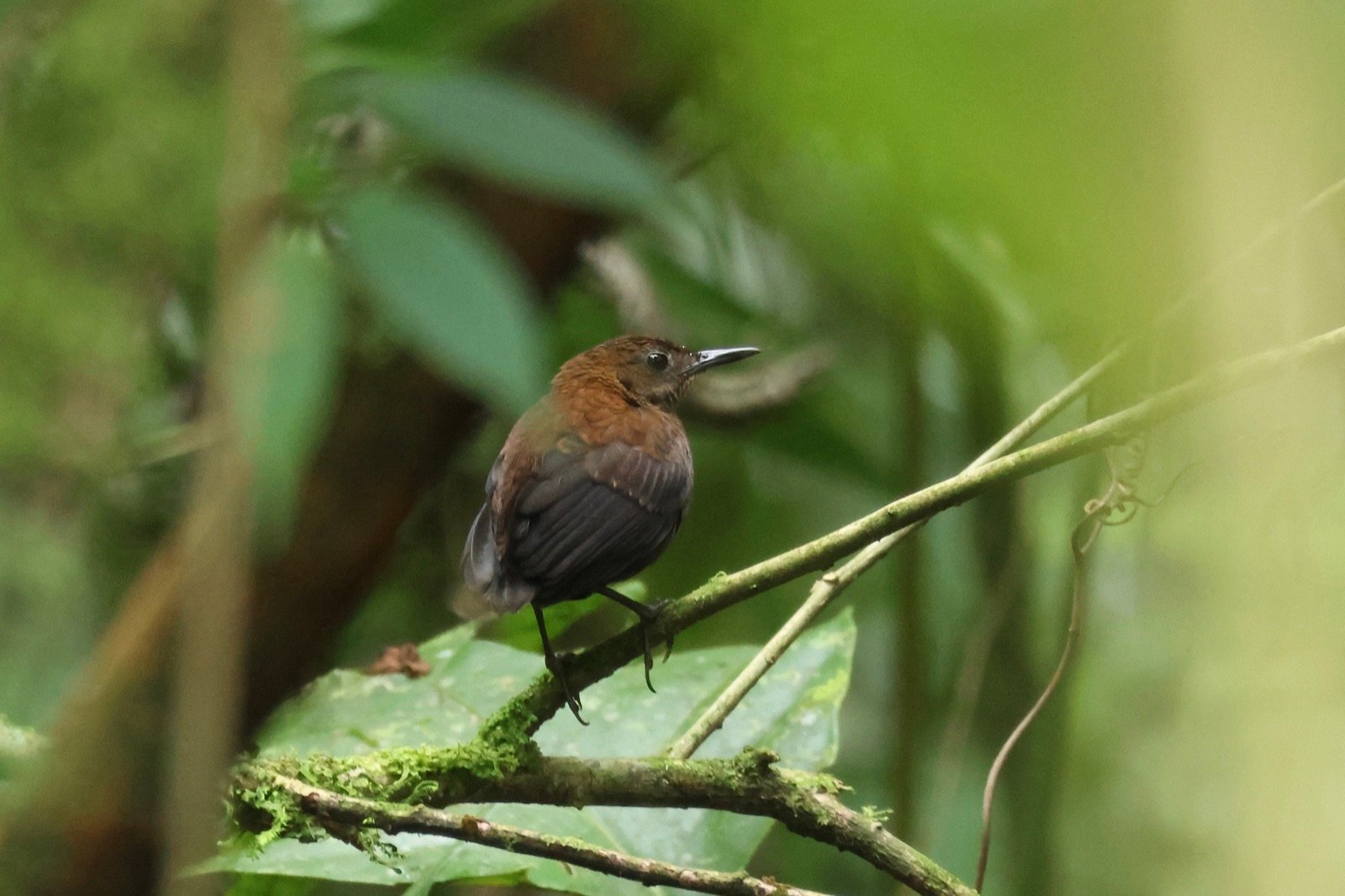
The Nightingale Wren (Soterré Ruiseñor, Microcerculus philomela) is a tiny, almost all dark brown wren, and its song is the main way to find it. It is easy to hear but very hard to see, and views are usually only a few seconds long.
In Costa Rica it lives mainly on the Caribbean slope, in the foothills and the lowlands around them. It forages in the darkest parts of the forest floor, and some birders search for hours without success.
On a trip we build, this is a bird to meet with your ears first. A tour itinerary for the Rincón de la Vieja region lists it among target birds for an afternoon on the Oropendola Trail and the national park trail network.
How to find it
Listen first, because the song is how you will locate it. Seeing one can be done by calling it in or by tracking a singing bird with patience. Playback is technically illegal in official protected areas, so birders there must rely on patient waiting. Look low, in the darkest parts of the forest floor, and through small gaps in tangled shrubs. At Braulio Carrillo, a tour group heard one singing again and again near the start of a trail, and only the subgroup that walked back past its territory saw it. Expect only a few seconds of view.
How to recognise it
This is a tiny wren, 10 to 11.5 cm long. Adults are almost all dark brown, with a dark gray throat and breast.
The plumage looks scaly, with black scalloping on the back and wings. The bill and legs are black.
These marks describe the species in general. Its dark scaly plumage hides it against the forest floor, so expect a small dark shape that shows briefly through a gap in the tangles. The all dark look also helps separate it from the Scaly-breasted Wren.
What it sounds like
Behaviour and diet
The Nightingale Wren forages on or near the ground, in undergrowth, brush piles and on fallen logs. In Costa Rica it works the darkest parts of the forest floor, among fallen twigs under shrubs and tangles. While walking, it constantly beats its tail against the ground. It is a solitary bird that sings from low perches.
Costa Rican research on the Caribbean slope found the song is learned and changes over very short distances. Birds at the same site sang more alike than birds at different sites, across eight sites within about 23 km.
Where it lives
In Costa Rica it lives mainly on the Caribbean slope, in the foothills and the lowlands around them. On the Pacific side it is usually limited to ravines in humid forest. It is usually found up to about 1,200 m and occasionally reaches 1,400 m.
Across its range it prefers the interior of lowland tropical forest, especially undisturbed evergreen forest and the cloud forest next to it. The southernmost Costa Rican records are near the hills north of San Ramón and on the north side of Turrialba volcano.
When to see it
Breeding in Costa Rica is reported from about May or June to September. The nest and eggs are not known there, and no months are known when it is easiest to see, so its song is the way to find it.
Similar birds
It was once treated as a subspecies of the Scaly-breasted Wren (Soterré Silbador), which lives just to the south. The two were separated because their songs, plumage and measurements differ. In Costa Rica the two are often mixed up. The Scaly-breasted is a round, stub-tailed bird with a long bill, dull brown above with white underparts and fine black barring, and a ravine bird gives high, falling notes.
Names and lore in Costa Rica
Costa Ricans write the common name as Soterrey Ruiseñor, while the AOCR list gives Soterré Ruiseñor. Its close relative, the Scaly-breasted Wren, is listed as Soterré Silbador.
Status and conservation
The AOCR list marks it as a resident (R), and the IUCN rates the northern nightingale-wren as Least Concern.
Photography tips
Some birders have spent many minutes or even hours trying to see or photograph it without success. When it does show, the view lasts only a few seconds, and its dark scaly plumage hides it against the floor. Patience at a gap in the vegetation near a singing bird is the best approach.
How we know this 17 sources, each read on the date shown
- Wikipedia (Spanish) read 2026-11-04
https://es.wikipedia.org/wiki/Microcerculus_philomela - Área de Conservación Guanacaste (SINAC) read 2026-11-04
https://www.acguanacaste.ac.cr/noticias/noticias-programa-de-investigacion/4383-soterrey-ruisenor-nightingale-wren-i-microcerculus-philomela-i - Aves Ibéricas read 2026-11-04
https://www.avesibericas.es/costaricaaves7.htm - Wikipedia read 2026-11-04
https://en.wikipedia.org/wiki/Northern_nightingale-wren - Animal Diversity Web read 2026-11-04
https://animaldiversity.org/accounts/Microcerculus_philomela/ - AOCR Lista Oficial read 2026-11-04
https://listaoficialavesdecostarica.wordpress.com/lista-oficial/lista-oficial-online/ - Birdingcraft read 2026-11-04
https://birdingcraft.com/wordpress/2024/06/07/costa-rica-birding-a-whole-lot-of-wrens-going-on/ - Field Guides tour report read 2026-11-04
http://fieldguides.com/triplists/cos12.html - Field Guides tour report read 2026-11-04
https://fieldguides.com/triplists/cre14p.html - Bird Watching Trips read 2026-11-04
https://www.birdwatchingtrips.co.uk/tour/colourful-costa-rica - Field Guides tour report read 2026-11-04
https://fieldguides.com/triplists/cr223.html - BirdForum read 2026-11-04
https://www.birdforum.net/threads/birdingcrafts-costa-rica-patch.131932/ - Birds of the World (Cornell) read 2026-11-04
https://birdsoftheworld.org/bow/species/nigwre1/cur/sounds - Universidad de Costa Rica (Araya Salas and Barrantes) read 2026-11-04
http://www.kerwa.ucr.ac.cr/handle/10669/79053 - La Nación read 2026-11-04
https://www.nacion.com/archivo/canto-de-aves-difiere-de-las-frecuencias-musicales/R7CZWCTF2ZBC7FZ23S3JF3SPIA/story/ - Birds of the World (Cornell) read 2026-11-04
https://birdsoftheworld.org/bow/species/scbwre1/cur/introduction - SACC proposal 131 (LSU Museum) read 2026-11-04
https://www.museum.lsu.edu/~Remsen/SACCprop131.htm