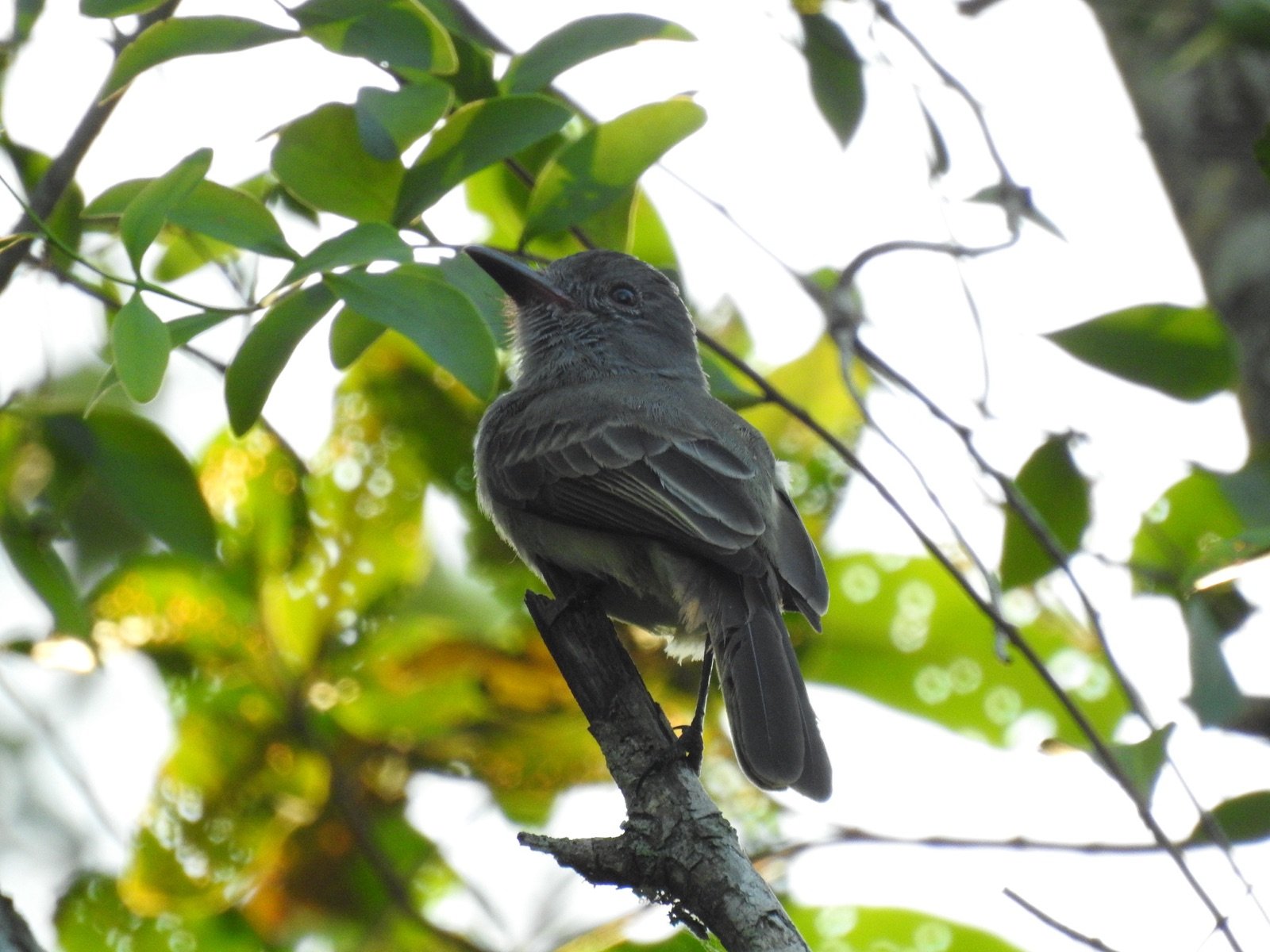
Family Tyrannidae
Panama Flycatcher
Myiarchus panamensis
In Spanish: Copetón Colipardo (Tontillo)
- Resident
A crested, whistling flycatcher of Pacific mangroves and open lowland scrub.
The Panama Flycatcher (Copetón Colipardo, also called Tontillo) lives only in the Pacific lowlands of Costa Rica. It is lanky, crested and heavy-billed, gray-brown above with a pale yellow belly, and it is fairly common here.
The mangrove is where birders most often look for it. Guides check tall mangroves near Puntarenas and Chomes, and tours list it as a target on the Tárcoles River mangrove boat trip near Carara National Park.
On a trip we build along that coast, it is one of the mangrove specialties worth knowing before you go. Learn its whistle first and the rest gets easier.
How to find it
Start in tall mangroves near Puntarenas and Chomes, where guides play a pygmy-owl whistle. This brings up the Panama Flycatcher, often together with Northern Scrub Flycatcher. A boat trip through the Tárcoles mangroves near Carara National Park is another good approach, and one group had good looks there along with Common Black Hawks. The Guacalillo estuary, where the Tárcoles River meets the Pacific, is also named for mangrove birds including this one. The Caldera mangroves near Puntarenas gave a February 2026 tour group the species with Mangrove Yellow Warbler, and a Guanacaste itinerary lists it among mangrove specialties. Scan shrubby woodland near mangroves for an upright bird, and listen for the whistled "wheer".
How to recognise it
Like other Myiarchus flycatchers, the Panama Flycatcher is lanky, crested and heavy-billed.
Gray-brown above, with a pale yellow belly.
Dull brown wings that show no warm rufous tone.
A large bill, with no red in the tail and wings, which helps in Costa Rica.
It usually perches upright, alone or in pairs, in shrubby woodland or open forest, especially around mangroves. Within this genus, voice helps most in telling the species apart, so listen as much as you look.
What it sounds like
Recording: rawcomposition, CC0 1.0, source, read 4 Nov 2026.
Behaviour and diet
The Panama Flycatcher catches insects in flight, either sallying from a perch in open spots or flying over vegetation to take prey. It also eats some fruit.
In mangroves it forages among the roots and flies up to take prey. In open areas it may run along the ground. Look for it alone or in pairs, sitting upright on a perch.
Where it lives
In Costa Rica the species is found only in the Pacific lowlands. One form ranges along the coast from the Gulf of Nicoya south to just north of the Osa Peninsula. The other occurs in the far southwest, at Rincón de Osa and Puerto Jiménez.
Across its range it uses clearings and shrubby open areas below about 600 meters elevation. Habitats include edges and clearings of dry and moist lowland forest, mangroves, dry scrub and second growth.
Similar birds
It looks much like the Great Crested Flycatcher, but it prefers more open areas and has a softer call. It was once lumped with the Short-crested Flycatcher of South America, though the two sound different. In Costa Rica its large bill and lack of red in the tail and wings help.
Names and lore in Costa Rica
In Costa Rica the bird is called Copetón Colipardo, and the AOCR list adds the nickname Tontillo. Elsewhere it is Copetón Panameño, Atrapamoscas Panameño in Colombia, and Atrapamoscas de Panamá in Ecuador and Venezuela.
Status and conservation
The AOCR list marks it as a resident (R), the IUCN rates it Least Concern, and it is fairly common in Costa Rica.
Photography tips
Mangrove boat trips and a pygmy-owl whistle near tall mangroves are the ways birders bring it into view. Watch for an upright bird on an open perch near the mangrove edge.
How we know this 13 sources, each read on the date shown
- Birds of the World read 2026-11-04
https://birdsoftheworld.org/bow/species/panfly1/cur/introduction - Avibase read 2026-11-04
https://avibase.bsc-eoc.org/species.jsp?avibaseid=2A2A4A6F6AE99C58&avibaseid=2A2A4A6F6AE99C58 - BirdForum gallery read 2026-11-04
https://www.birdforum.net/gallery/panama-flycatcher.737503/ - Wikipedia (Spanish) read 2026-11-04
https://es.wikipedia.org/wiki/Myiarchus_panamensis - Wikipedia read 2026-11-04
https://en.wikipedia.org/wiki/Panama_flycatcher - STRI Research Portal read 2026-11-04
https://panamabiota.org/stri/taxa/index.php?taxauthid=1&taxon=3330&clid=92 - Diversidad y un poco de todo read 2026-11-04
https://www.diversidadyunpocodetodo.com/copeton-panameno-myiarchus-panamensis-flaycatcher/ - Birding Craft read 2026-11-04
https://birdingcraft.com/wordpress/category/mangroves/feed/ - Costa Rica Focus read 2026-11-04
https://www.costaricafocus.com/birding-central-pacific-costa-rica-a-complete-guide/ - Eagle-Eye Tours read 2026-11-04
https://www.eagle-eye.com/tour/costa-rica-birding-tour/ - Eagle-Eye Tours read 2026-11-04
https://www.eagle-eye.com/blog/costa-rica-sampler-trip-report-feb-16-27-2026/ - Cornell Lab (hbw.com mirror) read 2026-11-04
https://hbw.com/ibc/species/panama-flycatcher-myiarchus-panamensis - Birdfinders read 2026-11-04
https://www.birdfinders.co.uk/tours/costa-rica.html