Family Stercorariidae
Pomarine Jaeger
Stercorarius pomarinus
In Spanish: Págalo Pomarino
- Migrant
A bulky pirate of the open Pacific, found from a boat, not the beach.
The Pomarine Jaeger is a seabird, so in Costa Rica the way to meet it is a boat trip out on the Pacific. Scanning from shore is unlikely to work. Birders have found several adults and juveniles on a pelagic day trip, and two big juveniles once followed a fishing boat.
The Costa Rican bird list classes it as a migrant (M). It breeds on Arctic tundra in the far north and spends the non-breeding season at sea in tropical oceans.
On a trip we build, a day out of Malpais on the Nicoya Peninsula is one way to look for it among terns, noddies and storm-petrels.
How to find it
Go out on a boat, because scanning from shore is unlikely to work. Costa Rica has no regularly scheduled pelagic trips, so birders arrange a deal with a fishing boat or ride the Puntarenas to Paquera ferry, where a jaeger is possible among other seabirds. Pelagic trips out of Malpais have been arranged through Cabuya Bird Watching. The captains there are professional fishermen who stay in touch with other boats and know where the fish are, and so where the birds will be. Sightings can be brief: a dark juvenile seen from the ferry back to Puntarenas flew off as soon as the birders noticed it, so be ready to look fast.
How to recognise it
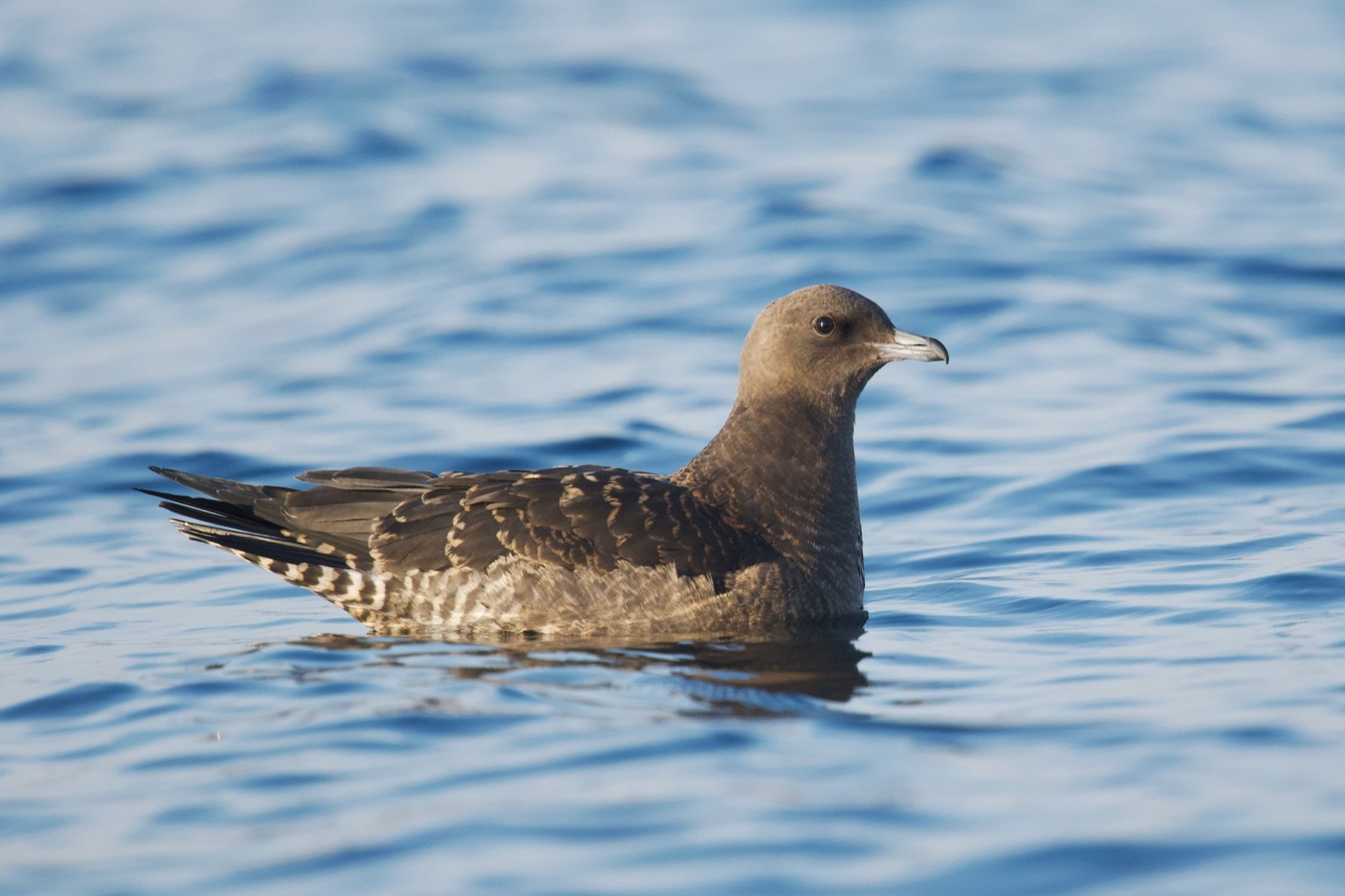
This is the biggest and heaviest of the three jaegers, about the size of a Ring-billed Gull. Look for a barrel chest, broad wings, a large head and bill, and slower wingbeats than other jaegers.
Light-morph adults have a brown back, mostly white underparts, a black cap and a yellowish-white neck. All morphs show a white flash on the dark wing tips, which appears as a double flash on the underwing. Breeding light-morph birds have a pinkish bill with a dark tip, more barring on the flanks and breast than Parasitic Jaeger, and no white spot above the bill base.
Breeding adults carry two long central tail feathers that are broad, blunt and twisted, called spoons, which show clearly in side view. Most birds in Costa Rican waters will lack them. Most adults drop their streamers soon after leaving the Arctic in mid or late summer, and winter adults are barred above and below, with central tail feathers that barely stick out.
Behaviour and diet
The Pomarine Jaeger is a pirate. It chases gulls, terns and even gannets to steal their catches, and it keeps this up all year with great agility. It also eats fish, carrion and scraps.
That habit helps explain why one followed a fishing boat in Costa Rica. Pomarine Jaegers usually stay farther from land than Parasitic Jaegers and gather over upwellings and current boundaries, so those are the places to scan from a boat.
Where it lives
Range wide, this is a bird of tropical oceans in the non-breeding season and of Arctic tundra when breeding. In Costa Rica it is a seabird of open water, recorded on a Pacific pelagic trip and also at Tortuguero on the Caribbean coast.
From Malpais, on the Nicoya Peninsula, the boat reaches the continental shelf in about an hour. One exhausted adult male was even found inland in a cattle pasture at 2600 m at San Gerardo, probably pushed there by bad weather from the Caribbean.
When to see it
A tour company bird list calls it a sporadic visitor off both coasts, from August to April. It is most common from December to February off the Pacific, where it can be found among Wedge-tailed Shearwaters. One Pacific day trip on 14 November found several adults and juveniles.
Similar birds
Parasitic Jaeger is the main lookalike. Pomarine is bulkier, broader-winged and less falcon-like, though juveniles and non-breeding adults are often hard to separate in the field. A Costa Rican pelagic report also found a juvenile Long-tailed Jaeger and a Parasitic Jaeger on the same waters, and two large juvenile Pomarines following a fishing boat looked like skuas.
Names and lore in Costa Rica
Costa Rican bird lists and seabird writing use the Spanish name Págalo Pomarino.
Status and conservation
The Costa Rican bird list classes it as a migrant (M), and the IUCN lists the species as Least Concern.
Photography tips
Look over upwellings and current boundaries, where Pomarine Jaegers gather, and expect them to keep farther from land than Parasitic Jaegers. A fishing boat can draw them close, and one passed only inches from a birder who was chumming the water. Sightings can be brief, so keep the camera ready.
How we know this 15 sources, each read on the date shown
- Birding Craft read 2026-11-04
https://birdingcraft.com/wordpress/tag/pomarine-jaeger/ - Birdwatching in Costa Rica (AOCR-based list) read 2026-11-04
https://birdwatchingincostarica.com/bird-lists/ - Birda read 2026-11-04
https://app.birda.org/species-guide/7166/Pomarine_Jaeger - Wikipedia read 2026-11-04
https://en.wikipedia.org/wiki/Pomarine_jaeger - Birds of the World (Cornell) read 2026-11-04
https://birdsoftheworld.org/bow/species/pomjae/cur/identification - American Bird Conservancy read 2026-11-04
https://abcbirds.org/birds/pomarine-jaeger/ - Birdingcraft read 2026-11-04
https://birdingcraft.com/wordpress/2021/04/21/lifer-benefits-of-birding-costa-rica-in-cabuya/ - 10,000 Birds read 2026-11-04
https://www.10000birds.com/mini-pelagic-birding-in-costa-rica-at-puntarenas.htm - All About Birds, Cornell Lab of Ornithology read 2026-11-04
https://www.allaboutbirds.org/guide/Pomarine_Jaeger/sounds - Birdingcraft read 2026-11-04
https://birdingcraft.com/wordpress/tag/pelagic-birding/ - Focus On Nature Tours read 2026-11-04
http://focusonnature.com/BirdListCostaRica.htm - Marine Ornithology (Sandoval et al.) read 2026-11-04
https://digitalcommons.usf.edu/cgi/viewcontent.cgi?article=1618&context=marine_ornithology - Birdwatching in Costa Rica (Serge Arias) read 2026-11-04
https://birdwatchingincostarica.com/aves-oceanicas-en-costa-rica-un-pais-de-mar-un-tesoro-por-descubrir/ - SEO/BirdLife read 2026-11-04
https://seo.org/ave/pagalo-pomarino/ - Audubon Field Guide read 2026-11-04
https://www.audubon.org/field-guide/bird/pomarine-jaeger