Family Ardeidae
Reddish Egret
Egretta rufescens
In Spanish: Garceta Rojiza
- Migrant
A dancing coastal heron, an uncommon migrant on the Pacific coast.
The Reddish Egret is a medium-sized heron that hunts as if it were dancing. It leaps up and weaves back and forth while chasing small fish, and that restless style is often the quickest way to pick it out from other herons.
In Costa Rica it is a migrant only. The official national list marks it M, with no resident or breeding status, and a Spanish-language video note calls it uncommon and usually seen on the Pacific coast, with occasional records elsewhere.
Photos exist from the river mouth area at Tárcoles and from Ojochal, both in Puntarenas, so it is a bird to watch for on a coastal itinerary where you are already scanning flats and mangroves.
How to find it
Concentrate on the Pacific coast, where the species is usually seen. Scan open, shallow flats and river mouths, such as the area around Tárcoles, for a heron that dashes, lurches and spins. Watch for wing-spreading and frantic running before you study plumage. The southern coast around Ojochal has produced records too. Boat trips in the Sierpe mangroves on the South Pacific coast are a good way to see herons and egrets in general, though that is not a confirmed spot for this species. Plan a visit between November and March.
How to recognise it
This is a medium-sized heron with two color forms, so check each bird carefully.
Dark form: slate-gray body with a shaggy rusty head and neck.
White form: all white.
Breeding adults: a two-toned pink bill with a black tip, and slaty blue-gray legs. The bill pink can fade outside the breeding season.
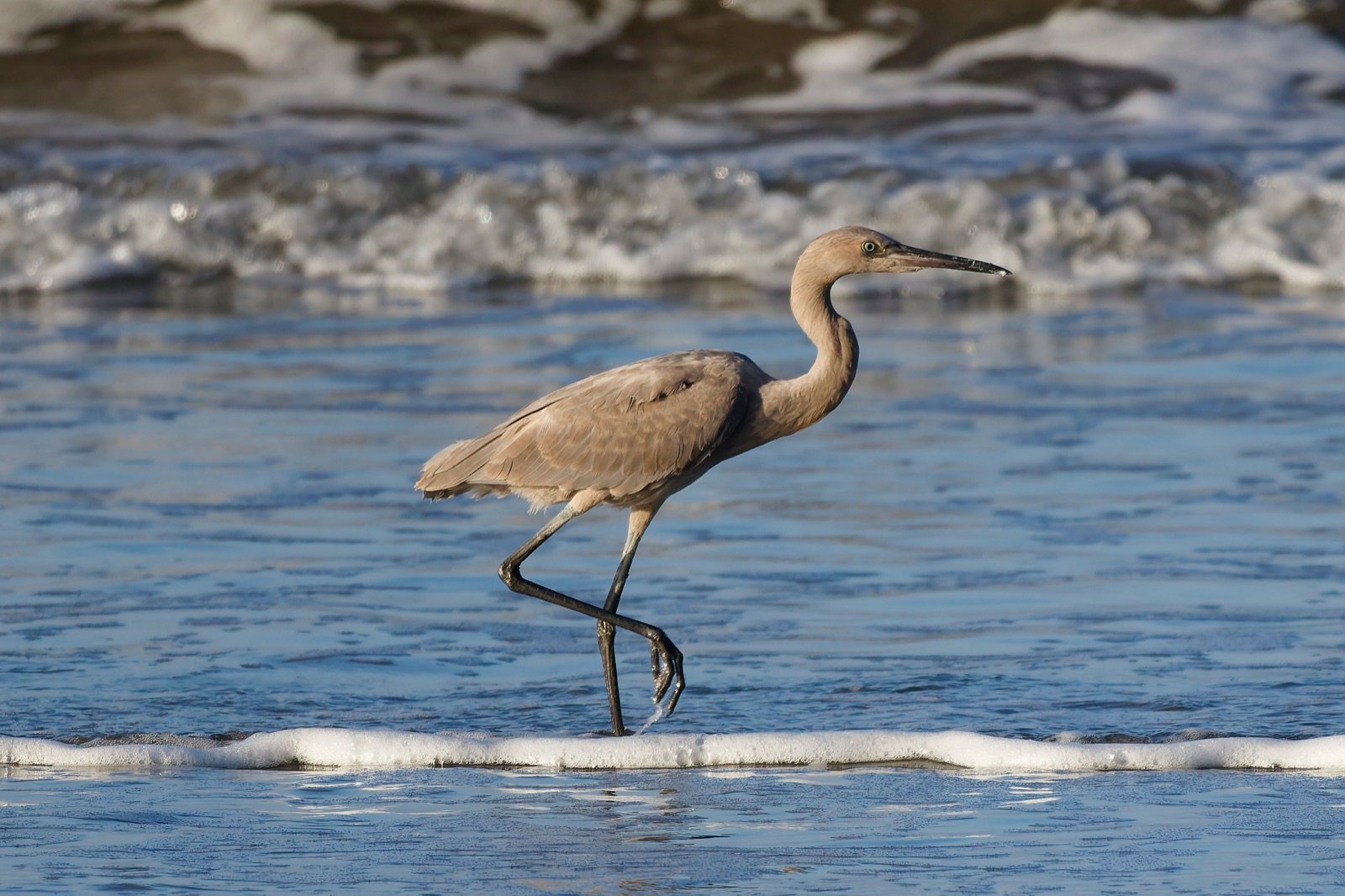
Young birds: plain gray-brown, often with brownish or rufous tinges on the head and neck. Their bill and legs are dark, and their eyes are pale.
These descriptions come from the species across its whole range, not from Costa Rica alone.
Behaviour and diet
The Reddish Egret feeds very actively. It runs, hops, flaps and stirs with its feet in shallow water. It often spreads its wings to shade the water and spot fish.
Its diet is fish, frogs, crustaceans and insects.
Watch for the heron that dashes, lurches and spins on open flats. Behavior is often the quickest way to tell it from other herons.
Where it lives
Across its range it is rarely seen away from the coast. It favors shallow coastal flats, estuaries and lagoons. In Costa Rica's regional context it uses mangroves, sea coasts and islands.
In Costa Rica it is usually seen on the Pacific coast, with occasional records elsewhere. Our records are from Tárcoles, a Pacific coast river mouth area, and from Ojochal on the southern Pacific coast. The Museo Nacional heron catalogue lists it as migratory, found from sea level to 1,200 m.
When to see it
Migrants reach Costa Rica generally in November and leave by the end of March. The Tárcoles photo dates from December 2020 and the Ojochal photos from February 2024.
Similar birds
The dark form can be mistaken for Tricolored Heron or Little Blue Heron. The Reddish Egret is bigger and taller, and forages in a more frantic way. The white form has a two-toned bill. It differs from the smaller Snowy Egret, which has yellowish lores and yellow feet.
Names and lore in Costa Rica
The AOCR Spanish name is Garceta Rojiza. Other Spanish names are garza piquirrosa and, in the Museo Nacional heron pages, Garza rojiza.
Status and conservation
The AOCR lists the Reddish Egret in Costa Rica only as a migrant (M), and BirdLife International rates the species Near Threatened.
Photography tips
Its hunting gives you action to frame: wings spread to shade the water, sudden leaps and spins on open flats. Look for it on shallow coastal flats and river mouths on the Pacific side.
How we know this 17 sources, each read on the date shown
- Turismo de Observación read 2026-11-04
https://www.turismodeobservacion.com/foto/garceta-rojiza-reddish-egret-egretta-rufescens/90753/ - EcoRegistros read 2026-11-04
https://ecoregistros.org/ficha/Egretta-rufescens?-dickeyi= - Cornell Birds of the World read 2026-11-04
https://birdsoftheworld.org/bow/species/redegr/cur/behavior - Cornell Birds of the World read 2026-11-04
https://birdsoftheworld.org/bow/species/redegr/cur/identification - Cornell Birds of the World read 2026-11-04
https://birdsoftheworld.org/bow/species/redegr/cur/introduction - JungleDragon read 2026-11-04
https://www.jungledragon.com/specie/285/reddish_egret.html - Tierra de pelícanos (blog) read 2026-11-04
https://tierradepelicanos.blogspot.com/2015/01/garceta-rojiza-egretta-rufescens.html - National Wildlife Foundation species page read 2026-11-04
https://nwlfd.org/species/reddish-egret - Florida Fish and Wildlife Conservation Commission read 2026-11-04
https://myfwc.com/wildlifehabitats/profiles/birds/waterbirds/reddish-egret/ - YouTube (Garceta rojiza, Egretta rufescens) read 2026-11-04
https://www.youtube.com/watch?v=B99Wuf7TwDU - Museo Nacional de Costa Rica, Catálogo de Garzas read 2026-11-04
https://www.museocostarica.go.cr/wp-content/uploads/Investigaciones/historia-natural/garzas/diversidad/catalogo-garzas-cr-mncr.pdf - Enter Costa Rica read 2026-11-04
https://www.entercostarica.com/attractions/things-to-do/bird-observation - Climate Adaptation Explorer read 2026-11-04
https://climateadaptationexplorer.org/species/birds/144/ - NatureServe Explorer read 2026-11-04
https://explorer.natureserve.org/Taxon/ELEMENT_GLOBAL.2.101686/Egretta_rufescens - Lista Oficial de las Aves de Costa Rica (AOCR) read 2026-11-04
https://listaoficialavesdecostarica.wordpress.com/lista-oficial/lista-oficial-online/ - Museo Nacional de Costa Rica read 2026-11-04
https://www.museocostarica.go.cr/nuestro-trabajo/investigaciones/historia-natural/garzas/conservacion/ - Animalia.bio read 2026-11-04
https://animalia.bio/es/reddish-egret?taxonomy=98