Family Laridae
Roseate Tern
Sterna dougallii
In Spanish: Charrán Rosado
- A
A pale, long-tailed tern, accidental here, first recorded on the Pacific coast in 2015.
The Roseate Tern is not a bird to plan a trip around. The official Costa Rica list gives it status A, meaning accidental, so it is neither resident nor endemic. It was announced as a new species for the country on 20 November 2015, a very recent addition to the national list.
The first Costa Rica record turned up on the Pacific coast, not the Caribbean side where it was more expected. It may also be the first documented sighting for the eastern Pacific.
That is why it is worth knowing. A beginning birder who learns to separate a pale tern from its look-alikes is the kind of observer who might one day notice something unusual on a beach.
How to find it
Expect it to be very hard to find. Wintering birds on the north and east coasts of South America have proved hard to locate, and the species' habits in the Caribbean and South America outside breeding season are poorly known, so land-based sightings are unlikely. If you want to look, scan Pacific beaches and the Gulf of Nicoya for terns. Check every pale one against Common and Arctic Terns, noting the long tail, the bill pattern and the very pale upperwing. Soft light helps show the faint peach tint below.
How to recognise it
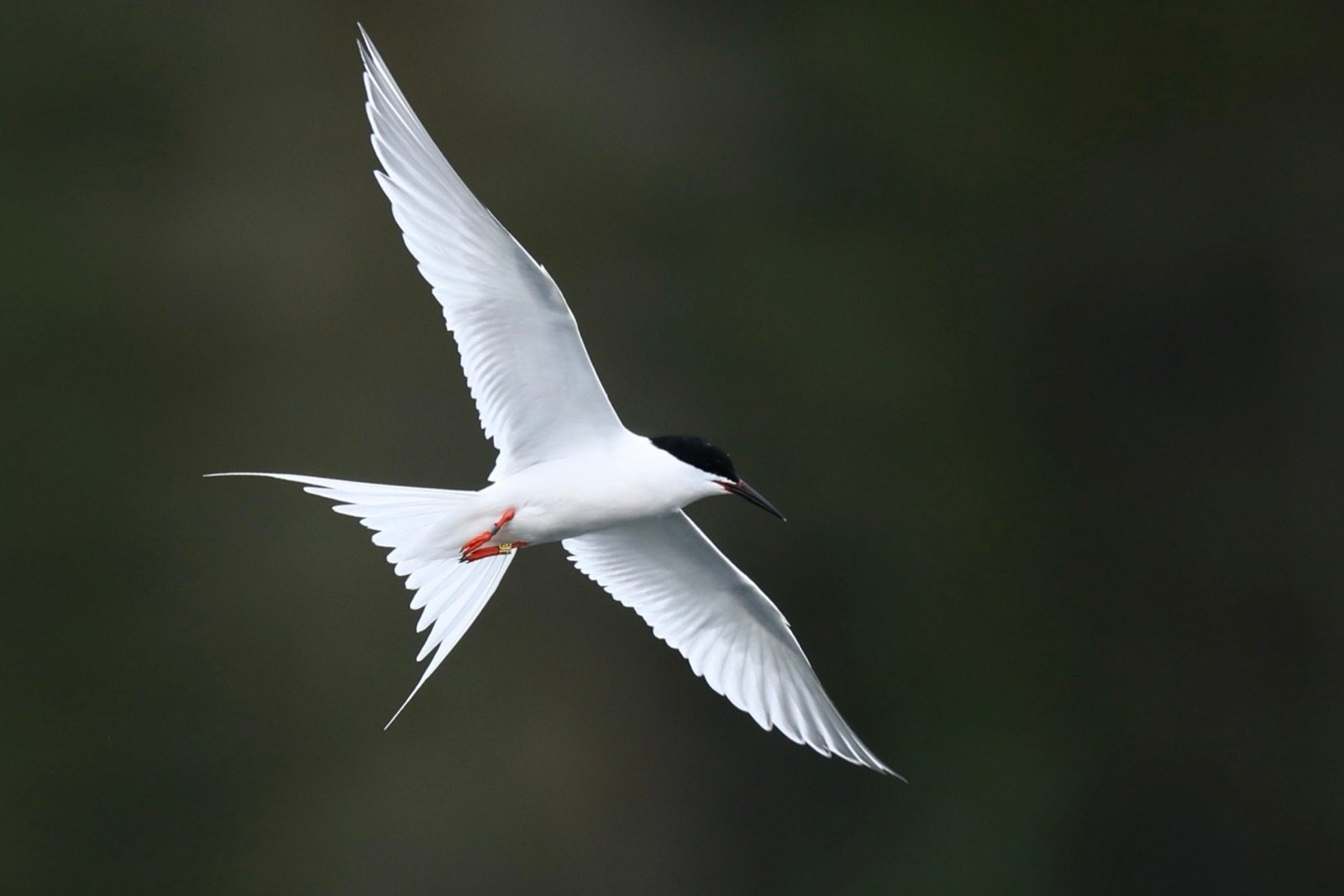
Roseate Tern is a pale, medium-sized tern. Learn these marks:
In summer, a mostly black bill with red at the base.
A very long forked tail.
Very pale upper wings.
Compared with Common and Arctic Terns it is much paler, with a bigger head and bill, a longer tail and shorter wings. When perched, the tail clearly projects past the wingtips.
The pink wash on the breast fades quickly in sunlight, so it is hard to see. In soft light it can show as a faint peachy tint on the underparts, so do not rely on it as your main clue.
What it sounds like
Recording: Steve Collins, CC BY 4.0, source, read 4 Nov 2026.
Behaviour and diet
Roseate Tern eats almost only small fish. It hovers high and then plunges up to about half a metre into the water. It also skims low over the surface to snatch fish.
It spends most of its time foraging at sea, which is part of why it is so seldom seen from land.
Where it lives
It is a coastal tern and is not seen inland. Outside the breeding season it is found mostly over open sea, and in winter it returns to coasts. Roseate Terns migrate well offshore, usually out of sight of land.
In Costa Rica the first record came from the Pacific coast, and the species is listed only as an accidental visitor.
When to see it
The first Costa Rica record was seen in late September 2015. Word only came out in October, after the observers realised what the bird was and posted it to the local rare bird alert.
Similar birds
It is easily confused with Common and Arctic Terns, and both are on the Costa Rica list. Roseate is much paler, with a bigger head and bill, a longer tail and shorter wings. Arctic Terns have also been seen on the Pacific coast, on beaches and in the Gulf of Nicoya, so Arctic is the other rare tern of that coast to check against a pale tern.
Names and lore in Costa Rica
The Spanish name on the official Costa Rica list is Charrán Rosado, and Costa Rican birders list it under that name. Another Spanish name in use in the region is Gaviotín Vientre Rosado.
Status and conservation
The official Costa Rica list gives the Roseate Tern status A, meaning accidental, and it is still rated A in the June 2026 update.
How we know this 13 sources, each read on the date shown
- Lista Oficial de las Aves de Costa Rica (AOCR) read 2026-11-04
https://listaoficialavesdecostarica.wordpress.com/lista-oficial/lista-oficial-online/ - Lista Oficial de las Aves de Costa Rica (AOCR) read 2026-11-04
https://listaoficialavesdecostarica.wordpress.com/category/especies-nuevas-cr/ - Audubon Field Guide read 2026-11-04
https://www.audubon.org/field-guide/bird/roseate-tern - Birds of the World (Cornell Lab) read 2026-11-04
https://birdsoftheworld.org/bow/species/roster/cur/introduction - SEO/BirdLife read 2026-11-04
https://seo.org/ave/charran-rosado/ - Birding Craft read 2026-11-04
https://birdingcraft.com/wordpress/2015/ - Cornell Lab, All About Birds read 2026-11-04
https://www.allaboutbirds.org/guide/Roseate_Tern/lifehistory - Birds of the World (Cornell) read 2026-11-04
https://birdsoftheworld.org/bow/species/roster/1.0/introduction?lang=es&printable= - Lista Oficial Aves de Costa Rica (Noticias) read 2026-11-04
https://listaoficialavesdecostarica.wordpress.com/category/noticias/page/2/ - Lista Oficial de las Aves de Costa Rica (AOCR committee) read 2026-11-05
https://listaoficialavesdecostarica.wordpress.com/nuevos-registros/ - EcoRegistros read 2026-11-05
https://www.ecoregistros.org/ficha/Sterna-dougallii - Lista Oficial de las Aves de Costa Rica read 2026-11-05
https://listaoficialavesdecostarica.wordpress.com/ - Bulletin of the British Ornithologists' Club read 2026-11-05
https://bioone.org/journals/bulletin-of-the-british-ornithologists-club/volume-140/issue-2/bboc.v140i2.2020.a11/New-documented-records-of-Ring-billed-Gull-Larus-delawarensis-and/10.25226/bboc.v140i2.2020.a11.full