Family Furnariidae
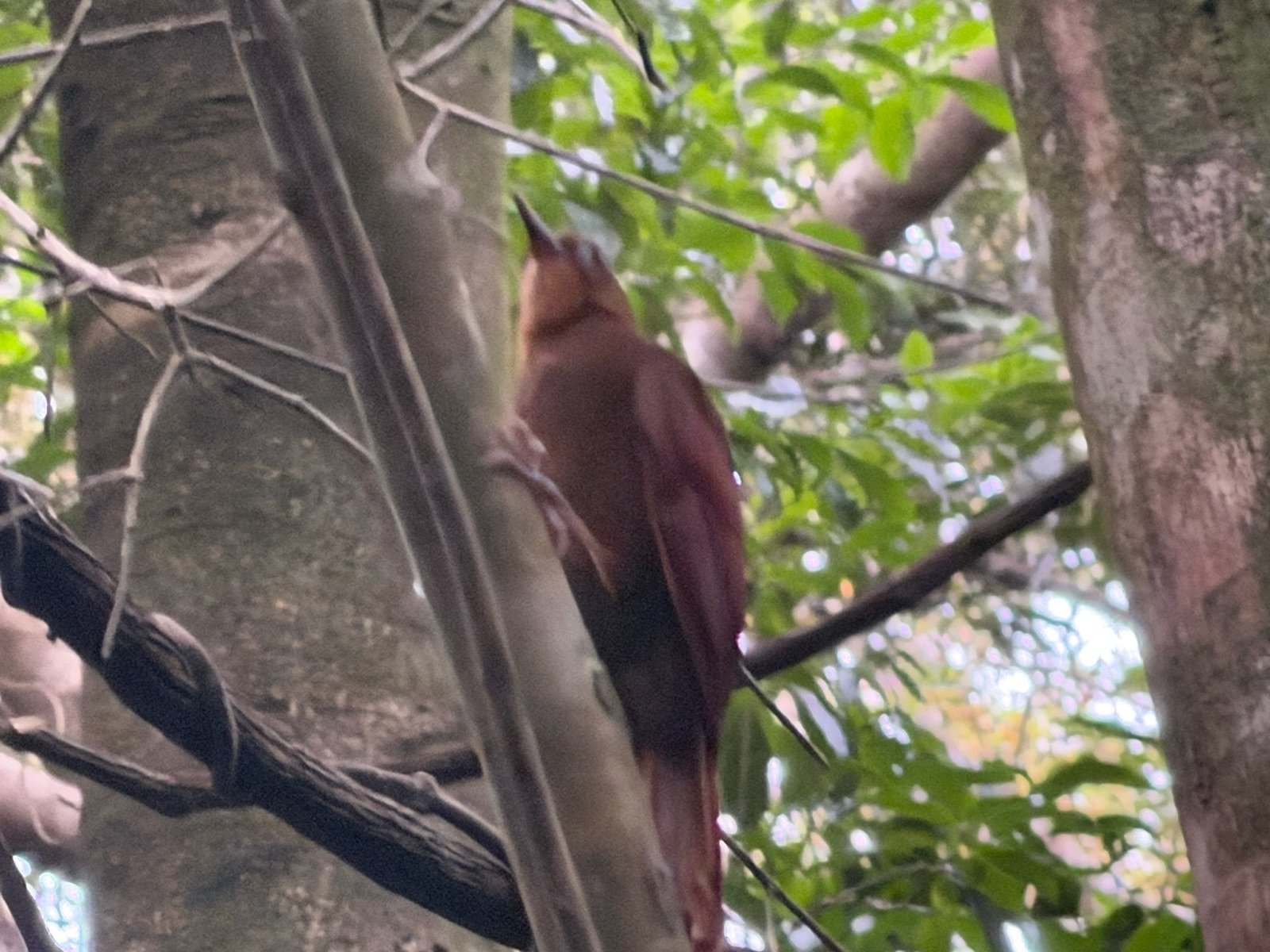
Ruddy Woodcreeper
Dendrocincla homochroa
In Spanish: Trepador Rojizo
- Resident
A plain rufous woodcreeper that turns up at army ant swarms.
The Ruddy Woodcreeper (Trepador Rojizo) is almost entirely rufous-brown, and that plainness makes it easy to name once you have it in view. In Costa Rica it mostly lives between about 500 and 1,200 m.
It relies heavily on army ant swarms for food, so the best way to find the bird is to find an active swarm. On a trip we build, that means slow forest walks, watching for several birds gathered low and for the mixed flock above the ants.
It is a resident here, listed as R on the AOCR list, and it is a bird you plan around rather than stumble on.
How to find it
Start with the ants. It is usually seen in mobile mixed flocks gathered at an army ant swarm, so an active swarm is the best way to find it. Look for swarms in any dry forest area, and watch for several birds gathered low in the forest. Swarms may need patience, as you often wait and follow the front until more birds arrive. Even a small swarm can be enough: a March 2025 tour found one at a small ant swarm on the well-kept trails of Curi-Cancha Reserve, in the Monteverde area. Because it forages below the canopy, scan trunks and stems at eye level and just above.
How to recognise it
Start with the colour: almost entirely rufous-brown, with no streaking. That plain, unstreaked look is the main clue.
Then check the details:
- Lores: grayish.
- Face: a grey line from the bill to the eye.
- Throat: paler than the rest of the body.
- Bill: short, stout and fairly straight for a woodcreeper.
- Size: about 17.5 to 20.5 cm long.
The lores and bill are described for the species across its range, and so are the size, throat and eye-line, not for Costa Rica alone.
Behaviour and diet
It makes short flights, then climbs and searches trunks, branches and stems below the canopy for insects. It usually forages alone, but it follows army ant swarms and may mix with other woodcreepers, including its own kind.
Across its range it nearly always follows swarms, though it sometimes joins mixed flocks away from them. It clings to a trunk up to 10 m above the ground and dashes out to catch prey flushed by the ants. At night it rests alone in tree crevices, and it nests in hollow palm stumps and tree cavities.
Where it lives
In Costa Rica it mostly lives between about 500 and 1,200 m, and it is rarely found below 300 m. A Costa Rican guide describes it as mostly in the understory of moist and dry forest on the northern Pacific slope.
The Costa Rican race acedesta lives on the Pacific slope, and the species also lives on the Caribbean slope of northern and central Costa Rica. In Panama it is found a bit lower, at roughly 300 to 900 m.
When to see it
At Guanacaste, one observer reported breeding in May and June, with adults feeding chicks at a nest on 27 May 2021.
Similar birds
Two close relatives in Costa Rica belong to the same genus, Dendrocincla. The Plain-brown Woodcreeper (Trepador Pardo) has a straight black bill and two dark lines on the face. The Tawny-winged Woodcreeper (Trepador Alirrubio) has contrasting rufous wings, a pale throat and a pale eyebrow.
Names and lore in Costa Rica
In Costa Rica the species goes by Trepador Rojizo. Elsewhere other Spanish names include trepatroncos rojizo (Mexico, Nicaragua, Panama), trepatroncos canelo (Mexico) and trepatroncos colorado (Colombia).
Status and conservation
It is a resident (R) on the AOCR list and rated Least Concern by the IUCN, uncommon to fairly common from Mexico to Costa Rica and only locally common from Costa Rica to Panama.
Photography tips
At an ant swarm, Ruddy Woodcreepers cling to a small trunk and watch calmly. They often sit still for a long while, then dash out to grab prey. Wait and watch from a distance, and be patient while the swarm front moves and more birds arrive.
How we know this 14 sources, each read on the date shown
- Wikipedia read 2026-11-04
https://en.wikipedia.org/wiki/Ruddy_woodcreeper - Area de Conservacion Guanacaste (ACG) read 2026-11-04
https://www.acguanacaste.ac.cr/paginas-de-especies/insectos-2/5863-i-dendrocincla-homochroa-i-furnariidae - Cornell Birds of the World read 2026-11-04
https://birdsoftheworld.org/bow/species/rudwoo1/cur/introduction - Animalia.bio read 2026-11-04
https://animalia.bio/ruddy-woodcreeper - Wikipedia read 2026-11-04
https://en.wikipedia.org/wiki/List_of_birds_of_Costa_Rica - Birding Craft read 2026-11-04
https://birdingcraft.com/wordpress/2011/11/07/tips-on-woodcreeper-identification-when-birding-costa-rica/ - Field Guides tour report, Costa Rica March 2025 read 2026-11-04
https://fieldguides.com/triplists/cos25/ - Field Guides tour report, Costa Rica 2015 read 2026-11-04
https://fieldguides.com/triplists/cos15.html - Wikipedia (Spanish) read 2026-11-04
https://es.wikipedia.org/wiki/Dendrocincla_homochroa - Rockjumper Birding Tours read 2026-11-05
https://www.rockjumperbirding.com/forest-phantom/ - Rockjumper trip report 2017 read 2026-11-05
https://app.rockjumperbirding.com/sites/rockjumper/attachments/9/Trip%20Report%20-%20RBL%20Costa%20Rica%20-%20Cloud%20Forest%20&%20Quetzals%20and%20Ext%202017.pdf - 10,000 Birds read 2026-11-05
https://www.10000birds.com/pats-costa-rica-bird-list-2021.htm - Avibase read 2026-11-05
https://avibase.bsc-eoc.org/species.jsp?avibaseid=A36EA7483EEC0700 - Birding Craft read 2026-11-05
https://birdingcraft.com/wordpress/2011/06/07/antswarms-at-carara-national-park-on/