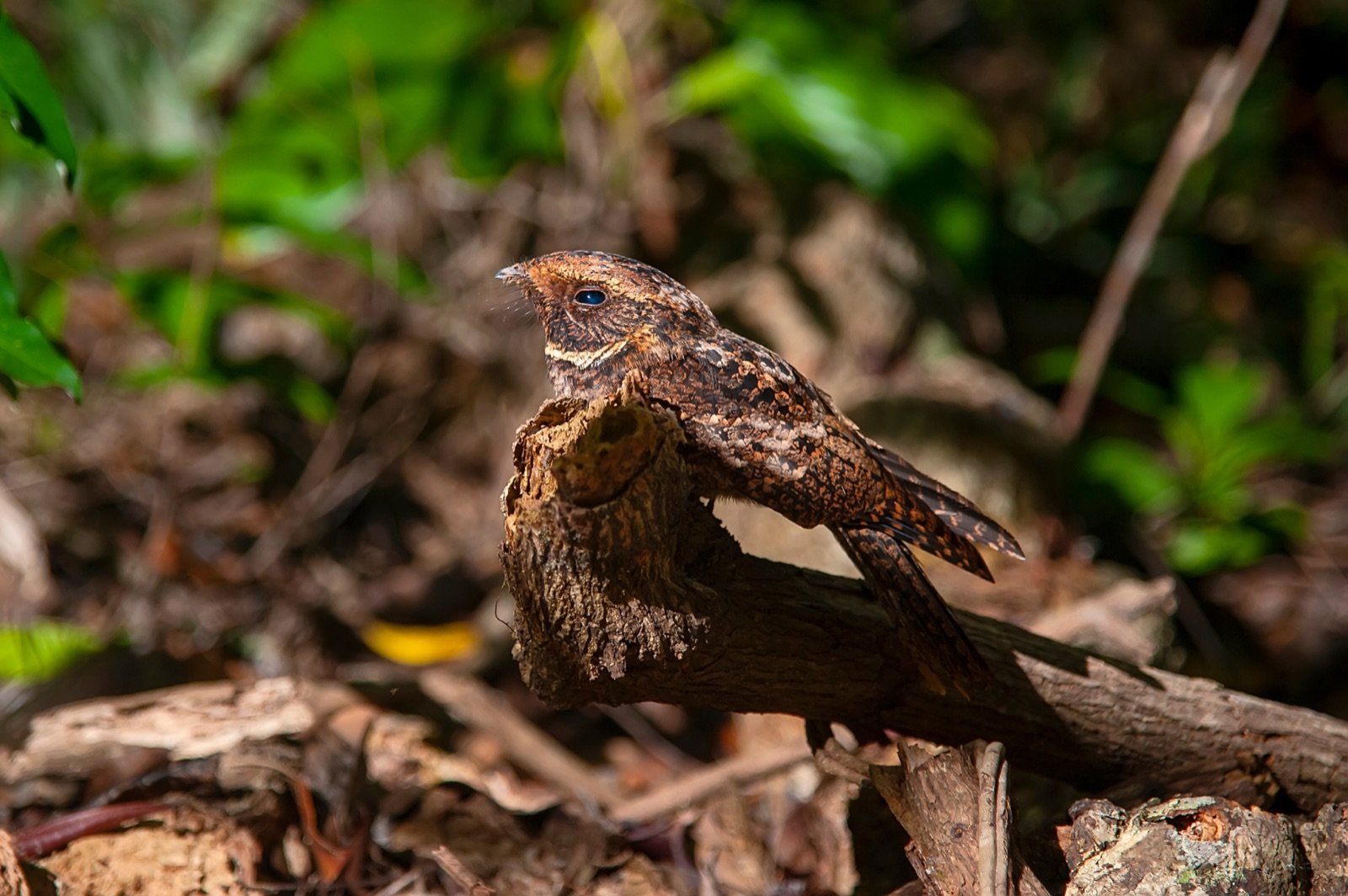
 Rufous Nightjar
Family Caprimulgidae
Rufous Nightjar
Antrostomus rufus
In Spanish: Chotacabras Rojizo
- Resident
A rare, local nightjar of the southern lowlands, found by ear after dark.
The Rufous Nightjar (Chotacabras Rojizo) is a rare, local resident of the southern lowlands and foothills of Costa Rica, on both slopes. It may be most numerous in the Térraba region of the south.
It is strictly nocturnal, so this is a bird you meet in the dark. A Panama source says you will probably hear it but have a hard time seeing it, which makes finding it by ear at night the practical approach.
If you are planning a first nightjar search in the south, learn the four-note song before you go. It is the surest way to know you have found one.
How to find it
Plan to look for it by ear after dark, because the song is the most dependable way to locate it. Learn the four-note phrase beforehand so you can pick it out. Focus on the southern lowlands and foothills below about 1000 m, where it is a rare and local resident. The Térraba region may hold the most birds. During the breeding season males call from perches inside woodland, so listen near wooded edges and second growth. Be patient about seeing it, since hearing it is the likelier result.
How to recognise it
This is a large, reddish brown nightjar, about 25 to 30 cm long across its range. Look for these marks:
- a buff collar on the sides and back of the neck
- a white band under the throat
- dull chestnut to rufous plumage, with fine vermiculations and heavy black streaks on crown, nape and back
- no white in the wings, unlike many nightjars
- a short, broad, black bill and grayish legs
The tail and the plumage tone help separate the sexes. The male shows white on the outer tail feathers, while the female has only pale buff tail tips and is paler and less rufous overall. These details describe the species in general, not Costa Rican birds alone.
What it sounds like
Recording: Nicolas Olejnik, CC BY 4.0, source, read 4 Nov 2026.
Behaviour and diet
The Rufous Nightjar is strictly nocturnal, and it is most active around dawn and dusk. In the breeding season, males usually call from a perch on a branch inside woodland.
By day it roosts on a low perch or on the ground under thick vegetation. It hunts insects by flying out from a low perch such as a branch or fence post. Nightjars as a family are very hard to spot at rest, so a daytime search is rarely the way to meet one.
Where it lives
In Costa Rica it occurs from the lowlands up the foothill slopes to about 1000 m. It is a bird of the southern part of the country on both slopes. On the Pacific side it reaches north to the hills above Parrita, and on the Caribbean side it reaches the Valle de la Estrella.
Across its wider range it lives in wet and dry tropical forest, heavily degraded woodland and savanna scrub, and it prefers rolling terrain. Around Bocas del Toro in Panama it is found in second-growth woodland and along forest edges.
Similar birds
The Rufous Nightjar looks very much like the Chuck-will's-widow, a winter visitor to Costa Rica. Voice separates the two when the nightjar is heard well, because the Chuck-will's-widow call is lower-pitched and slower. Outside the breeding season both are usually silent, so telling them apart then takes great care. The buff neck collar and whitish throat are the plumage marks to check.
Names and lore in Costa Rica
Costa Rican lists use Chotacabras Rojizo, and another Costa Rican list gives Chotacabras Colorado instead. One regional list spells it 'Chotacabras rojico'. Elsewhere you may meet atajacaminos colorado, chotacabras rufo, Guardacaminos colorado (Colombia), tapacamino moreno (Panama) and pocoyo rojizo (Nicaragua).
Status and conservation
The official Costa Rican bird list gives it the status R (resident), and the IUCN lists it as Least Concern across its range, though the population is thought to be falling.
How we know this 16 sources, each read on the date shown
- Aves de Costa Rica (Caprimulgidae) read 2026-11-04
https://www.avesdecostarica.org/caprimulgidae.html - Wikipedia (Spanish) read 2026-11-04
https://es.wikipedia.org/wiki/Antrostomus_rufus - STRI Research Portal (Panama) read 2026-11-04
https://panamabiota.org/stri/taxa/index.php?taxauthid=1&taxon=2759&clid=92 - Wikipedia read 2026-11-04
https://en.wikipedia.org/wiki/Rufous_nightjar - Birda species guide read 2026-11-04
https://app.birda.org/species-guide/2017/Rufous_Nightjar - Lista Oficial de las Aves de Costa Rica (AOCR) read 2026-11-04
https://listaoficialavesdecostarica.wordpress.com/lista-oficial/lista-oficial-online/ - Cornell Neotropical Birds read 2026-11-04
https://neotropical.birds.cornell.edu/Species-Account/nb/species/rufnig1/systematics - Bird Finding (St. Lucia Nightjar page) read 2026-11-04
https://birdfinding.info/st-lucia-nightjar/ - Cornell Neotropical Birds Online read 2026-11-04
https://neotropical.birds.cornell.edu/Species-Account/nb/species/rufnig1/appearance - Guía de Aves de Misiones read 2026-11-04
https://guiadeavesdemisiones.com/atajacaminos-colorado-antrostomus-rufus/ - Bird Watching Costa Rica read 2026-11-04
https://www.birdwatchingcostarica.com/familia/caprimulgidae/ - Animalia.bio read 2026-11-04
https://animalia.bio/rufous-nightjar - Carolina Birds (Birds of the World nightjar page) read 2026-11-04
https://carolinabirds.org/HTML/Nightjar_New_World.htm - Wikipedia read 2026-11-05
https://en.wikipedia.org/wiki/Caprimulgus_rufus - Avibase read 2026-11-05
https://avibase.bsc-eoc.org/species.jsp?avibaseid=C6B09772 - Animalia.bio (from Wikipedia) read 2026-11-05
https://animalia.bio/rufous-nightjar?taxonomy=215