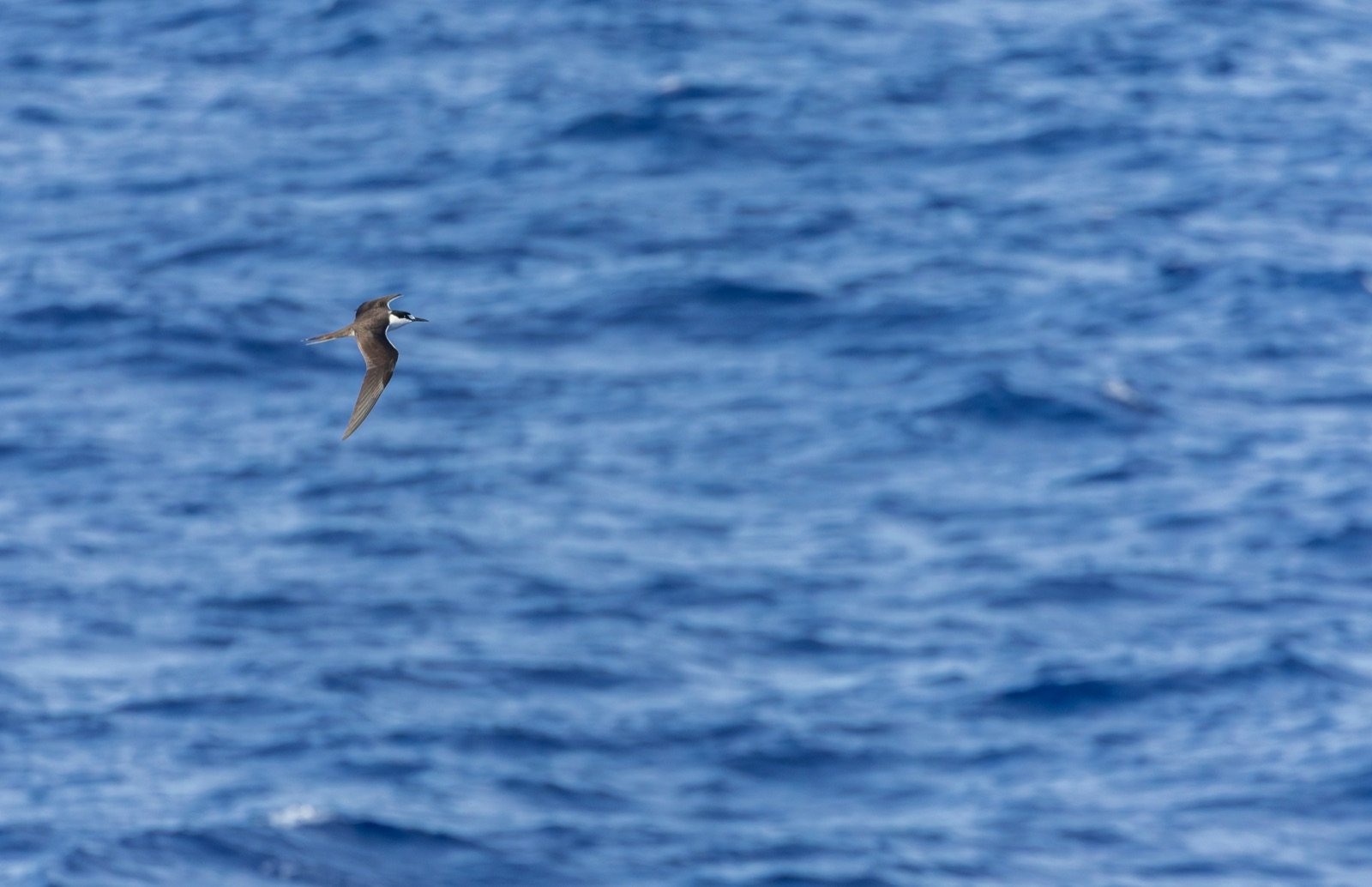
 Sooty Tern
Family Laridae
Sooty Tern
Onychoprion fuscatus
In Spanish: Charrán Sombrío
- Resident
A dark-backed ocean tern that nests on remote Isla del Coco.
The Sooty Tern spends most of its life in the air, and in Costa Rica it is tied to Isla del Coco, the remote Pacific island national park. There it is a breeding resident, alongside White Tern and Black Noddy.
This is not a mainland bird, so it is one to know about rather than to expect. Seeing one from the mainland takes luck, because young birds go to sea and may not return to land for several years.
On a trip we build, the realistic chance is offshore, on a boat that finds feeding flocks over tuna and dolphins in Pacific waters.
How to find it
Plan around Isla del Coco, the place a Costa Rican source names for this tern. From the mainland, treat any sighting as a bonus. Young birds stay at sea for years, which is one reason it is so seldom seen from shore.
Boat trips off the Pacific coast that find feeding flocks over tuna and dolphins are a way to meet it. On one such trip, adults and juveniles soared over a feeding frenzy, and birders looked for it among shearwaters and other terns.
If a dark-backed tern passes offshore, check it against Bridled Tern first. Look at the forehead patch and at whether a pale line runs back past the eye.
How to recognise it
Adults are blackish above and white below, with a white forehead. The upperparts are mostly uniform blackish, and the white forehead patch ends above or just behind the eye.
The tail is deeply forked. The wings are long and pointed. Together they give a streamlined, long-tailed look in flight.
Immatures look quite different: mostly dark sooty brown, with white spots on the back. A young bird is far less crisp than the black and white adult.
What it sounds like
Behaviour and diet
The Sooty Tern takes small fish and squid from the ocean surface. It almost never rests on the water and spends most of its life in the air.
It nests in very large, noisy colonies, and on remote islands these can hold up to a million pairs. At nesting islands, flocks first visit at night, circle over the island calling, then leave at dawn. Courtship includes a high flight with a gliding descent, and on the ground birds strut and bow.
The nest is a shallow scrape, with nests about 50 cm apart. Normally one whitish egg is laid, both parents incubate for 28 to 30 days, and chicks fledge in about two months.
Where it lives
Outside the breeding season it is very much an open-ocean bird. It lives in warm tropical seas, usually far out, and avoids shallow water and areas near the mainland coast.
It nests on oceanic islands, mostly small ones, on sand, rock or coral, on open sandy ground with sparse plants.
In Costa Rica the place tied to it is Isla del Coco, far west of the mainland. A tourism page also names Isla del Caño Biological Reserve as a possible nesting site.
Similar birds
The Bridled Tern is the look-alike. It is smaller and paler, with a clear pale line between bill and eye. Its white forehead patch is narrower and extends behind the eye, with thin white brow lines running well past it.
Bridled also has a black cap and a gray back, where the Sooty is uniformly blackish above. In Costa Rica Bridled is listed as rare and a migrant (RR, M), so it is the one to check against.
Names and lore in Costa Rica
The Costa Rican national museum calls it charrán sombrío, and groups it with White Tern and Black Noddy as seabirds that spend a season on Isla del Coco to breed. Other Spanish names for the species include gaviotín apizarrado, gaviotín oscuro, gaviota monja and gaviota golondrina oscura. In English it is also called Wideawake, because its noisy, constantly calling colonies earned the nickname.
Status and conservation
The AOCR list gives the Sooty Tern as a resident (R) and Isla del Coco sources treat it as a local breeder, though the current online Lista Oficial marks it as a migrant (M).
Photography tips
Photography here means boats, not trails. A trip that finds feeding flocks over tuna and dolphins puts birds in the air above the boat, where the deeply forked tail and long pointed wings show well.
How we know this 19 sources, each read on the date shown
- Museo Nacional de Costa Rica read 2026-11-04
https://www.museocostarica.go.cr/nuestro-trabajo/investigaciones/historia-natural/isla-del-coco/aves/ - Revista de Biología Tropical (Montoya 2008) read 2026-11-04
https://www.redalyc.org/pdf/449/44920231010.pdf - Hotel Rivel blog read 2026-11-04
https://hotelrivel.online/es/charran-sombrio-un-ave-marina-sofisticada-surca-los-cielos-de-costa-rica-ocasionalmente/ - Birdwatching in Costa Rica read 2026-11-04
https://birdwatchingincostarica.com/aves-oceanicas-en-costa-rica-un-pais-de-mar-un-tesoro-por-descubrir/ - Audubon Field Guide read 2026-11-04
https://www.audubon.org/field-guide/bird/sooty-tern - New Zealand Birds Online read 2026-11-04
https://www.nzbirdsonline.org.nz/species/sooty-tern - SEO/BirdLife read 2026-11-04
https://seo.org/ave/charran-sombrio/ - Cornell Lab, All About Birds read 2026-11-04
https://www.allaboutbirds.org/guide/Sooty_Tern/overview - DiBird read 2026-11-04
https://dibird.com/species/sooty-tern/ - Zeledonia 21 (2017) read 2026-11-04
https://www.zeledonia.com/zeledonia-21-20171.html - Lista Oficial de las Aves de Costa Rica read 2026-11-04
https://listaoficialavesdecostarica.wordpress.com/lista-oficial/lista-oficial-online/ - Wikipedia (es) read 2026-11-04
https://es.wikipedia.org/wiki/Onychoprion_fuscatus - Hotel Rivel blog read 2026-11-04
https://hotelrivel.online/sooty-tern-a-sophisticated-seabird-takes-flight-in-costa-ricas-skies-occasionally/ - Bird Finding read 2026-11-04
https://birdfinding.info/sooty-tern/ - Aves de Chile read 2026-11-04
https://www.avesdechile.cl/129.htm - Animalia.bio read 2026-11-04
https://animalia.bio/sooty-tern - 10,000 Birds read 2026-11-05
https://www.10000birds.com/shearwater-chase-in-costa-rica.htm - Oiseaux-Birds read 2026-11-05
https://www.oiseaux-birds.com/article-island-birds-endemic-cocos-island.html - Animalia.bio read 2026-11-05
https://animalia.bio/es/sooty-tern?environment=147