Family Rallidae
Sora
Porzana carolina
In Spanish: Polluela Sora
- Migrant
A small, secretive marsh rail that winters in Costa Rican lowlands.
The Sora (Polluela Sora) is a northern migrant that spends the northern winter in Costa Rica. It is a local winter resident, yet it is spread widely across the lowlands, so it turns up in more places than many beginners expect.
It is most numerous in the Tempisque river basin and around Río Frío. Birds mainly arrive in October and stay until late February or March.
This is a rail that is rarely seen but often heard. By day it hides in cattail patches, rushes and damp grass, which makes it a good first lesson in listening at the edge of a marsh.
How to find it
Listen first, because the Sora is heard more often than seen. Look for it at the edges of marshes and reeds. Scan the margins of open water, where birds are sometimes seen walking. Playing its call increases the chance of hearing one. Rice fields and flooded fields are worth checking as well as reedy ponds.
How to recognise it
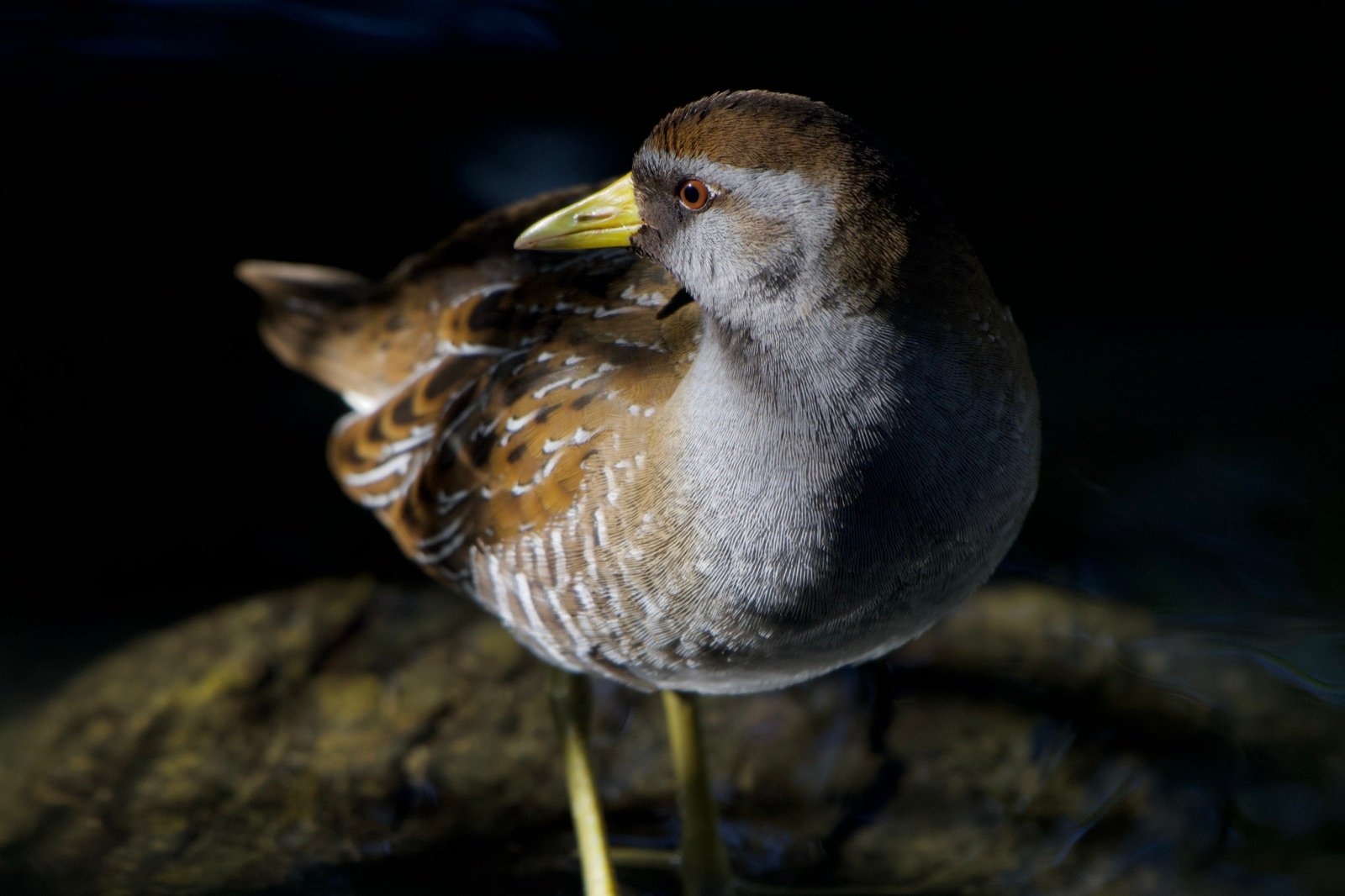
The Sora is a small, reddish-brown rail, about 23 cm long.
Look for these marks:
- a short, thick yellow bill
- a black face patch and black throat around the bill
- greenish legs
- mottled brown upperparts
- a grey-blue face and underparts
- flanks barred black and white
- a short, cocked white tail
The contrast of grey head and chest, black mask and plain yellow bill is the quickest way to separate it from other small marsh rails.
What it sounds like
Behaviour and diet
The Sora feeds alone by day on water insects, snails and seeds. It forages by walking or by swimming, so you may see it paddling across open water, not only creeping through reeds. Birds are sometimes seen walking near open water.
By day it hides in cattail patches, rushes and damp grass. It migrates at night and roosts together at night. A Sora in a San José yard ran quickly and silently into the edge vegetation when it felt threatened, yet it still showed curiosity toward the people watching it.
Where it lives
In Costa Rica the Sora lives in marshes with soft-stemmed plants, rice fields, flooded fields and ponds edged with reeds. It ranges from the lowlands up to about 1500 m.
It occurs on both the Caribbean and Pacific slopes, including the Central Valley. It is more numerous in the lowlands and found only locally at higher elevations.
When to see it
Birds mainly arrive in October and stay until late February or March.
Similar birds
Other small marsh rails on the Costa Rican list include Yellow-breasted Crake, Paint-billed Crake and Gray-breasted Crake. The Paint-billed Crake has a red and yellow bill and bright red legs, while the Sora has a plain yellow bill and dull greenish legs. The Yellow-breasted Crake is tiny and yellowish with yellow legs, whereas the Sora is bigger, with a grey head and chest and a black face patch.
Names and lore in Costa Rica
Besides the official name Polluela Sora, Costa Rican sources also call this bird Polluela Norteña, meaning 'northern crake', a name that fits its role as a visitor from the north. Elsewhere in Latin America it is also called Gallito Sora, Gallineta Sora and Gallinuela Oscura.
Status and conservation
The Sora is listed as a migrant (M) on the AOCR list, a local winter resident in Costa Rica, while the species overall is widespread, common and rated Least Concern.
Photography tips
Patience at the edge of a marsh pays best, since the Sora moves stealthily and runs quickly and silently into edge vegetation when threatened. Watch open water margins, where it may walk or paddle into view.
How we know this 12 sources, each read on the date shown
- Flickr (Costa Rican species account) read 2026-11-04
https://www.flickr.com/photos/jobando/31403328115 - Catálogo de la biodiversidad (Colombia) read 2026-11-04
https://catalogo.biodiversidad.co/file/56cd319b207ecea54a561e71 - Fundación Humedales Bogotá read 2026-11-04
https://humedalesbogota.com/2015/04/06/la-polluela-nortena-en-el-humedal-la-conejera/ - NH PBS NatureWorks read 2026-11-04
https://nhpbs.org/natureworks/sora.htm - Animalia.bio read 2026-11-04
https://animalia.bio/es/sora?letter=s - Wikipedia read 2026-11-04
https://en.wikipedia.org/wiki/Sora_(bird) - iNaturalist (from Spanish Wikipedia) read 2026-11-04
https://mexico.inaturalist.org/taxa/162-Porzana-carolina - ResearchGate (Costa Rican note on Sora in San José) read 2026-11-04
https://www.researchgate.net/publication/387668234_Observacion_de_la_polluela_nortena_Porzana_carolina_Rallidae_en_un_patio_en_San_Jose_Costa_Rica - Birding Craft read 2026-11-04
https://birdingcraft.com/wordpress/tag/cano-negro/ - Wikipedia (Paint-billed crake) read 2026-11-04
https://en.wikipedia.org/wiki/Paint-billed_crake - Cornell Birds of the World read 2026-11-04
https://birdsoftheworld.org/bow/species/yebcra1/cur/introduction - Hotel de Campo read 2026-11-04
https://www.hoteldecampo.com/national-wildlife-refuge-cano-negro/