 Southern Lapwing
Family Charadriidae
Southern Lapwing
Vanellus chilensis
In Spanish: Chorlitazo Sureño (Avefría)
- Resident
A bold, noisy crested plover of wet pastures and mudflats
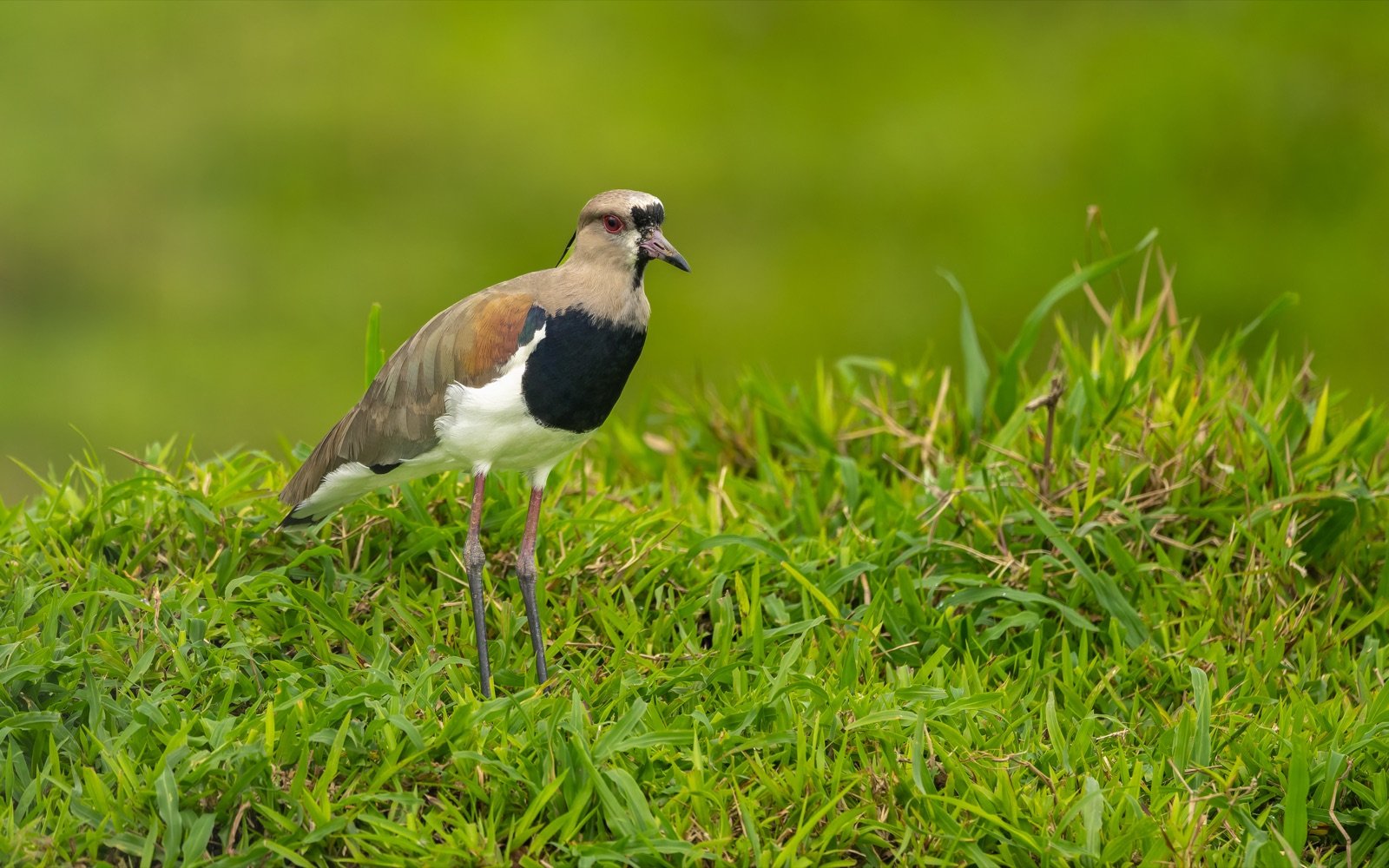
The Southern Lapwing (Chorlitazo Sureño, also called Avefría) is a large plover with a thin crest, a black face and chest, and pink legs. It is the only crested wader in South America, and in Costa Rica it is a resident, coded R on the national bird list.
It is a newcomer here. It reached Panama about a century ago and settled in Costa Rica late in the 20th century, and the first Costa Rican record dates from 1993. Since then it has spread into Nicaragua and farther north.
On trips we build, guests meet it on boat trips and walks along wetland edges, where it is often among the first species identified. It is bold and noisy, which makes it a friendly first wader for a beginner.
How to find it
Listen first: the loud calls usually give it away before you see it. In the northern wetlands, look in wet meadows and pastures by the lagoons, on exposed mudflats, and on grassy edges of the water. Boat trips and walks along wetland edges are where visitors often meet it. In Guanacaste Conservation Area, one observer found it at puddles and freshly ploughed wet fields. Tour groups have also recorded it near the Tárcoles River, along the La Gamba road in open farmland, and in pineapple fields near Sarapiquí. Keep your distance from nesting birds.
How to recognise it
Start with the shape: a large plover with a thin crest.
Look for these marks:
- a grey head, black face and chest
- pink legs
- a pink bill with a black tip
- bronze-green shoulders that carry small spurs
- bright red eyes, which give it an alert look
- long reddish legs that let it stride across wetlands and grassland
Both sexes look alike. In flight it shows a broad white bar across the wing, black flight feathers, a white rump and a black tail.
The birds in Costa Rica belong to the subspecies cayennensis, which has less black on the upper breast, a whiter face, and a cinnamon-brown head and neck rather than blue-grey.
What it sounds like
Recording: Camilo Segura, CC BY 4.0, source, read 4 Nov 2026.
Behaviour and diet
It hunts by running a few steps, stopping, then pecking. It sometimes stirs the soil with its feet to feel for worms beneath, then pulls them out with its bill.
It defends its nest hard. Pairs or trios stand guard: one adult stays on the ground with the young while the other flies at the threat and strikes with its wing spurs. A Costa Rican golf course guide calls it highly territorial.
It calls at the slightest disturbance, and a lodge in the northern wetlands notes that its loud calls often warn of other wildlife nearby.
Where it lives
Across its range it is common in open country such as pastures, river plains, open marsh and the edges of rivers and lakes, usually near water. It sometimes uses open forest clearings or town gardens.
In Costa Rica a bird-watching site says it lives on both coasts, in short-grass areas that are usually near water. It has been photographed in the mangroves along the Tárcoles River and in San José province, and recorded in Guanacaste, the south Pacific and the northern lowlands.
When to see it
A lodge in the northern wetlands says the lapwing can be seen there all year. Sightings are especially common in the dry season, December to April, when falling water exposes wide mudflats and pastures.
Similar birds
The Costa Rican subspecies differs from the southern birds of the species. It shows less black on the upper breast, a whiter face, and a cinnamon-brown head and neck rather than blue-grey. Some authorities treat the northern subspecies as a separate species, Vanellus cayennensis.
Names and lore in Costa Rica
The official Spanish name is Chorlitazo Sureño, often given with Avefría as a second name. Other countries use Tero, Queltehue or Alcaraván, so Costa Rican guides may use Tero Común. A lodge in the northern wetlands says locals call it Tero Común, and nicknames it the "guardians of the grasslands" because it sounds the alarm so readily.
Status and conservation
The Costa Rican bird list codes it R, meaning resident, and it is rated Least Concern globally.
Photography tips
On a small sandbar in the Tárcoles River, the birds squawked at a photographer in a boat, and the photo was taken at 1/2000 sec with a 500 mm lens. The bronze and green sheen on the wings shows best in sunlight. A golf course guide warns it will try to scare you off if you come too close, so keep your distance.
How we know this 22 sources, each read on the date shown
- JungleDragon read 2026-11-04
https://www.jungledragon.com/specie/223/southern_lapwing.html - Birda read 2026-11-04
https://app.birda.org/species-guide/6457/Southern_Lapwing - Catálogo de la biodiversidad (Colombia) read 2026-11-04
https://catalogo.biodiversidad.co/fichas/4605 - iNaturalist Panama (Wikipedia text, Spanish) read 2026-11-04
https://panama.inaturalist.org/taxa/4867-Vanellus-chilensis - World Bird Photos read 2026-11-04
https://www.worldbirdphotos.com/photo/lapwing-southern-vanellus-chilensis-adult-costa-rica/ - Valery Schollaert (Vanneau téro) read 2026-11-04
https://valeryschollaert.wordpress.com/vanneau-tero-vanellus-chilensis/ - Birdwatching in Costa Rica (AOCR list) read 2026-11-04
https://birdwatchingincostarica.com/bird-lists/ - the-birds.net read 2026-11-04
https://www.the-birds.net/birds/southern.lapwing.html - Cano Negro Lodge read 2026-11-04
https://canonegrolodge.com/the-southern-lapwing-in-cano-negro-wetlands-the-watchful-guardian-of-the-grasslands/ - Área de Conservación Guanacaste read 2026-11-04
https://www.acguanacaste.ac.cr/paginas-de-especies/insectos-2/5831-i-vanellus-chilensis-i-charadriidae - La Iguana Golf Course local bird guide read 2026-11-04
https://www.golflaiguana.com/wp-content/uploads/sites/9272/2023/10/Wildlife_page.pdf - Birds of the World read 2026-11-04
https://birdsoftheworld.org/bow/species/soulap1/cur/sounds - Oiseaux-Birds read 2026-11-04
https://www.oiseaux-birds.com/card-southern-lapwing.html - Eagle-Eye Tours trip report read 2026-11-04
https://www.eagle-eye.com/blog/costa-rica-birding-trip-report-jan-11-27-2026/ - Eagle-Eye Tours trip report read 2026-11-04
https://www.eagle-eye.com/blog/costa-rica-birding-tour-trip-report-jan-22-feb-7-2025/ - El Ecoturista read 2026-11-04
https://elecoturista.com/internacional/costa-rica-un-destino-ornitologico-top-y-ii-centro-y-norte/ - ResearchGate (New information about Costa Rican birds) read 2026-11-04
https://www.researchgate.net/publication/252929142_NEW_INFORMATION_ABOUT_COSTA_RICAN_BIRDS - Animalia.bio (from Wikipedia) read 2026-11-04
https://animalia.bio/southern-lapwing/1000 - Bird Watching Costa Rica read 2026-11-04
https://www.birdwatchingcostarica.com/ave/southern-lapwing/ - Macaulay Library read 2026-11-04
https://macaulaylibrary.org/asset/454620401 - Linda Murdock Photography read 2026-11-04
http://gustaviatex.com/blog/2019/10/23/costa-rica-finding-the-river-birds - Hispanopedia read 2026-11-04
https://es.hispanopedia.com/wiki/Vanellus_chilensis