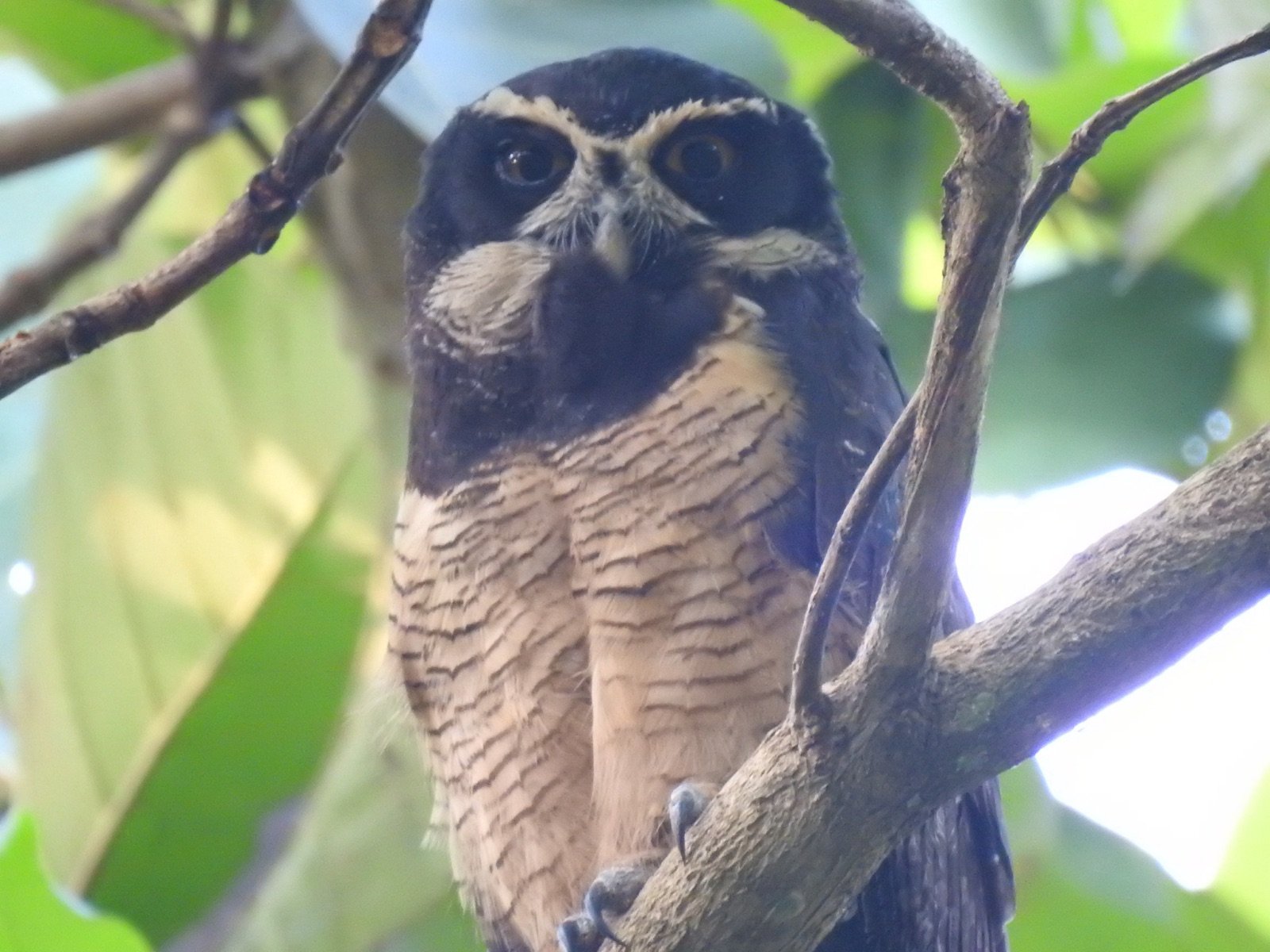
Family Strigidae
Spectacled Owl
Pulsatrix perspicillata
In Spanish: Búho de Anteojos (Oropopo)
- Resident
The largest owl in Costa Rica, with white spectacles round yellow eyes.
The Spectacled Owl, known to Costa Ricans as the Oropopo, is described as the largest owl in the country. A dark brown head with white lines around big yellow eyes gives it the look of wearing spectacles.
It is a widespread resident on both slopes, uncommon to fairly common, and it occurs across Costa Rica except the highest elevations. Despite its size and striking looks, it is often heard more than seen.
On a trip we build, a guided night walk is a good way to meet one, and by day a patient look at shady roosts can also pay off.
Where to see it
- Hotspot page
- Named place
- Nearby lodge (numbers match the cards)
- Corcovado National Park and the OsaOn the hotspot page's bird table.
- Palo Verde National Park and the Tempisque RiverPhotographed at the park.Not on the map above: it sits too far away to show at this zoom.
- Carara National ParkA roosting bird was photographed at Carara Biological Reserve.Not on the map above: it sits too far away to show at this zoom.
- Arenal Volcano National ParkA photographer shows one at the national park.Not on the map above: it sits too far away to show at this zoom.
Also named by birders, not pinned:
- Las Horquetas, Sarapiquí
- Lowland rainforest near Sarapiquí
- Guanacaste (Pacific) and Limón (Caribbean) lowlands
Nearby lodges
Within 20 km of a place on the map, in the same zone.
- 1
 Aguila de Osa Inn18.5 km from Corcovado National ParkSee the lodge
- 2
 Rancho Humo Estancia5.9 km from Palo Verde National Park (off the map)See the lodge
- 3Photo comingSanta Lucía Jungle Hacienda, Autograph Collection2.7 km from Carara National Park (off the map)See the lodge
- 4
 Arenal Observatory Lodge0.1 km from Arenal Volcano National Park (off the map)See the lodge
- 5
 Drake Bay Wilderness Resort18.8 km from Corcovado National ParkSee the lodge
How to find it
In Guanacaste's dry season, look for them hiding in the shade of papaturro trees during the day. They also drink at dry season waterholes. Elsewhere, one owl guide says it often roosts near rivers and streams in the lowland forests of both coasts. By day it often roosts low to mid-level in shady spots, usually well hidden, and it flushes easily, so approach slowly and keep your distance. Guided night walks are a good way to see one, since they are readily located by their calls. Guides have filmed Spectacled Owls near Guápiles, in the Caribbean lowlands.
How to recognise it
This is a big owl, about 19 inches tall, and the largest owl in Costa Rica.
- Head: dark brown, with white lines around big yellow eyes that look like spectacles.
- Wings: dark brown.
- Belly: creamy tan. Northern birds usually show clear barring on the pale belly feathers when mature.
- Bill: pale.
- Eyes: yellow, which sets it apart from the other owls in its genus, Pulsatrix.
Young chicks look completely different. They are bright white balls of down, and their plumage darkens to brown or black with age, so a very pale young bird looks quite unlike the adult.
What it sounds like
Behaviour and diet
By day it usually sits motionless on a branch, then becomes active at night. It hunts mostly after dark, scanning from a bare mid-height branch and leaning forward, then diving on prey or swooping to snatch it from foliage.
It takes large prey, including skunks, opossums and even smaller owls. In a Costa Rican study that played owl recordings, Spectacled Owls were the least responsive and did not call back to other owl species or to their own species' calls.
Eggs are laid in the dry season (November to May) or early in the wet season (June to July). The nest is usually in an unlined tree cavity.
When to see it
One biologist sees them most often in Guanacaste's dry season, in leafy trees along dry streambeds. Juveniles have been seen in Costa Rica in September.
Similar birds
By sight the Spectacled Owl is otherwise unmistakable, and it is unlikely to be confused with any other Central American owl. A call alone can mislead, though. An uncommon variant call of the Mottled Owl sounds much like the Spectacled Owl's pulsing series of deep hoots. A very pale young bird also looks quite different from the adult.
Names and lore in Costa Rica
Costa Ricans commonly call this owl Oropopo. One Costa Rica writer says ordinary people use it more than Búho de Anteojos, and he finds it more fun to say. Búho de Anteojos is also used in Mexico and Colombia, while other Spanish names include lechuzón de anteojos in Venezuela and lechuzón mocho grande in Argentina and Paraguay.
Status and conservation
It is a widespread resident on both slopes (R on the AOCR list), uncommon to fairly common, and rated Least Concern by the IUCN.
Photography tips
By day it roosts alone in trees with dense foliage, often low to mid-level in shady spots and usually well hidden. It flushes easily, so approach slowly and keep your distance. It is most vocal on calm, moonlit nights, which helps a guide to locate one for a night walk.
Trips that find it
- Carara, the Osa and the Quetzal11 nightsSee the trip
- Costa Rica Classic Birding, All Inclusive8 nightsSee the trip
- Coast to Coast Birding, Tortuguero to the Osa18 nightsSee the trip
- The Grand Birding Circuit16 nightsSee the trip
Tell us when you are travelling and our team in Costa Rica builds the trip around the birds you want to see.
Plan my birding tripHow we know this 21 sources, each read on the date shown
- Tico Times read 2026-11-04
https://ticotimes.net/2024/08/08/costa-rica-birding-meet-the-spectacled-owl - AcademiaLab read 2026-11-04
https://academia-lab.com/enciclopedia/buho-de-anteojos/ - Take Me To The Wild read 2026-11-04
https://www.takemetothewild.com/stories/owls-of-costa-rica/ - Exotica Esoterica read 2026-11-04
https://www.exoticaesoterica.com/magazine/a-hoot-of-a-spectacle - Rancho Costafalo read 2026-11-04
https://www.ranchocostafalo.com/spectacled-owl - Wikipedia read 2026-11-04
https://en.wikipedia.org/wiki/Spectacled_owl - The Owl Pages read 2026-11-04
https://www.owlpages.com/owls/species.php?i=378 - Spanish Wikipedia read 2026-11-04
https://es.wikipedia.org/wiki/Pulsatrix_perspicillata - TikTok read 2026-11-04
https://www.tiktok.com/discover/buho-con-lentes - Tico Times read 2026-11-04
https://ticotimes.net/2026/10/18/costa-rica-owls-camera-traps - Vevico (Spanish-language blog) read 2026-11-04
https://vevico.wordpress.com/2021/06/12/el-murucututu-o-buho-de-anteojos-pulsatrix-perspicillata/ - Crónica del Quindío read 2026-11-04
https://cronicadelquindio.com/actualidad/novedades/fauna/buho-de-anteojos/ - Birds & Breakfast Costa Rica read 2026-11-04
https://birdsandbreakfast.com/en/spectacled-owl/ - YouTube read 2026-11-04
https://www.youtube.com/watch?v=pPB8sHu4tRQ - La Nación read 2026-11-04
https://www.nacion.com/archivo/4-especies-de-buhos-cambian-de-casa-y-habitos-en-el-pais/PL6OYJRVXZDU7H6R7KW6ZZSK2M/story/ - Mistico Park blog read 2026-11-04
https://misticopark.com/blog/nature/where-to-see-owls-in-costa-rica/ - Birds for Beer read 2026-11-04
https://birdsforbeer.com/2020/08/01/spectacled-owl-at-turrialba/ - owling.com read 2026-11-04
https://www.owling.com/spectacled-owl/ - Ecos del Bosque read 2026-11-04
https://ecosdelbosque.com/fauna/pulsatrix-perspicillata - El Colectivo 506 read 2026-11-04
https://elcolectivo506.com/the-whooose-whoo-of-costa-rican-owls/?lang=en - The Owl Pages read 2026-11-04
https://www.owlpages.com/owls/species.php?s=1470