Family Furnariidae
Spotted Barbtail
Premnoplex brunnescens
In Spanish: Subepalo Moteado
- Resident
Small spotted creeper of mossy cloud forest, often with mixed flocks.
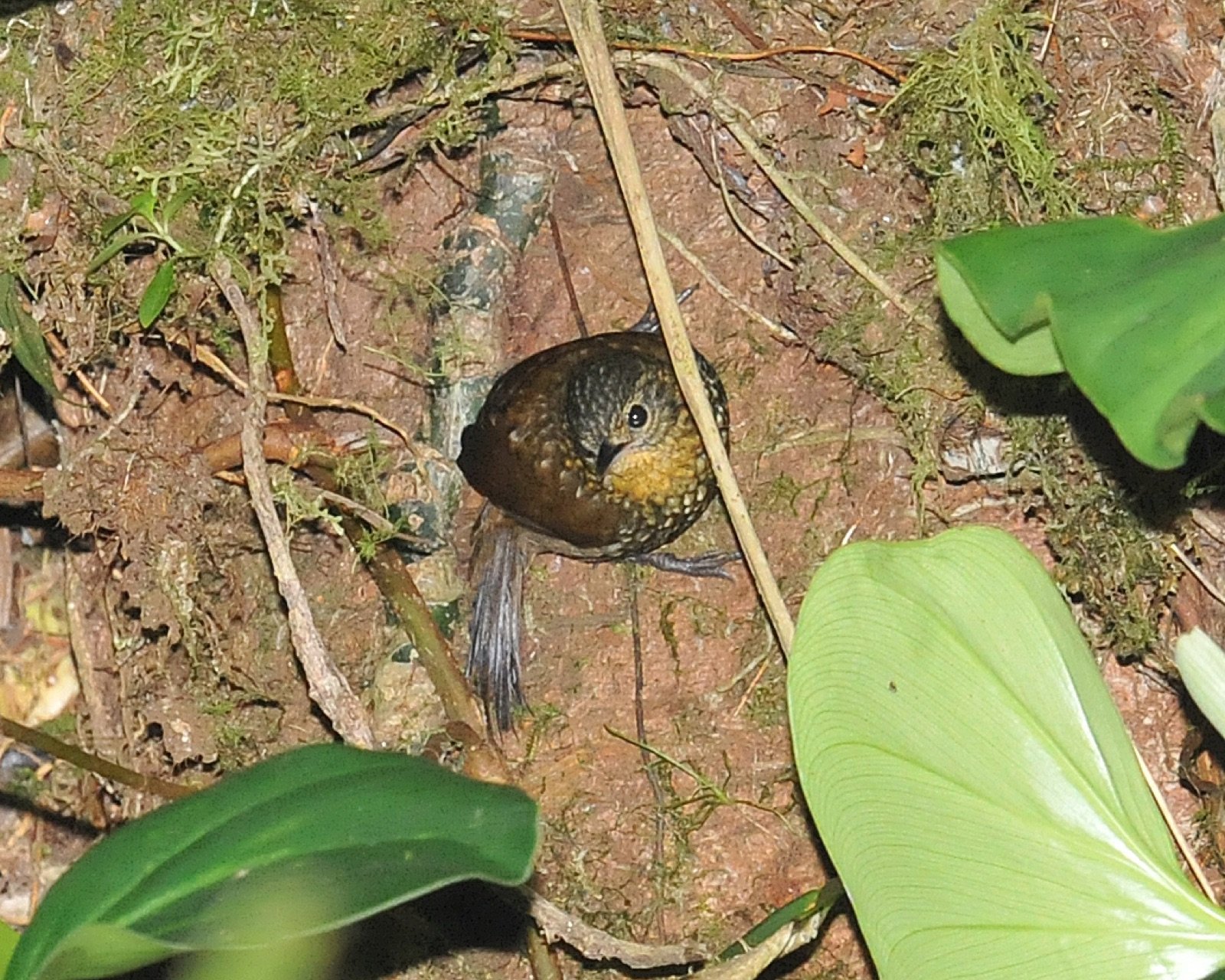
The Spotted Barbtail (Subepalo Moteado) is a small, plump, dark brown bird of about 14 cm, with buffy teardrop spots across its underparts. It is common at middle elevations on both slopes of Costa Rica.
It is usually unobtrusive, so it rewards a quiet approach. On a trip we build, guests tend to meet it on cloud forest trails, when a mixed-species flock or an army ant swarm moves through and slowly reveals its members.
For a beginning birder it is a lesson in patience: stand still, watch the flock, and let the quiet birds come into view.
How to find it
Start with mixed-species flocks in cloud forest, where guides often find it. Check army ant swarms in mid-elevation forest too: tour groups have watched two Spotted Barbtails hunting around one at Bosque de Paz, and another birder saw one at an ant swarm at Santa Elena. At Santa Elena a quiet, stealthy flock followed a swarm and slowly revealed several birds, including this one. At Tapanti National Park, a flock near the ranger station gave close looks, and the park has an easy wide road and a loop trail. Listen for the high, thin song with its final trill, and be patient, because a flock reveals its members slowly.
How to recognise it
Look for a small, plump, dark brown bird about 14 cm long.
The underparts are heavily marked with buffy teardrop spots. The tail feather shafts stick out like soft spines, because the feathers lack barbs on the last few millimetres. That spiny tail helps separate it from other brown, streaky foliage-gleaners.
Elsewhere in its range the throat is buffy-ochre, the eye-ring and eyebrow are buffy, and the cap and back are dark olive-brown. The lower mandible is pale.
What it sounds like
Recording: Thibaud Aronson, CC BY-SA 4.0, source, read 4 Nov 2026.
Behaviour and diet
The Spotted Barbtail creeps along moss-covered trunks and branches and is usually unobtrusive. It often hangs upside down while gleaning insects from bark and moss.
Across its range it often forages in the midstory of humid mountain forest, frequently with mixed-species flocks. At Monteverde, a flock may include it probing mossy limbs and bromeliads alongside the Buffy Tuftedcheek and Ruddy Treerunner.
Where it lives
In Costa Rica it is common at middle elevations on both slopes. It occurs from about 600 m on the Caribbean side and about 1000 m on the Pacific side, up to roughly 2450 m.
Across its range it lives in the undergrowth of humid mountain and foothill forest, mostly between 900 and 2500 m. One documented Costa Rican nest was found at Agua Buena, at about 1,250 m, in a natural cavity, which shows the bird nests in the middle elevation band.
When to see it
The breeding season in Costa Rica runs from March to June. Tour groups have found it in late January and early February, and a July tour also found it in mixed flocks, which hints it can be seen in both the dry and the green season.
Similar birds
Across its range it resembles the Rusty-winged Barbtail, which has darker-plumaged cousins in dusky-brown upperparts and tail on our bird, but the Rusty-winged is a South American species. The White-throated Barbtail of Venezuela also looks similar, but the Spotted has tawny spots instead of white, smaller and sparser breast spots and a shallower bill. It does not occur in Costa Rica.
Names and lore in Costa Rica
Costa Ricans, like Panamanians and Ecuadorians, call it Subepalo Moteado. Other countries use other names for the same bird, such as Corretroncos Barranquero in Colombia and Cola-púa Moteada in Peru.
Status and conservation
The official Costa Rican bird list marks it R, a resident species, and BirdLife International rates it Least Concern.
Photography tips
Mixed flocks and army ant swarms bring it into view, so wait at a flock rather than chase it. The wide road at Tapanti National Park gives an easy, open setting for close looks.
How we know this 17 sources, each read on the date shown
- Aves de Costa Rica read 2026-11-04
https://avesdecostarica.com/Premnoplex-brunnescens.html - Wikipedia (Spanish) read 2026-11-04
https://es.wikipedia.org/wiki/Premnoplex_brunnescens - Peru Aves read 2026-11-04
https://www.peruaves.org/furnariidae/spotted-barbtail-premnoplex-brunnescens/ - Arthur Grosset read 2026-11-04
http://www.arthurgrosset.com/sabirds/spottedbarbtail.html - ResearchGate (review of taxonomy, distribution and breeding biology) read 2026-11-04
https://www.researchgate.net/publication/252928080_The_Spotted_Barbtail_Premnoplex_brunnescens_a_review_of_taxonomy_distribution_and_breeding_biology_with_additional_observations_from_northeastern_Ecuador - EcoRegistros read 2026-11-04
https://www.ecoregistros.org/ficha/Premnoplex-brunnescens - Cloudbridge Nature Reserve bird list read 2026-11-04
https://www.cloudbridge.org/wp-content/uploads/2020/04/Bird-Species-List-Costa-Rica-13-April-2020.pdf - Lista Oficial de las Aves de Costa Rica (AOCR) read 2026-11-04
https://listaoficialavesdecostarica.wordpress.com/lista-oficial/lista-oficial-online/ - Naturalist Journeys read 2026-11-04
https://www.naturalistjourneys.com/tours/2027/02/22/costa-rica-birding-across-the-continental-divide - Field Guides tour list 2023 read 2026-11-04
https://fieldguides.com/triplists/cr223PRINT.html - Birds of Passage blog read 2026-11-04
https://birdsofpassage.wordpress.com/2014/05/11/monteverde-costa-rica/ - Cornell Birds of the World read 2026-11-04
https://birdsoftheworld.org/bow/species/spobar1/cur/introduction - Field Guides tour list 2017 read 2026-11-04
https://fieldguides.com/triplists/cr217.html - Birding Craft read 2026-11-04
https://birdingcraft.com/wordpress/tag/prong-billed-barbet/ - WINGS Birding Tours read 2026-11-04
https://wingsbirds.com/tours/costa-rica-july/ - Wikipedia read 2026-11-04
https://en.wikipedia.org/wiki/Spotted_barbtail - Avibase read 2026-11-04
https://avibase.bsc-eoc.org/species.jsp?avibaseid=B023E37883BB7D29