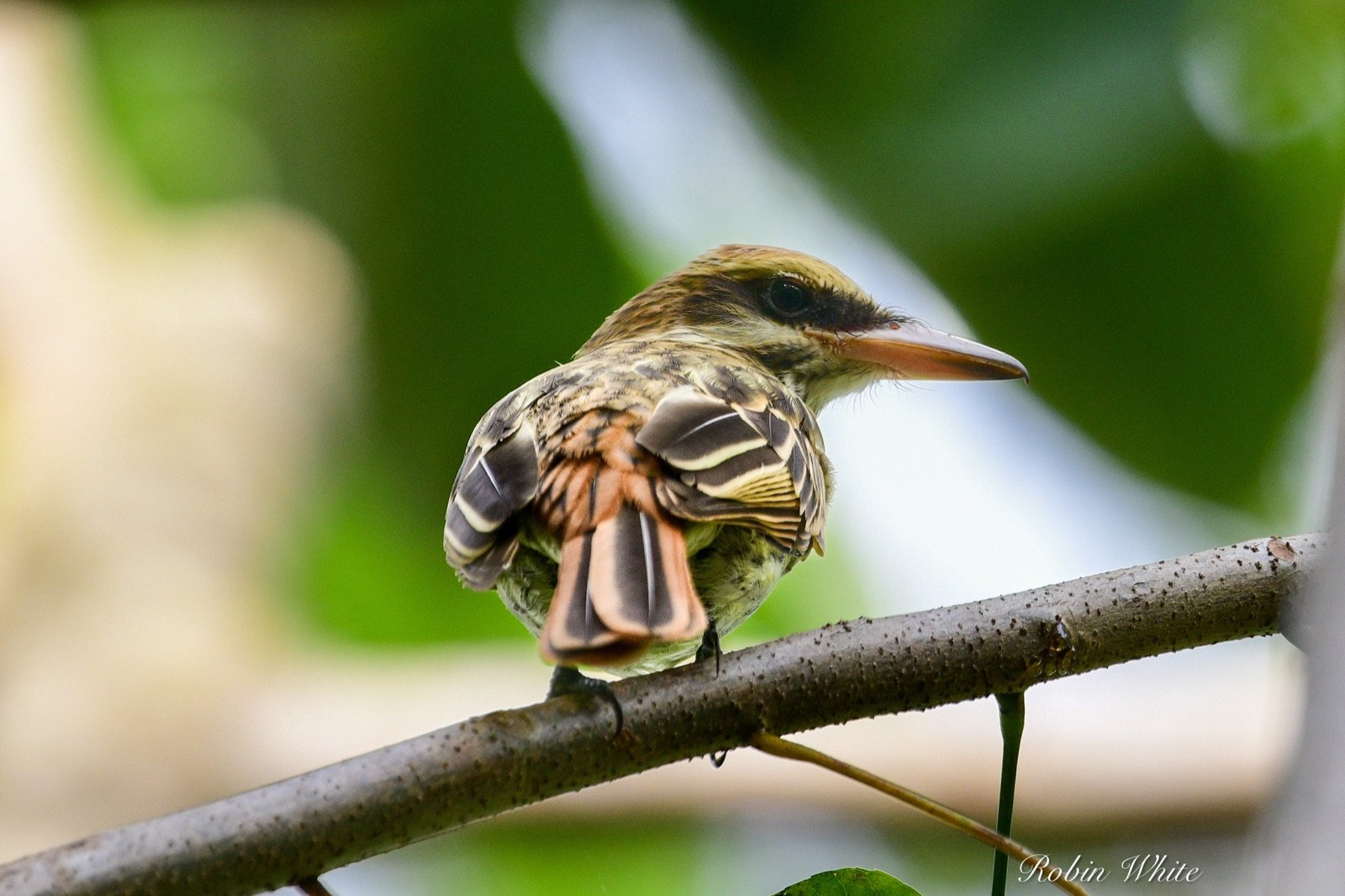
Family Tyrannidae
Streaked Flycatcher
Myiodynastes maculatus
In Spanish: Mosquero Listado (Pecho Amarillo)
- Resident
A noisy, streaky flycatcher of Pacific lowland forest, easy to hear near Carara.
The Streaked Flycatcher, Mosquero Listado in Spanish, is fairly common in the Pacific lowlands of Costa Rica. It is a brown, streaky tyrant flycatcher with a rufous tail and a loud voice.
It is noisy and often seen darting out from a perch after insects, so a beginner who learns its call has a real chance of finding it. It also tolerates people, which is why it turns up around buildings as well as in forest.
On a trip we build around Tárcoles and Carara National Park, it is one of the flycatchers to look and listen for.
How to find it
Listen before you look: the sharp 'kip!' and the two-part 'sqiii-zip' give the bird away. Start on the Pacific side in the lowlands, in forest and secondary forest. Scan high perches for a bird darting out after insects, then check canopy foliage where it picks berries and insects. Garden edges near Carara are worth a slow look, since birders have logged it there with Gray-capped and Social Flycatchers. Pairs may nest in buildings, so check eaves near lodges.
How to recognise it
This is a fairly large flycatcher, 20.5 to 23 cm (8.1 to 9.1 in) long and weighing 36.5 to 50 g, measured across its whole range. Look for:
A streaked brownish crown and a brown streaked back.
Pale yellowish-white underparts with dark streaks on the breast and flanks.
A rufous tail.
A buffy eyebrow, a dark stripe from the bill down the cheek, and a pink base to the lower bill.
Both sexes have a hidden yellow crown patch. Adults show a white chin and throat with light dark streaking, and the cheeks are pale yellow with a dusky streak on the malar area. Young birds have a rufous crown with heavy black streaks and no yellow.
What it sounds like
Behaviour and diet
The Streaked Flycatcher catches flying insects, mostly wasps and ants, from a high perch. More often it hops over dense foliage to take cicadas, other insects and small lizards. It also eats berries and arillate seeds.
Birders usually notice it darting out from a perch after insects, or picking insects and berries from foliage in the canopy. It is a noisy bird, and that is how most people find it first.
Where it lives
In Costa Rica it is fairly common in the Pacific lowlands. It is less common at higher elevations on that slope and only casual on the Caribbean side. It ranges up to about 1,200 m (3,900 ft).
A Costa Rica bird list describes it as a widespread, common lowland species, usually inside forest or secondary forest. The breeding subspecies, difficilis, occurs through western Costa Rica.
When to see it
Costa Rica's population includes permanent residents and migrants from the north. The bird is clearly less common in Guanacaste outside the breeding season, and it is unclear whether the whole breeding population leaves.
Similar birds
The usual confusion is the Sulphur-bellied Flycatcher. The Streaked has a thicker, paler bill and a white throat and chin, and any yellow below is stronger on the breast. Its belly is a lighter yellow and it is generally less cleanly streaked. Its dark cheek stripes are much thinner and do not meet under the chin, and the call differs too.
Names and lore in Costa Rica
In Costa Rica the bird is called Mosquero Listado. Elsewhere it has other Spanish names, such as bienteveo rayado in Argentina and chilero rayado in Honduras.
Status and conservation
The AOCR list marks it as a resident, a rare resident in places and a migrant (R, RR, M), and it is fairly common in the Pacific lowlands.
Photography tips
Pairs may nest in human structures, so check building eaves near lodges. Nests are also placed in tree holes, between palm leaf bases and in nest boxes, 2.5 to 23 m up. A bird on a high exposed perch, calling, is your best chance for a clear view.
How we know this 15 sources, each read on the date shown
- Wikipedia read 2026-11-04
https://en.wikipedia.org/wiki/Myiodynastes_maculatus - Flickr (Historia Natural de Costa Rica text) read 2026-11-04
https://www.flickr.com/photos/jobando/40657313545 - Birds of the World (Cornell) read 2026-11-04
https://birdsoftheworld.org/bow/species/strfly1/cur/identification - Birds of Costa Rica (Tom Friedel) read 2026-11-04
https://www.birdsofcolombia.org/costarica/Myiodynastes.html - Wikipedia (es) read 2026-11-04
https://es.wikipedia.org/wiki/Myiodynastes_maculatus - Aves de Colombia read 2026-11-04
https://birdscolombia.com/2018/02/02/siriri-rayado-streaked-flycatcher-myiodynastes-maculatus/ - Cornell Birds of the World read 2026-11-04
https://birdsoftheworld.org/bow/species/strfly1/cur/introduction?media=audio - Listening to Birds (John Gordon blog) read 2026-11-04
https://thecanadianwarbler.blogspot.com/2025/03/costa-rica.html - FotoNat (Spanish Wikipedia text) read 2026-11-04
https://fotonat.org/taxa/myiodynastes-maculatus - Wikipedia read 2026-11-04
https://en.wikipedia.org/wiki/Streaked_Flycatcher - Costa Rica Focus read 2026-11-04
https://www.costaricafocus.com/hotspot/carara-national-park/ - Field Guides Birding Tours read 2026-11-04
https://fieldguides.com/triplists/cos18.html - Eagle-Eye Tours read 2026-11-04
https://www.eagle-eye.com/blog/costa-rica-sampler-trip-report-feb-16-27-2026/ - La Iguana local bird guide read 2026-11-04
https://www.golflaiguana.com/wp-content/uploads/sites/9272/2023/10/Wildlife_page.pdf - Costa Rican natural history record (via Flickr) read 2026-11-04
https://www.flickr.com/photos/jobando/39739422200