Family Tinamidae
Thicket Tinamou
Crypturellus cinnamomeus
In Spanish: Tinamú Canelo (Gallina de monte, Gongolona, Perdiz)
- Resident
Red-legged ground bird of Guanacaste dry forest, heard before it is seen
The Thicket Tinamou is a resident across a wide area of the northern Pacific slope, usually common in large patches of leftover tropical dry forest. It is the only tinamou over most of that region, so a tinamou in Guanacaste dry forest is probably this one.
Most people meet it by ear first. A Guanacaste field biologist says he often hears it before he sees it, and one Guanacaste naturalist calls its whistle the sound of Guanacaste.
On a trip we build through Guanacaste, real dry forest in places such as Santa Rosa, Palo Verde and Rincon de la Vieja is where guests have a chance to meet it.
How to find it
Look for real dry forest, not pasture with scattered trees. Be on the trail at dawn or dusk, when the bird is most vocal, and listen for the whistle before you try to spot anything. The easy loop trail near the Casona at Santa Rosa is a dry forest walk where one is possible, and Banded Wren and trogons are also expected there. At Santa Rosa this tinamou is less shy than elsewhere in its Costa Rican range, so it is easier to see. Patience and a tolerance for mosquitoes are still needed.
How to recognise it
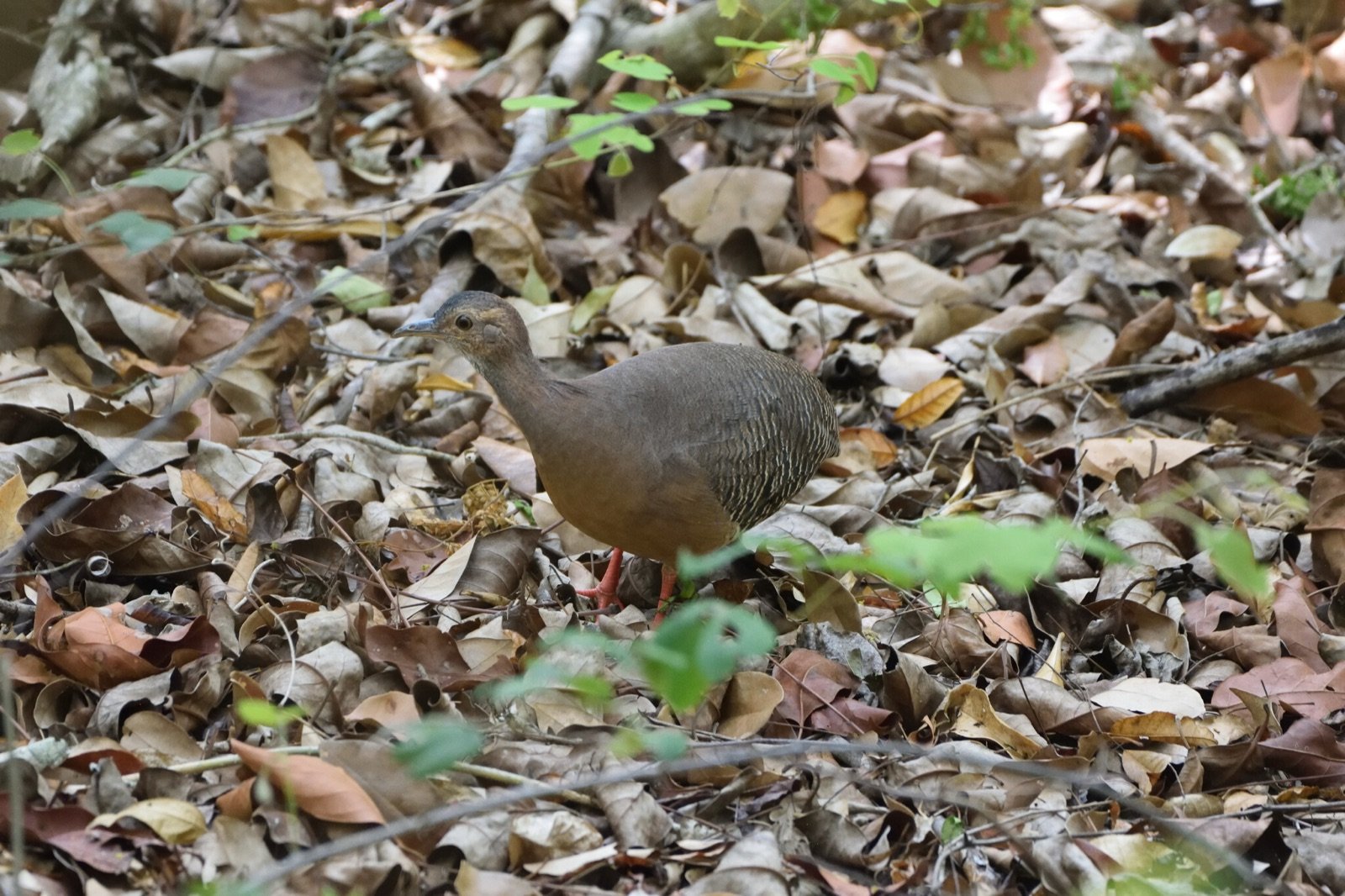
This is a medium-sized tinamou, about 28 cm long, with red legs and a strongly marked pattern. One writer calls it a fat, oversized, tailless dove, and both sexes have bright orange legs.
Above, adults are heavily barred brown or buff and black. Below, they are mostly cinnamon-buff, with black bars on the flanks and a white throat. The upper bill is blackish and the lower one yellowish.
The sexes differ. Females have broad, fine black barring on the breast. Males show little or no barring there and have a plain brown chest.
What it sounds like
Behaviour and diet
The Thicket Tinamou is usually solitary and stays hidden in dense scrub, vine tangles and ground bromeliad thickets. It is most active and vocal at dawn and dusk, especially in the dry season. Walking through dry leaves it can be quite noisy.
When disturbed it usually runs into cover and flushes only at close range. The male incubates the eggs and cares for the chicks, and females may lay eggs in the nests of several males. The nest is a leaf-lined hollow on the forest floor.
Where it lives
In Costa Rica it ranges from sea level to about 500 m in the Guanacaste range, and up to 1,000 m along the mountains of the Nicoya Peninsula. It walks the floor of mature and secondary forest and prefers dense undergrowth, especially spiny ground bromeliads. In the dry season it retreats to evergreen gallery forest.
The Costa Rican form lives in the western lowlands from the Gulf of Nicoya to the foot of the Guanacaste cordillera. It probably also reaches the lower slopes of the Tilarán range.
When to see it
Breeding runs from March to August, and one photo shows an incubating bird on 20 May 2025. It is most vocal in the dry season.
Similar birds
Slaty-breasted Tinamou also has red legs but is much darker, with a clearly slaty breast, and it does not live in the dry lowlands. Guanacaste staff say the Thicket shows clearer barring and that the two are easy to separate by voice and range. Little Tinamou is plainer and greyer on the head and throat. All other Costa Rican tinamous and quail have dull-coloured legs.
Names and lore in Costa Rica
Costa Ricans use several names for this bird: congolona, gongolona, perdiz and tinamú canelo, which means cinnamon tinamou and is the name bird books and biologists use. Just about everyone else says gallina de monte, which means bush chicken or wild chicken. Larger tinamous are also called gongolonas, and the smaller ones yerre.
Status and conservation
It is a resident (R) on the AOCR list, and the IUCN rates it Least Concern because of its wide range.
Photography tips
Good light and binoculars are needed to see the clearer barring that separates it from Slaty-breasted Tinamou. A Guanacaste biologist says a bird startled beside a trail may burst out of the brush suddenly, so keep your camera ready.
How we know this 17 sources, each read on the date shown
- Aves de Costa Rica read 2026-11-04
https://www.avesdecostarica.com/Crypturellus-cinnamomeus.html - Cornell Birds of the World read 2026-11-04
https://birdsoftheworld.org/bow/species/thitin1/cur/systematics - BirdForum gallery read 2026-11-04
https://www.birdforum.net/gallery/thicket-tinamou.704612/ - Ecoregistros read 2026-11-04
https://www.ecoregistros.org/ficha/Crypturellus-cinnamomeus - Cornell Birds of the World read 2026-11-04
https://birdsoftheworld.org/bow/species/thitin1/cur/introduction?lang=es - Simply Birding read 2026-11-04
https://www.simplybirding.com/birds/thicket-tinamou-crypturellus-cinnamomeus/ - Tierra de cigueñas read 2026-11-04
https://ciconiiformes.blogspot.com/2012/12/tinamu-canelo-crypturellus-cinnamomeus.html - Asociación Ornitológica de Costa Rica read 2026-11-04
https://avesdecostarica.weebly.com/tinamidae.html - The Tico Times read 2026-11-04
https://ticotimes.net/2023/08/04/costa-rica-wildlife-meet-the-thicket-tinamou - Birding Craft read 2026-11-04
https://birdingcraft.com/wordpress/2017/05/04/good-birding-at-santa-rosa-national-park/ - Birding Craft read 2026-11-04
https://birdingcraft.com/wordpress/2016/03/09/looking-for-tinamous/ - Bird Alliance of Oregon read 2026-11-04
https://birdallianceoregon.org/event/guancastecr2024/ - Birding Craft read 2026-11-04
https://birdingcraft.com/wordpress/2017/02/01/a-few-tips-for-dry-forest-birding-in-costa-rica/ - Wikipedia read 2026-11-04
https://en.wikipedia.org/wiki/Thicket_tinamou - Birds of the World read 2026-11-04
https://www.hbw.com/species/eastern-thicket-tinamou-crypturellus-cinnamomeus - Área de Conservación Guanacaste read 2026-11-04
https://www.acguanacaste.ac.cr/paginas-de-especies/insectos-2/6458-i-crypturellus-cinnamomeus-i-tinamidae - Birdingcraft read 2026-11-04
http://birdingcraft.com/wordpress/2009/10/21/how-to-see-tinamous-in-costa-rica/