Family Hirundinidae
Tree Swallow
Tachycineta bicolor
In Spanish: Golondrina Bicolor
- Migrant
Glossy blue-green above, pure white below: a swallow that visits from the north.
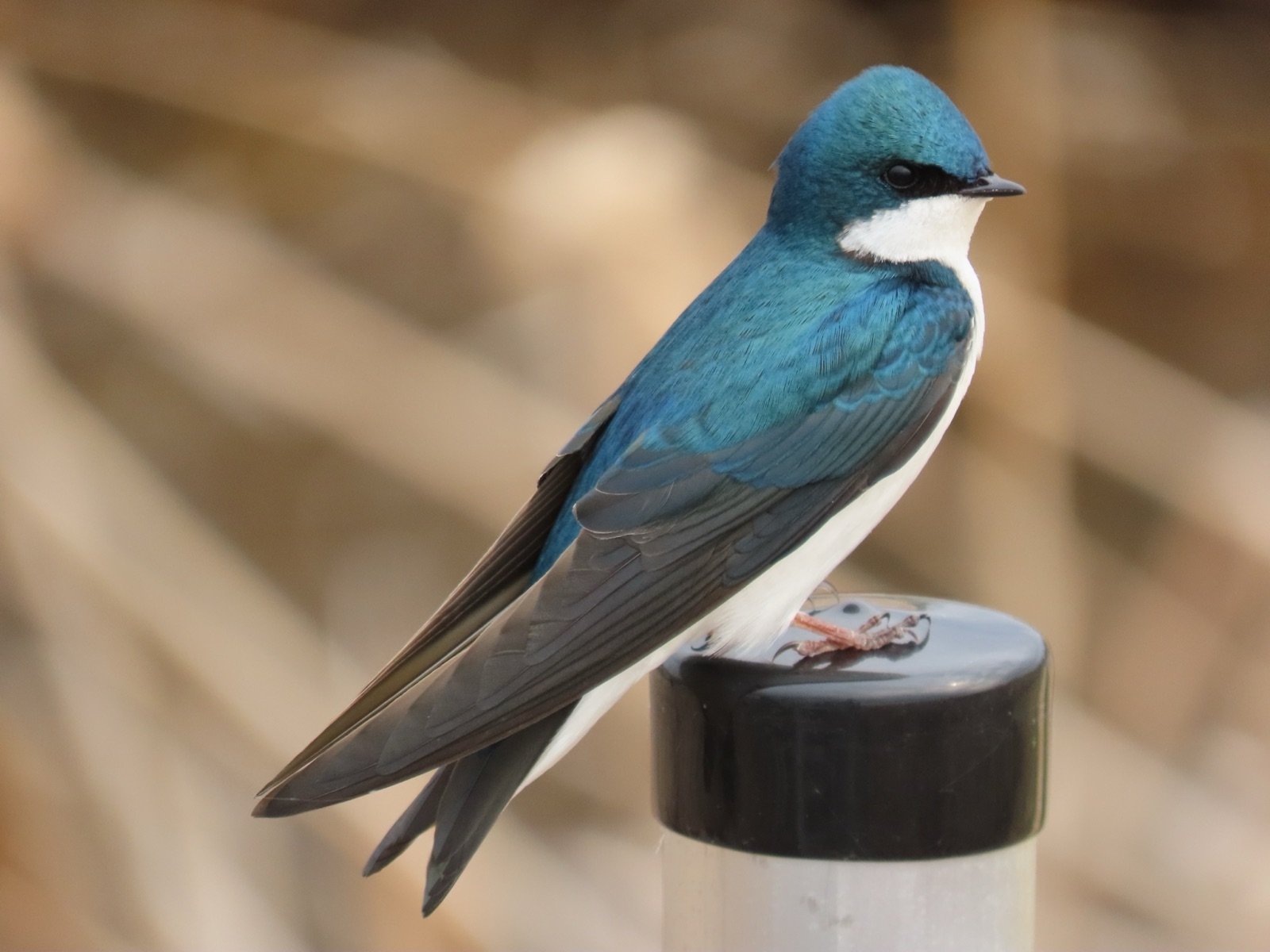
The Tree Swallow (Golondrina Bicolor) is a small migrant swallow, about 14 cm long, glossy dark blue-green above and pure white below. Costa Rica has no resident Tree Swallows. They come from the north as passage birds in autumn and spring, plus some winterers.
In Costa Rica it is an irregular migrant, rare to locally common. Numbers swing widely from year to year, and birders have met irruptions of 100 or more, yet in most years it is only rare to occasional.
On a trip we build, the best approach is to scan flocks of other swallows over open country and water, and look for the few that stand out in clean white.
How to find it
Look for open ground near water, where flocks hunt. Scan the larger flocks of other migrant swallows, because a few Tree Swallows are often tucked among them. This happens both on autumn passage and in winter. Check for white undertail coverts and a deeper tail notch to pick them out. Sometimes they form large single-species flocks, so keep an eye out for that. Expect numbers to change from one year to the next.
How to recognise it
Field marks to look for:
The adult male is glossy dark blue-green above, with blackish wings and tail. Below it is pure white, sometimes with a grayish tint on the breast. The tail is notched, and the undertail coverts are white. It is a small swallow, about 14 cm long.
Juveniles look different. They are grayish brown above, with a dusky band across the chest. Their underparts are clearer white than those of young Bank or Northern Rough-winged Swallows, a useful clue when a mixed flock sweeps past.
What it sounds like
Behaviour and diet
The Tree Swallow catches insects in flight. It forages up to about 50 m above the ground, alone or in groups, and its flight mixes flapping and gliding. It glides more than other swallows.
Just before sunset, flocks can gather in dense swirling clouds over a roost site, then drop down to perch. In Costa Rica, a few Tree Swallows are often tucked among larger flocks of other migrant swallows, though sometimes they form large single-species flocks.
Where it lives
In Costa Rica it ranges from the lowlands of both slopes up to about 1500 m. It is a migrant and winter resident.
It frequents pastures and open savanna near ponds, marshes or salt pans, and sometimes flies over open water.
When to see it
It is a passage migrant from early September to late October and again in March and April. It is also a winter resident.
Similar birds
It is larger than the Blue-and-white Swallow, with longer wings and tail, a deeper tail notch and white undertail coverts. Juveniles resemble Bank Swallows, but the Bank Swallow is smaller, with a crisp, clean-edged brown breast band, white behind the ear and a paler brown rump. Violet-green Swallow is a rare migrant in Costa Rica; its white reaches above and behind the eye and it has white patches on the rump sides, while the Tree Swallow's white does not reach above the eye.
Names and lore in Costa Rica
The official Spanish name on the Costa Rican list is Golondrina Bicolor. Plain 'golondrina' is also used as a common name.
Status and conservation
The AOCR lists it as a migrant (M), and the species is rated Least Concern.
Photography tips
Look for open ground near water, where flocks hunt. Birds forage up to about 50 m above the ground, so a flock hunting low over a pond gives the best chance of a clear view.
How we know this 11 sources, each read on the date shown
- NatureServe Explorer (citing Stiles and Skutch 1989) read 2026-11-04
https://explorer.natureserve.org/Taxon/ELEMENT_GLOBAL.2.101167/Tachycineta_bicolor - Aves de Costa Rica read 2026-11-04
https://avesdecostarica.com/Tachycineta-bicolor.html - Guide to Boreal Birds read 2026-11-04
https://www.borealbirds.org/bird/tree-swallow - Amigos Alados read 2026-11-04
https://amigosalados.org/Tree-Swallow.php - Wikipedia read 2026-11-04
https://en.wikipedia.org/wiki/Tree_swallow - National Geographic read 2026-11-04
https://www.nationalgeographic.com/animals/birds/facts/tree-swallow - Southern Wisconsin Bird Alliance read 2026-11-04
https://swibirds.org/blog/2025/7/17/whos-that-singing-tree-swallow - EcoRegistros read 2026-11-04
https://www.ecoregistros.org/ficha/Tachycineta-bicolor - Audubon Field Guide read 2026-11-04
https://www.audubon.org/field-guide/bird/tree-swallow - Illinois DNR read 2026-11-04
https://dnr.illinois.gov/education/wildaboutpages/wildaboutbirds/wildaboutbirdscrows/wabtreeswallow.html - All About Birds, Cornell Lab read 2026-11-04
https://www.allaboutbirds.org/guide/Tree_Swallow/overview