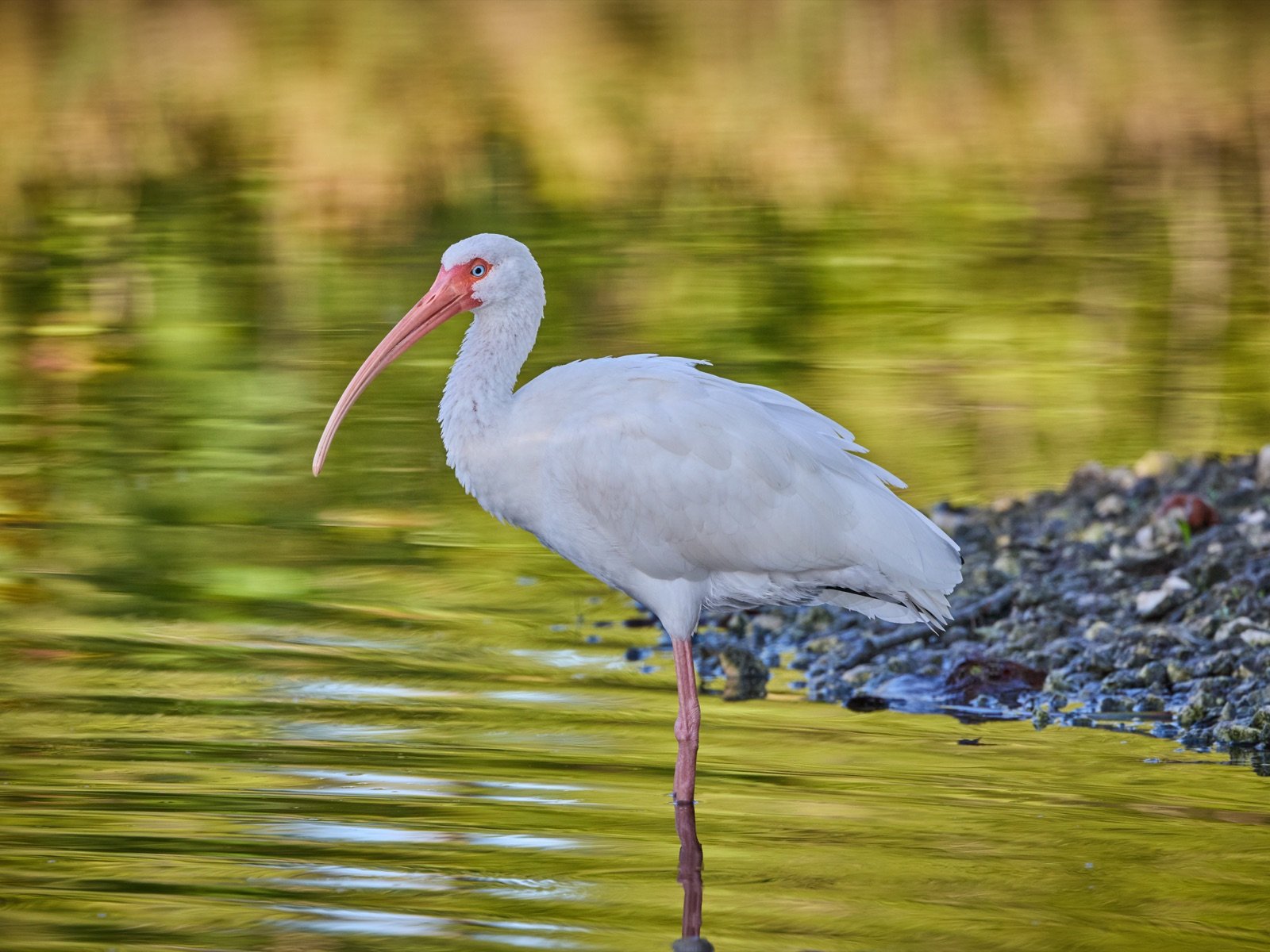
 White Ibis
Family Threskiornithidae
White Ibis
Eudocimus albus
In Spanish: Ibis Blanco (Coco)
- Resident
The only mostly white Costa Rican ibis, probing mud around the Gulf of Nicoya.
The White Ibis (Ibis Blanco, or Coco) is the only Costa Rican ibis with a large amount of white in its plumage. Slim, with a curved bill and about 63 cm long, it is easy to pick out once you know where to look.
In Costa Rica it is most abundant around the Gulf of Nicoya and the Tempisque River basin, and it breeds on Isla Pájaros in the Tempisque River. On a trip we build, a boat tour on the Tempisque passes Isla de los Pájaros, where about 3,000 water birds nest, white ibis among them, with roseate spoonbills and wood storks.
It is a social bird that feeds and flies in flocks, so a good morning on the mud is a lively one for a beginning birder.
How to find it
Around the Gulf of Nicoya, estuaries and coastal areas are good places to look. Low tide is best, when the ibises feed on exposed mud. At Tárcoles they are often seen feeding on mudflats among the mangrove swamps, which makes the river mouth a good place to start. A wildlife refuge in the northern lowlands is named as a place to see them, especially on boat tours. At Palo Verde, the dry months concentrate birds in the remaining pools, so they are easier to spot. On the Tempisque, a boat tour passes the nesting island.
How to recognise it
Adults are white with pink facial skin and a long downcurved red-orange bill and legs. The black wingtips usually show only in flight, so a perched adult can look entirely white apart from the colour on the face, bill and legs.
In Costa Rica it is the only ibis with a large amount of white, which narrows the choice quickly. It is slim, with a curved bill, and about 63 cm long.
Young birds look quite different. They are mostly brown with a white rump, underwings and underparts, and they turn white over about two years. A flock can therefore mix clean white adults with darker young birds in the same line.
What it sounds like
Recording: Fyn Kynd, CC BY-SA 4.0, source, read 4 Nov 2026.
Behaviour and diet
The White Ibis pushes its bill into soft mud and finds mollusks and other invertebrates by touch. These are social birds that usually feed and fly in flocks. They gather in shared roosts, mostly in mangroves, and often perch in trees.
In flight the neck and legs are stretched out, often in long loose lines or V shapes, with alternating flaps and glides. It makes strong seasonal movements linked to changes in the water level of its habitat, so numbers at one spot can change through the year.
Where it lives
The White Ibis is found in fresh and salt water habitats, including mangroves, estuaries, lakes and lagoons. In Costa Rica it is most abundant around the Gulf of Nicoya and the Tempisque River basin.
It is seasonally common from the Río Frío region southward, and locally along the Pacific coast. In the other lowland areas of both slopes it is rare and sporadic.
When to see it
Breeding starts early in the rainy season, with a peak in June, and the nest is a stick platform in a mangrove tree, usually holding two eggs. At Palo Verde, the dry season (roughly December to March) gives the best sightings, as falling water levels crowd birds into the remaining pools.
Similar birds
The decurved bill and black wingtips separate an adult White Ibis from white egrets. A young White Ibis can be mistaken for a young Glossy Ibis, but the Glossy is wholly dark brown and has no white belly or rump.
Names and lore in Costa Rica
Other Spanish names for this ibis across Latin America include Coco Blanco, coco pato and Corocoro Blanco. The Costa Rican name listed is plain Ibis blanco.
Status and conservation
The AOCR lists it as a resident (R), and the global population is judged stable, last assessed in 2021.
Photography tips
At Tárcoles, ibises are often seen feeding on mudflats among the mangrove swamps, which makes the river mouth area a good place to look for them. Low tide on the Gulf of Nicoya brings them onto exposed mud.
How we know this 15 sources, each read on the date shown
- Flickr (Costa Rican natural history account, Palo Verde National Park photo) read 2026-11-04
https://www.flickr.com/photos/jobando/33224445850 - World Bird Photos read 2026-11-04
https://www.worldbirdphotos.com/photo/ibis-american-white-eudocimus-albus-costa-rica-2/ - Flickr (Costa Rican natural history account, Carara photo) read 2026-11-04
https://www.flickr.com/photos/jobando/26219802785 - Wikipedia read 2026-11-04
https://en.wikipedia.org/wiki/American_white_ibis - IUCN Red List read 2026-11-04
https://www.iucnredlist.org/species/22697411/188454802 - Nicoya Peninsula (Palo Verde page) read 2026-11-04
https://nicoyapeninsula.com/naturereserves/paloverde/ - Howler Magazine read 2026-11-04
https://howlermag.com/costa-rica-white-ibis/ - Costa Rica Fayla Tours read 2026-11-04
https://www.costaricafaylatours.com/what-can-first-time-birdwatchers-expect-at-palo-verde-national-park/ - Trek Zone read 2026-11-04
https://trek.zone/en/costa-rica/animals/american-white-ibis - Cornell Lab, All About Birds read 2026-11-04
https://www.allaboutbirds.org/guide/White_Ibis/sounds - JungleDragon read 2026-11-04
https://www.jungledragon.com/specie/254/american_white_ibis.html - Texas Saltwater Fishing Magazine read 2026-11-04
https://www.texassaltwaterfishingmagazine.com/fishing/white-ibis - National Wildlife Foundation species page read 2026-11-04
https://nwlfd.org/species/white-ibis - Avibase read 2026-11-04
https://avibase.bsc-eoc.org/species.jsp?avibaseid=74EDE3CA - Flickr (Wikipedia-based text) read 2026-11-04
https://www.flickr.com/photos/gogolac/52042539352