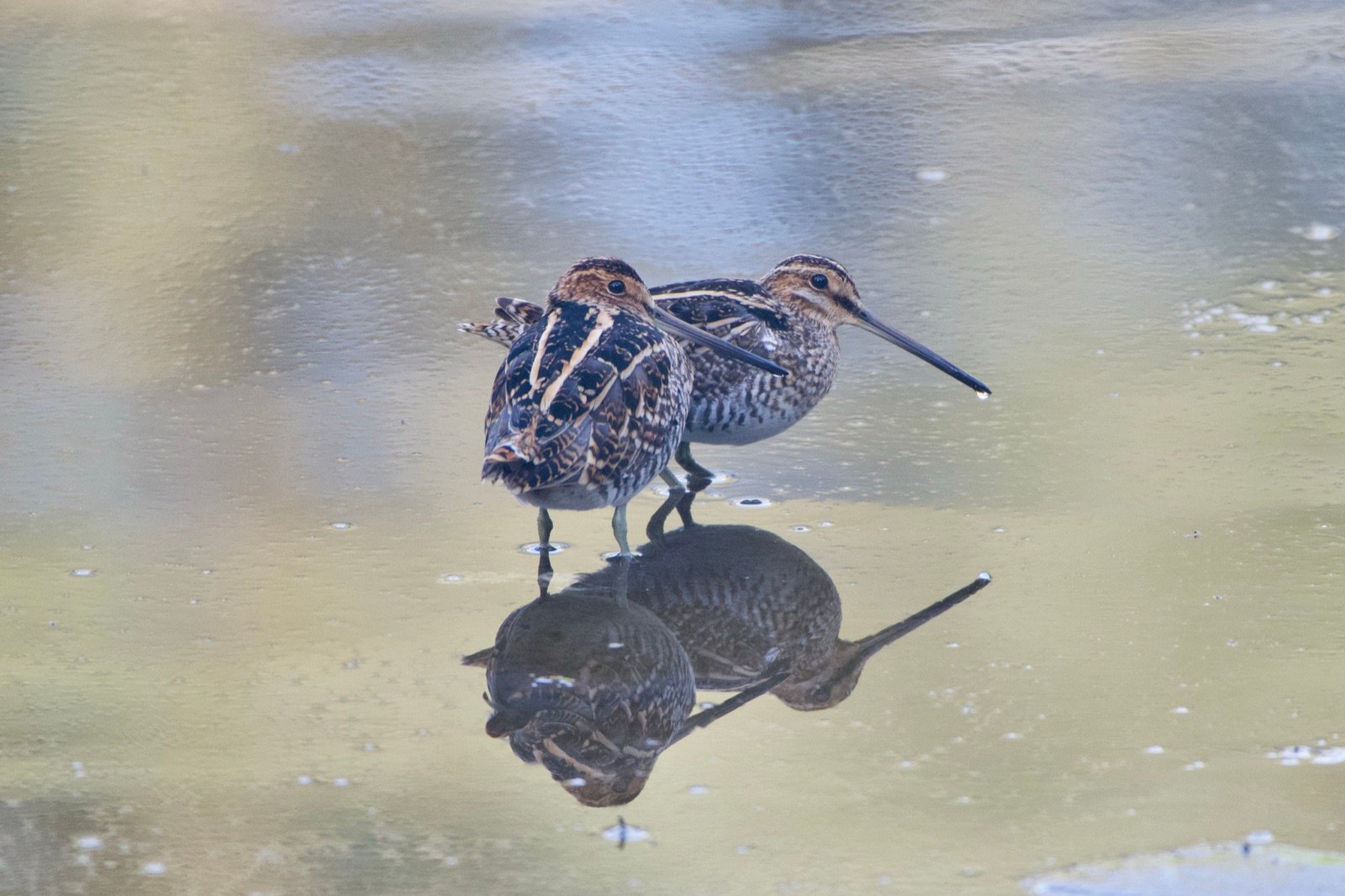
Family Scolopacidae
Wilson's Snipe
Gallinago delicata
In Spanish: Becacina Común (Becada)
- Migrant
A striped, pudgy winter migrant that sits tight until nearly stepped on.
Wilson's Snipe (Becacina Común, also called Becada) is a bird you often meet by surprise. When alarmed it crouches and freezes, and it usually flushes only when nearly stepped on, then flies low and erratically before dropping suddenly to the ground.
In Costa Rica it is a migrant and winter resident, widespread but usually uncommon. It arrives in mid to late October and stays until March or April.
On a trip we build to the northern plains, a Ramsar-protected wetland refuge counts it among its wetland highlights, and birders have also met it on flooded cattle pasture.
How to find it
Look at wet places, not dry ground: grassy marshes, flooded pastures, roadside pools and puddles. On one tour, a snipe was found in a roadside pool, and seven Least Sandpipers were feeding in a roadside puddle on the way there, so shorebird flocks deserve a second look for a striped head. Another group saw it on a flooded cattle pasture alongside Black-bellied Whistling-Ducks, Blue-winged Teal and Glossy Ibis. One was flushed by chance from a small leftover wetland at La Ceiba in Guanacaste, which fits its habit of sitting tight. Walk slowly and watch the ground ahead of you.
How to recognise it
Look for a pudgy shorebird with short legs and a striped head.
The back carries long buffy streaks. In Costa Rica, field guides describe two bold buff stripes down each side of the back.
The underparts are white, with flanks barred in black, brown and buff.
The tail is orange with a black band near the tip, a detail you may catch as the bird flies off.
The eyes sit far back on the head. This lets the bird watch for predators on both sides while its bill is buried in the mud.
What it sounds like
Recording: Anders Hastings, CC BY 4.0, source, read 4 Nov 2026.
Behaviour and diet
By day it feeds alone or in loose groups. It pushes its bill deep into soft mud, or pecks at the surface, grass or shallow water, taking worms, insect larvae, small snails and seeds.
When alarmed it crouches and freezes. It usually flushes only when nearly stepped on, then flies low and erratically before dropping suddenly to the ground.
It usually sleeps in flocks. It also moves seasonally in response to changes in water level in its habitat.
Where it lives
In Costa Rica it lives in grassy marshes, ponds, lakes and lagoons, and it also uses watery meadows and rain puddles.
It is widespread from the lowlands up to mid elevations, and during migration it sometimes reaches 3,000 m.
Sizeable concentrations still occur in the Central Valley, especially around Cartago. It has also turned up in Guanacaste and in the wetlands of the northern plains.
When to see it
It arrives in mid to late October and stays until March or April.
Similar birds
The bill looks like a dowitcher's, but the stocky body and the lack of a white rump separate the two. It is smaller than a Long-billed Dowitcher, with shorter legs and a pudgier body, and the streaked back and striped head help too. Until 2003 it was treated as a subspecies of the Common Snipe, which it closely resembles. It has 16 tail feathers, against 14 in the Common Snipe.
Names and lore in Costa Rica
Costa Ricans use the names Becada and Becacina Común for this bird, and the official list gives Becacina Común (Becada) as the Spanish name.
Status and conservation
The official Costa Rican bird list marks it as M, a migrant, and it is a widespread but usually uncommon winter resident, rated Least Concern on the IUCN Red List.
Photography tips
Snipe usually sit tight until you are almost on top of them, so approaching one for a photo is hard. They forage on the ground but sometimes perch on posts or stumps, where they are easier to see. They are most active at dawn and dusk, often doze through the day, and like thick, low vegetation where they can hide.
How we know this 19 sources, each read on the date shown
- Aves de Costa Rica read 2026-11-04
https://www.avesdecostarica.com/Gallinago-delicata.html - Birds of the World (Cornell) read 2026-11-04
https://birdsoftheworld.org/bow/species/wilsni1/cur/multimedia?lang=es&media=photos - Ecos del Bosque (citing Stiles and Skutch) read 2026-11-04
https://ecosdelbosque.com/fauna/gallinago-delicata - Costa Rican natural history account (Flickr, Aves de Costa Rica text) read 2026-11-04
https://www.flickr.com/photos/jobando/52593289643 - Birds of the World (Cornell) read 2026-11-04
https://birdsoftheworld.org/bow/species/wilsni1/cur/introduction - Lista Oficial de las Aves de Costa Rica (AOCR) read 2026-11-04
https://listaoficialavesdecostarica.wordpress.com/lista-oficial/lista-oficial-online/ - Wikipedia read 2026-11-04
https://en.wikipedia.org/wiki/Wilson's_snipe - Eastside Audubon Society read 2026-11-04
https://www.eastsideaudubon.org/corvid-crier/2022/4/wilsons-snipe - Animal Diversity Web read 2026-11-04
https://animaldiversity.org/accounts/Gallinago_delicata/ - Birding Craft read 2026-11-04
https://birdingcraft.com/wordpress/2022/12/15/some-local-tips-for-birding-costa-rica-in-guanacaste/ - Field Guides trip list read 2026-11-04
https://fieldguides.com/triplists/cr217.html - Eagle-Eye Tours read 2026-11-04
https://www.eagle-eye.com/blog/costa-rica-birding-tour-trip-report-jan-22-feb-7-2025/ - Birding for Conservation read 2026-11-04
https://www.birdingforconservation.com/2019/01/cano-negro-wildlife-refuge-birding-paradise/ - Animalia.bio read 2026-11-04
https://animalia.bio/es/wilsons-snipe - Ecosistemas de Costa Rica read 2026-11-04
https://ecosistemasdecostarica.blogspot.com/2012/08/aves.html - Aves y Ventanas Costa Rica read 2026-11-04
https://avesyventanascostarica.wordpress.com/algunas-aves-que-han-golpeado-contra-ventanas-en-costa-rica/ - Audubon Field Guide read 2026-11-04
https://www.audubon.org/field-guide/bird/wilsons-snipe - All About Birds (Cornell) read 2026-11-04
https://www.allaboutbirds.org/guide/Wilsons_Snipe/id - Birds Caribbean read 2026-11-04
https://www.birdscaribbean.org/tag/wilsons-snipe/