Family Scolopacidae
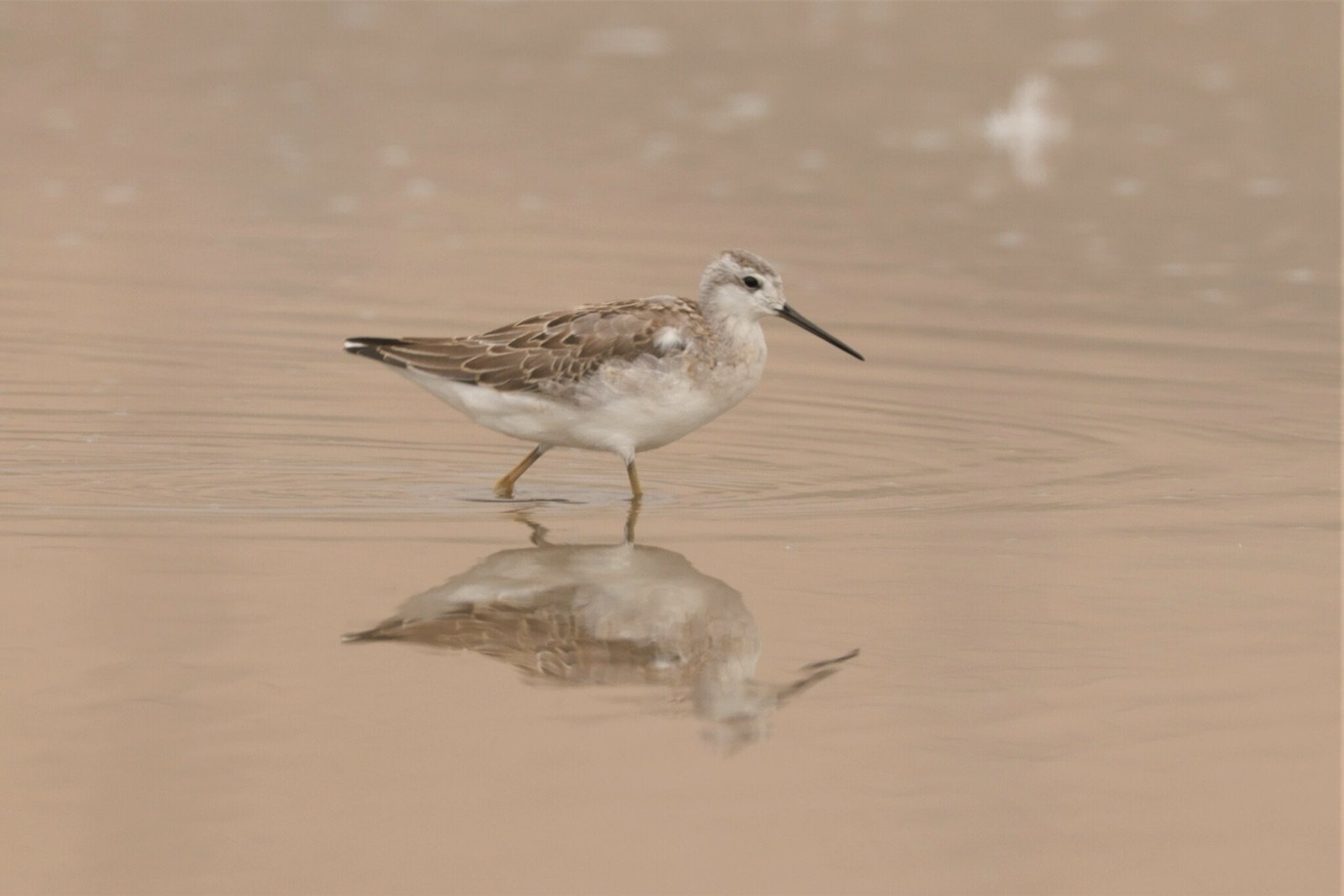
Wilson's Phalarope
Phalaropus tricolor
In Spanish: Falaropo Tricolor
- Migrant
A spinning, duck-like shorebird that stops over on Gulf of Nicoya salt pans.
Wilson's Phalarope (Falaropo Tricolor) is a small shorebird that swims like a tiny duck and feeds by spinning in tight circles. In Costa Rica it is a migrant, a traveller on its way somewhere else.
It breeds in western Canada and the western United States and winters mainly on inland salt lakes near the Andes in Argentina, so Costa Rica is only a stopover. Around the Gulf of Nicoya it is common to abundant in suitable habitat.
For a beginning birder it is a good one to learn: it is often very tame and approachable, it usually gathers in groups, and its feeding is easy to read once you know what to watch for.
How to find it
Start with the Gulf of Nicoya and check its salt pans first. Then try coastal lagoons, freshwater ponds and marshes. Scan the open water rather than only the mud edges, because this bird feeds mainly while swimming. Look for small pale birds turning in circles. Since it usually gathers in groups, finding one often means finding several. When a bird flies, check for the white rump and plain wings.
How to recognise it
The birds seen in Costa Rica are in non-breeding plumage, and in that plumage both sexes look alike.
Look for these marks:
- pale gray above and white below
- poorly defined face markings, with no black eye patch
- about 23 cm long, slightly larger than the Red Phalarope
- the largest and most land-loving of the three phalarope species
The best mark comes in flight. In every plumage a flying Wilson's Phalarope shows a white rump and plain wings with no white wing stripe. That separates it from the Red-necked and Red Phalaropes, which are slightly smaller and show a black eye patch in non-breeding plumage.
Behaviour and diet
Feeding is the signature of the species. It swims in tight spinning circles to bring small invertebrates to the surface, then picks them off. It also lunges at flies and probes soft mud.
In Costa Rica it usually gathers in groups, picking aquatic insects and small crustaceans from the water or mud surface. Birders at Gulf of Nicoya salt ponds say the birds behave like tiny ducks on the water.
Where it lives
On migration and in winter this phalarope prefers salty lakes rich in invertebrate prey. In Costa Rica the places to check are salt pans, coastal lagoons, freshwater ponds and marshes, with the Gulf of Nicoya the best area.
A Costa Rican natural history page maps its range in the Pacific Central, Arenal, Guanacaste, Osa and Tempisque conservation areas, and Isla del Coco, with scattered reports from other Pacific lowland sites. There are no reports from the Caribbean side.
When to see it
It passes through as a migrant in September and October, and again in spring. A few birds may stay the winter on the salt pans around the Gulf of Nicoya, at least in some years, and non-breeding birds are sometimes seen in summer.
Similar birds
In non-breeding plumage it can be mistaken for a Stilt Sandpiper or a Lesser Yellowlegs, both of which are less pale gray. The phalarope feeds more actively, while the yellowlegs is slower and more methodical. Against the Red and Red-necked Phalaropes, look for the lack of a black eye patch and for the clear white rump.
Names and lore in Costa Rica
Costa Rican Spanish uses Falaropo Tricolor, also written Falaropo de Wilson. Elsewhere in the Spanish-speaking world it is called Pollito de mar tricolor (Chile) and Falaropo pico largo (Honduras).
Status and conservation
The AOCR list marks it as a migrant (M), and the IUCN rates the species Least Concern.
Photography tips
Check the ponds at high tide for closer views. At low tide birds scatter over huge mud flats and become distant silhouettes. Once the flats flood they crowd into accessible ponds.
How we know this 15 sources, each read on the date shown
- Cornell Birds of the World read 2026-11-04
https://birdsoftheworld.org/bow/species/wilpha/cur/identification - Cornell Birds of the World read 2026-11-04
https://birdsoftheworld.org/bow/species/wilpha/cur/introduction - Wikipedia read 2026-11-04
https://en.wikipedia.org/wiki/Wilson's_phalarope - Flickr (Costa Rica natural history text) read 2026-11-04
https://www.flickr.com/photos/jobando/33923078374 - Avibase read 2026-11-04
https://avibase.bsc-eoc.org/species.jsp?avibaseid=667C6969D7874433 - Exotic Birding Palo Verde checklist read 2026-11-04
https://www.exoticbirding.com/costarica/paloverde/checklist.html - 10,000 Birds read 2026-11-04
https://www.10000birds.com/pats-2017-year-list-for-costa-rica-and-wherever-else.htm - Costa Rican natural history page (Flickr) read 2026-11-04
https://www.flickr.com/photos/jobando/34764928205 - Oikonos Conservation Plan for Wilson's Phalarope read 2026-11-04
https://www.oikonos.org/wp-content/uploads/plan_wiph_2024_final_en.pdf - Tennessee Wildlife Resources Agency read 2026-11-04
https://www.tn.gov/twra/wildlife/birds/waterbirds/wilsons-phalarope.html - Bird Watcher's Digest read 2026-11-04
https://bwdmagazine.com/species/wilsons-phalarope/ - Birdfact read 2026-11-04
https://www.birdfact.com/birds/wilsons-phalarope - Birdingcraft read 2026-11-05
https://birdingcraft.com/wordpress/2015/11/05/tips-for-birding-in-costa-rica-at-chomes-and-puerto-morales/ - Birdingcraft read 2026-11-05
https://birdingcraft.com/wordpress/tag/costa-rica/page/15/ - Birdingcraft read 2026-11-05
https://birdingcraft.com/wordpress/category/mangroves/feed/