Family Scolopacidae
Red Phalarope
Phalaropus fulicarius
In Spanish: Falaropo Rojo
- Migrant
A rare ocean-going migrant, looked for offshore on the Pacific side.
The Red Phalarope (Falaropo Rojo) is a small swimming sandpiper that spends up to 11 months of the year at sea, which makes it the most ocean-going of the phalaropes. In Costa Rica it is a bird of open water, not of marshes or beaches.
The Costa Rican bird list marks it M, the migrant category, and a checklist of the marine birds of Golfo Dulce in the south calls it a rare, pelagic migrant.
For a beginning birder it is a challenge rather than a sure thing. The Red-necked Phalarope is the one you are far more likely to meet off the Pacific coast, so the real task is checking each flock carefully for a Red.
How to find it
Plan on a boat trip beyond the coast on the Pacific side, since this bird is rarely seen inland. Expect distant, bobbing birds from a moving boat, in flocks riding the waves. Birders on a Pacific boat day were checking over a large area and missed many birds, so patience and many eyes help. Go through every phalarope flock slowly, because small groups of Red-necked Phalaropes turned up on every offshore survey trip and a Red may sit among them. Look for the plain back, the thicker bill and the dark tail feathers.
How to recognise it
The Red Phalarope is about 20 to 22 cm long, a swimming sandpiper with lobed toes. In Costa Rica, nonbreeding birds are the ones to expect:
- pale gray above and white below
- a dark eye patch
- a black bill, often with a yellowish tinge at the base
- gray legs
- a smooth, unstreaked gray back and dark tail feathers
In shape, look for a chunkier bird with a thicker bill. In all adult plumages there is a white stripe along the wing and a dark stripe down the tail, and the sides of the rump contrast in colour.
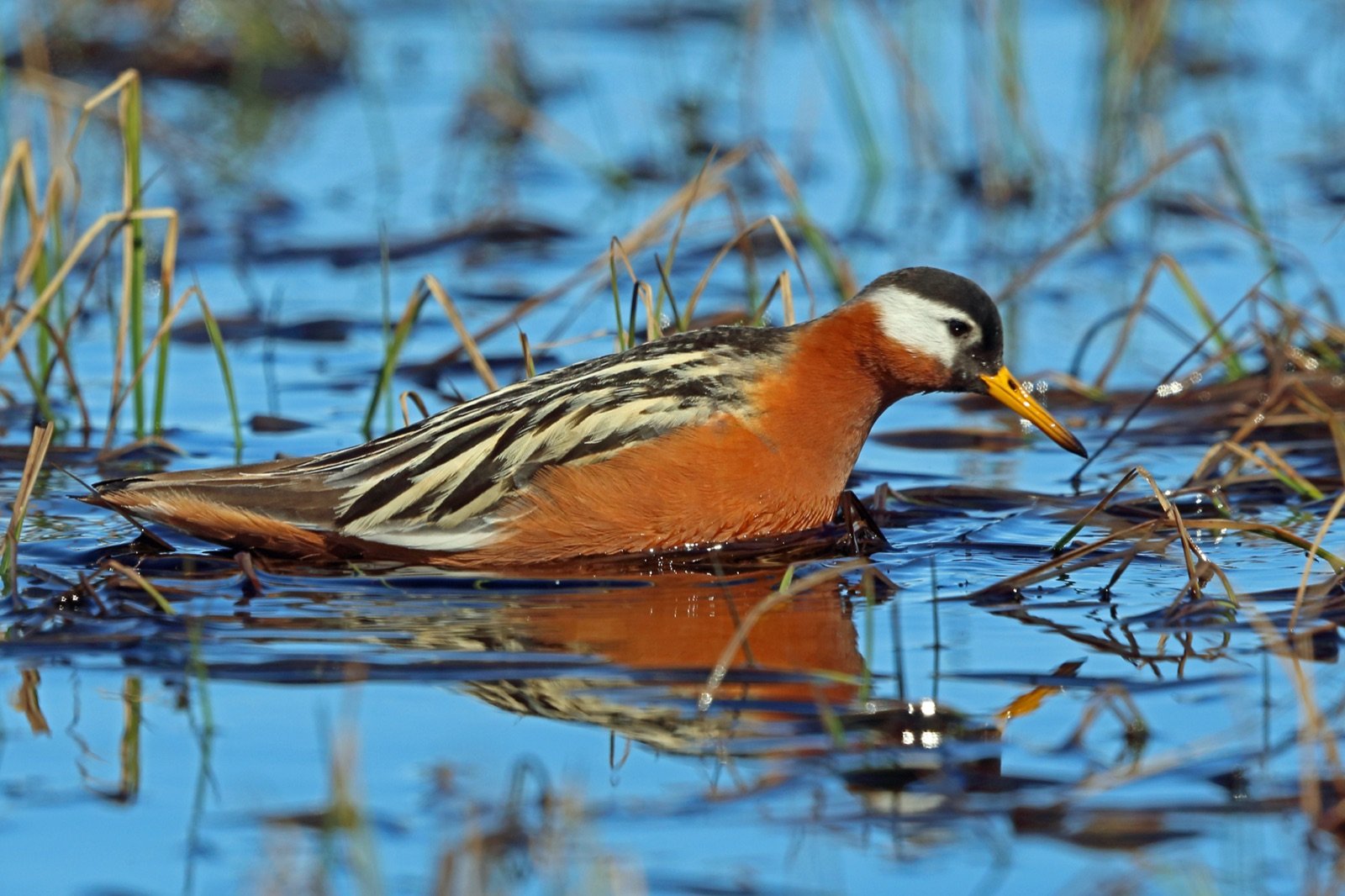
Breeding birds are bright chestnut red below, with a white cheek patch, a dark crown and a yellow bill. In that plumage the red colour alone sets it apart.
Behaviour and diet
Away from the breeding grounds this phalarope feeds at sea. It takes plankton, small amphipods and small fish from the surface or just below. In winter its diet is plankton only, while breeding birds eat mainly insects.
Outside the breeding season it is usually in small flocks, though sometimes in larger groups. It often mixes with Red-necked Phalaropes, so a flock of one species may hide a few of the other. Phalaropes are good swimmers and swim like small gulls, and in flight they touch the water surface and spin.
Where it lives
Outside the breeding season this is a sea bird. Its migration routes run entirely over the ocean, and birds usually fly well offshore. It is rarely seen inland.
In Costa Rica the place to look is offshore on the Pacific side, on boat trips beyond the coast. Sightings in the 2006 to 2010 Pacific seabird survey were made well offshore. Red birds usually occur farther offshore than Red-necked birds, though the two can overlap.
When to see it
On Pacific offshore surveys the Red Phalarope was not found in the dry season, which points to a passage migrant seen mainly at other times of year. The Golfo Dulce record dates from 28 January 2017.
Similar birds
In nonbreeding plumage the Red Phalarope closely resembles the Red-necked Phalarope. The Red-necked has a streaky gray back, while the Red's back is plain. The Red is also chunkier, paler in body, and has a thicker bill than the Red-necked, and it is paler than Wilson's Phalarope too, with a shorter bill and shorter legs than both.
Names and lore in Costa Rica
Costa Rica's official Spanish name is Falaropo Rojo, listed as M beside Falaropo Picofino (Red-necked) and Falaropo Tricolor (Wilson's). Other Spanish names used elsewhere include falaropo picogrueso and falaropo gris. In Chile it is called pollito de mar rojizo, reddish little sea chick.
Status and conservation
The Costa Rican bird list codes it M, a migrant, and globally the IUCN lists the species as Least Concern.
Photography tips
Expect distant, bobbing birds from a moving boat, so a long lens and a steady stance matter. Flocks ride the waves and are hard to scan, so check each one for the plain back and thicker bill.
How we know this 14 sources, each read on the date shown
- Birdwatching in Costa Rica (bird list) read 2026-11-04
https://birdwatchingincostarica.com/bird-lists/ - Oiseaux-birds.com read 2026-11-04
https://www.oiseaux-birds.com/card-red-phalarope.html - Mass.gov (citing Birds of the World) read 2026-11-04
https://www.mass.gov/info-details/red-phalarope - Waders (Australasian Wader Studies Group) read 2026-11-04
https://waders.org.au/red-phalarope/ - All About Birds (Cornell Lab) read 2026-11-04
https://www.allaboutbirds.org/guide/Red_Phalarope/id - BirdWeb (Seattle Audubon) read 2026-11-04
http://www.birdweb.org/birdweb/bird/red_phalarope - Lista Oficial de las Aves de Costa Rica (AOCR) read 2026-11-04
https://listaoficialavesdecostarica.wordpress.com/lista-oficial/lista-oficial-online/ - Avibase read 2026-11-04
https://avibase.bsc-eoc.org/species.jsp?avibaseid=18A1938091EEEA73&avibaseid=18A1938091EEEA73 - Observation frequency and seasonality of marine birds off the Pacific coast of Costa Rica read 2026-11-04
https://www.researchgate.net/publication/297895427_Observation_frequency_and_seasonality_of_marine_birds_off_the_Pacific_coast_of_Costa_Rica - Checklist of the marine birds of Golfo Dulce read 2026-11-04
https://www.researchgate.net/publication/377889017_An_updated_checklist_of_the_marine_birds_Aves_of_Golfo_Dulce_southern_Costa_Rica - Birds Colombia read 2026-11-04
https://birdscolombia.com/2020/08/11/falaropo-colorado-red-phalarope-phalaropus-fulicarius/ - Birding Craft read 2026-11-04
https://birdingcraft.com/wordpress/2010/11/16/pelagic-day-trip-off-the-pacific-coast-of-costa-rica/ - iNaturalist (Oiseaux du Québec guide) read 2026-11-05
https://www.inaturalist.org/guide_taxa/34637 - Birdweb read 2026-11-05
http://birdweb.org/Birdweb/bird/red_phalarope