Family Thamnophilidae
Zeledon's Antbird
Hafferia zeledoni
In Spanish: Hormiguero de Zeledón
- Resident
Red-eyed antbird of Caribbean foothill forest, often heard before seen.
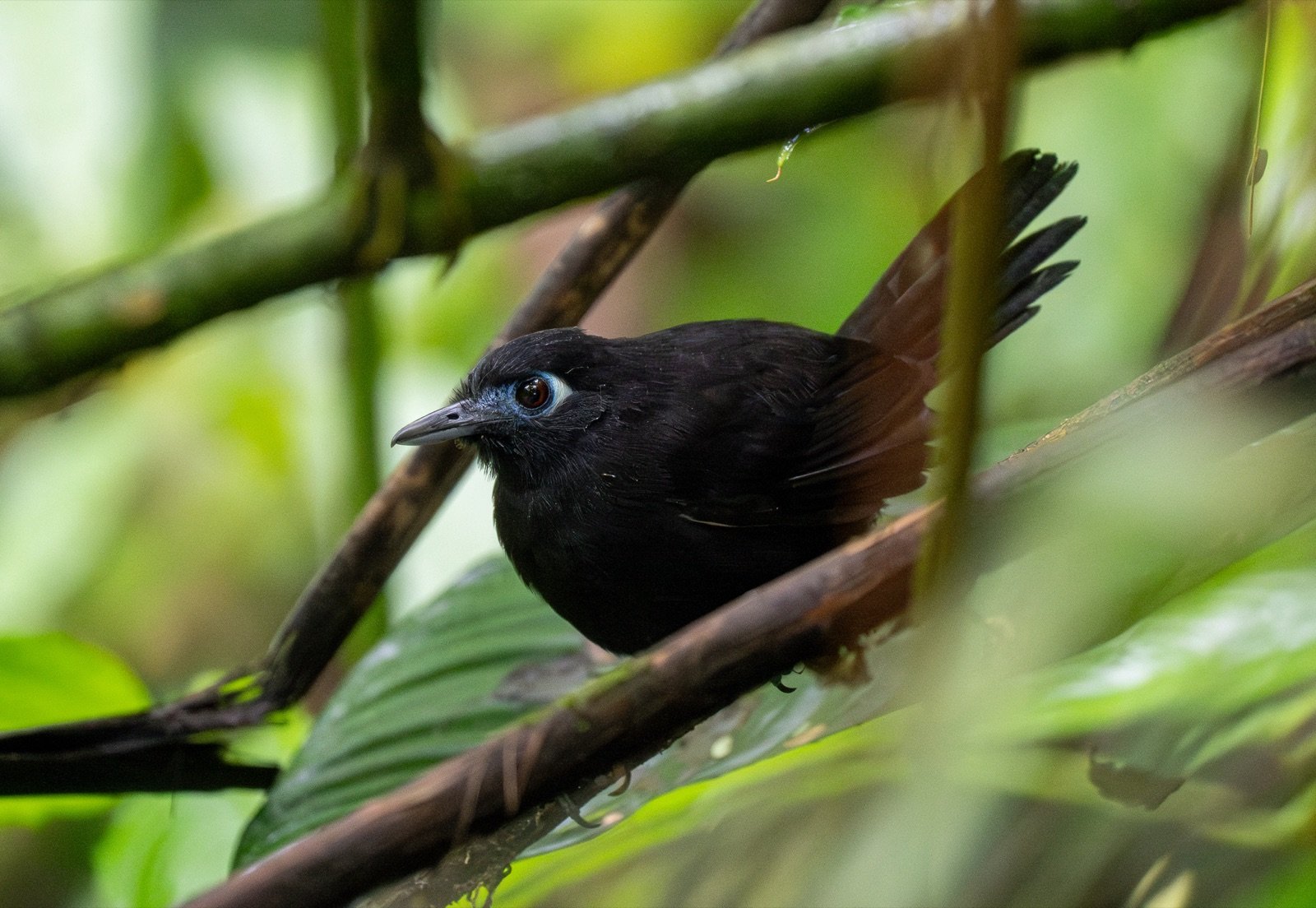
Zeledon's Antbird is a medium-sized antbird of the forest understorey, and in Costa Rica it lives mostly on the Caribbean slope. Males are mostly black, females mostly dark brown, and both wear a wide pale blue ring around a deep red eye.
It is called fairly uncommon on the Caribbean slope and rare on the Pacific slope, so it rewards patience. It tends to sing from dense cover, which means your ears will usually find it before your eyes do.
On a trip we build through the foothills, guests can listen for it around Tapantí and Río Macho, where pairs have come in to inspect one visiting birding group.
How to find it
Listening for the song is the first step, because it sings from dense cover and is not always easy to see. Birders have found it at small army ant swarms in Caribbean slope foothill forest, together with Ocellated Antbird and Spotted Barbtail, so an active swarm is worth checking. Steep slopes, ravines and tree-fall gaps suit it, since it favours regrowth there. Roadside plants are worth scanning too, as an excited pair once hopped through them calling loudly. Expect it to stay hidden even when very near.
How to recognise it
Look for these marks:
Males are mostly black.
Females are mostly dark brown.
Both sexes have a wide pale blue ring around the eye and a deep red iris, the best mark if you get a clear view.
Any white on the male's wing is almost always hidden, so do not count on it.
It is a medium-sized antbird, about 17 to 20 cm long, weighing roughly 40 to 56 g. It also has a habit of lowering its tail and then slowly raising it back to horizontal or slightly higher.
Behaviour and diet
Zeledon's Antbird forages on the ground and in low forest growth, mostly within 1 to 2 m of the ground. It usually forages in pairs and regularly follows army ant swarms when they are available.
It eats many kinds of arthropods and also small lizards and frogs. Prey records from Costa Rica and Panama include grasshoppers. It tends to sing from dense cover, so it is not always easy to see.
Where it lives
It lives in the understorey and edges of humid evergreen forest and mature secondary forest in the foothills. It favours regrowth at landslides and tree-falls on steep slopes and ravines.
In Costa Rica it lives mostly on the Caribbean slope and much less often on the Pacific slope. It is mostly found above about 500 m on the Caribbean side and above about 900 m on the Pacific side. Across Central America the range is about 250 to 1,750 m.
Similar birds
It looks very much like the Blue-lored Antbird, which does not occur in Costa Rica, so confusion with it is not a worry here. Zeledon's has a slightly longer bill, and females are darker on the crown than that species.
Names and lore in Costa Rica
The Spanish name used in Costa Rica is Hormiguero de Zeledón. The name honours the Costa Rican naturalist José Castulo Zeledón (1846 to 1923).
Status and conservation
The AOCR list marks it as a resident (R), fairly uncommon on the Caribbean slope and rare on the Pacific slope.
Photography tips
Patience matters more than gear. One group heard it at close range along the Tapantí road and saw no movement at all, so it can stay hidden when very near. Another year a roadside bird there was very cooperative. Stay still, listen for the song, and watch low roadside plants and any army ant swarm.
How we know this 12 sources, each read on the date shown
- Wikipedia read 2026-11-04
https://en.wikipedia.org/wiki/Zeledon's_antbird - Wikipedia (Spanish) read 2026-11-04
https://es.wikipedia.org/wiki/Hafferia_zeledoni - Bulletin of the British Ornithologists' Club read 2026-11-04
https://bioone.org/journals/bulletin-of-the-british-ornithologists-club/volume-144/issue-2/bboc.v144i2.2024.a4/Remarks-on-the-Costa-Rican-expeditions-of-Ridgway-and-Zeled%c3%b3n/10.25226/bboc.v144i2.2024.a4.full - Cornell Birds of the World read 2026-11-04
https://birdsoftheworld.org/bow/species/zelant1/cur/introduction?media=video - Birding Craft read 2026-11-04
https://birdingcraft.com/wordpress/2014/06/06/birding-in-costa-rica-you-have-a-good-chance-at-seeing-ocellated-antbird/ - Field Guides tour report, Costa Rica 2017 read 2026-11-04
https://fieldguides.com/triplists/cos17.html - WINGS Birding Tours read 2026-11-04
https://wingsbirds.com/tours/costa-rica-july#narratives - Costa Rica Focus read 2026-11-04
https://www.costaricafocus.com/birding-braulio-carrillo-national-park-a-complete-guide/ - Mark Pretti Nature Tours read 2026-11-04
https://www.markprettinaturetours.com/costa-rica-ii - Field Guides Costa Rica 2020 trip list read 2026-11-04
https://fieldguides.com/triplists/cos20.html - Field Guides Costa Rica 2016 trip list read 2026-11-04
https://fieldguides.com/triplists/cos16.html - Field Guides Costa Rica 2018 trip list read 2026-11-04
https://fieldguides.com/triplists/cos18.html