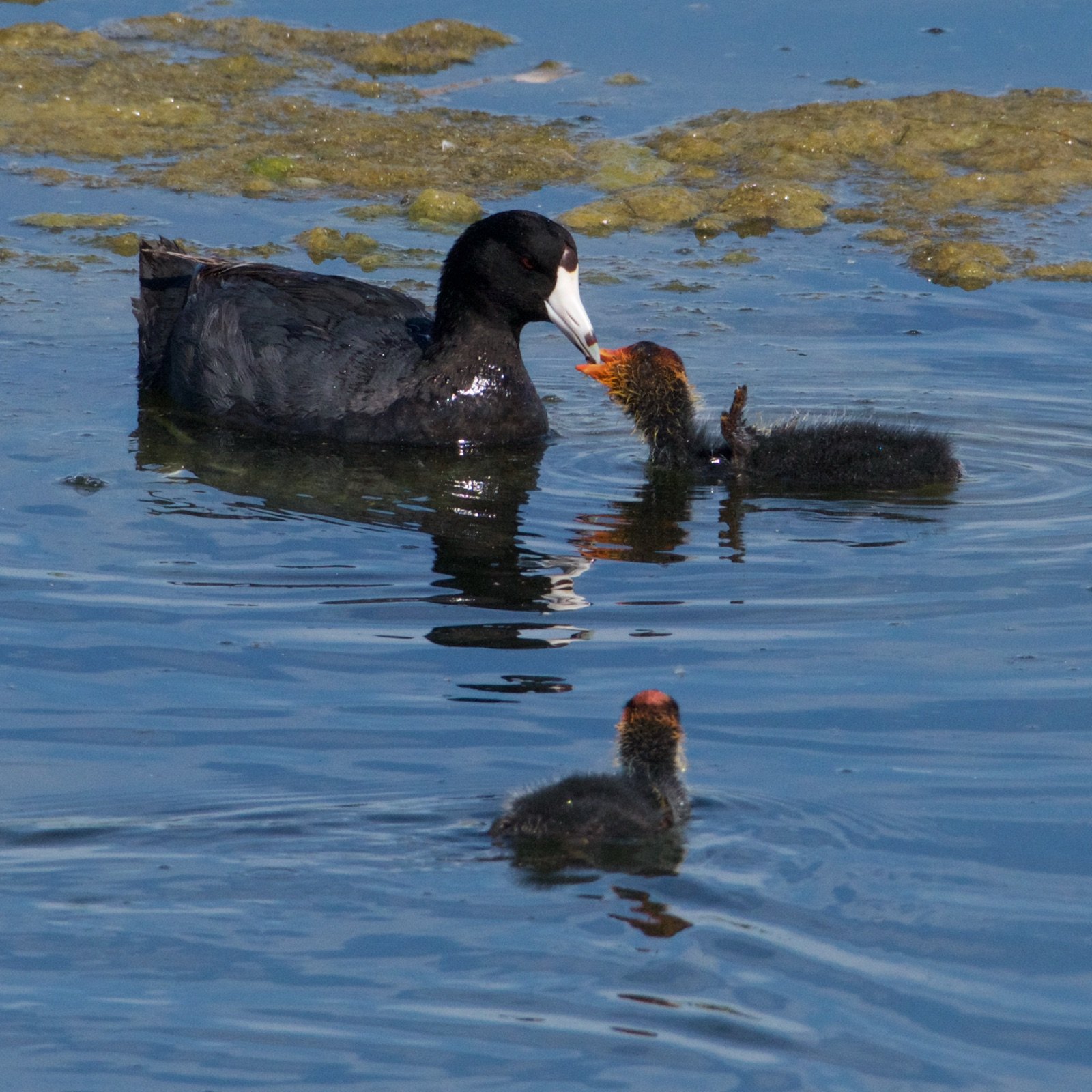
Family Rallidae
American Coot
Fulica americana
In Spanish: Focha Americana
- Resident
A dark gray, white-billed swimmer that looks like a duck but is a rail.
The American Coot (Focha Americana) looks like a duck but is only distantly related to ducks, and that small surprise is a good way into your first wetland morning in Costa Rica. The official Costa Rican bird list marks it as both a resident and a migrant, so some birds stay year round and others arrive from the north.
Northwestern Costa Rica is the southern edge of its breeding range. Northern birds are mostly migratory, so many of the coots you meet here may be winter visitors.
On a trip we build, look for flocks on calm, open water with plenty of algae and other water plants. It is a bird you may well hear before you see it, which makes it a friendly one to learn early.
How to find it
Scan the open water of ponds and lakes for flocks swimming together, because coots are usually in groups. Check the shore and open ground near the water too, where they also walk. Listen for honking, cackling and grunting from reeds, cattails and bulrush, since a bird may call from cover before it appears. Pick out the white bill against the dark gray body to tell it from the gallinules. Wetlands with calm, open water and plenty of plants, such as Caño Negro, are the places to give it time.
How to recognise it
Adults have a black head and neck that fade to dark gray on the body.
The bill is short, thick and white, with a small dark spot near the tip. The forehead shield is white too, usually with a reddish-brown spot near the top.
The legs are greenish.
Adults are about 35 cm (14 in) tall. The tail is black, and the sides of the undertail are white.
Males and females look alike, but females are smaller.
Watch a swimming bird closely and look at the toes: they have broad lobes instead of webbing, a clue that coots are not ducks, even though they swim in open water like them.
What it sounds like
Recording: Logan Otremba, CC BY 4.0, source, read 4 Nov 2026.
Behaviour and diet
The coot is noisy and quarrelsome, especially in flocks and when defending territory. Rival birds at territory edges rear up and attack each other with their feet, which makes a flock a lively thing to watch.
Coots are usually in groups. They swim on open water, and they also walk on the shore and on open ground near ponds.
They are clumsy fliers. To take off they run a long way across the water surface, pattering and beating their wings hard.
Where it lives
The American Coot lives on calm, open water that has plenty of algae and other water plants, such as ponds and lakes. One Spanish-language source also lists marshes, estuaries and rivers as habitat.
Its breeding range reaches south to northwestern Costa Rica. It has also been recorded among the waterbirds of the Cartago highland wetlands, such as Laguna de Ochomogo, near the Greater Metropolitan Area. It is listed as well for the wetlands of Caño Negro Wildlife Refuge in the north, and a trip report once noted it at Tortuguero on the Caribbean side.
When to see it
Northern migrants reach Costa Rica generally by October, and most leave by the end of April. Resident birds are on the list as well, so some coots stay year round.
Similar birds
Coots look like ducks but are only distantly related to them, and their lobed toes are the giveaway. The Common Gallinule and Purple Gallinule share Costa Rican wetlands with the coot and belong to the same group of rails. The coot's white bill and shield and its dark gray body set it apart.
Names and lore in Costa Rica
The Costa Rican Spanish name is Focha Americana. Elsewhere in Spanish the bird is also called gallareta, choca, hayno, focha cenicienta, gallareta americana and gallineta pico plata, though these are general Spanish names and not shown to be Costa Rican nicknames.
Status and conservation
The AOCR list marks the American Coot as both resident and migrant (R,M), and it is rated Least Concern worldwide.
Photography tips
A photography guide suggests a lens of at least 400 mm and keeping about 10 m away, because coots can be wary. Soft morning or late afternoon light works best.
How we know this 22 sources, each read on the date shown
- Lista Oficial de las Aves de Costa Rica (AOCR) read 2026-11-04
https://listaoficialavesdecostarica.wordpress.com/lista-oficial/lista-oficial-online/ - BC Conservation Data Centre species summary read 2026-11-04
https://a100.gov.bc.ca/pub/eswp/speciesSummary.do;jsessionid=15GTT2fBhTNyhPgZpWgCQM8RSp1l2d8LrQ0mDQydghm11xP2pmL0!234374013?id=17181 - Avibase read 2026-11-04
https://avibase.bsc-eoc.org/species.jsp?avibaseid=4FB248BAEFEC2868 - Bird Watching Costa Rica read 2026-11-04
https://www.birdwatchingcostarica.com/ave/american-coot/ - Wikipedia read 2026-11-04
https://en.wikipedia.org/wiki/American_coot - Wikipedia: List of birds of Costa Rica read 2026-11-04
https://en.wikipedia.org/wiki/List_of_birds_of_Costa_Rica - Aves del Nea read 2026-11-04
https://avesdelnea.blogspot.com/2019/01/focha-americana-american-coot-fulica.html - Cornell Birds of the World read 2026-11-04
https://birdsoftheworld.org/bow/species/y00475/cur/sounds - CICIMAR-IPN read 2026-11-04
https://www.cicimar.ipn.mx/conocenos/a-la-intemperie/gallereta-americana.html - Museo Nacional de Costa Rica read 2026-11-04
https://www.museocostarica.go.cr/nuestro-trabajo/investigaciones/historia-natural/gam/aves/ - Birds Colombia read 2026-11-04
https://birdscolombia.com/2017/05/22/focha-americana-fulica-americana/ - Avibase (Clements checklist) read 2026-11-04
https://avibase.bsc-eoc.org/species.jsp?avibaseid=2EA49B12C37E48BD - Exotic Birding checklist, Caño Negro read 2026-11-04
https://www.exoticbirding.com/costarica/cano-negro/checklist.html - Birds of the World read 2026-11-04
https://birdsoftheworld.org/bow/species/y00475/cur/introduction - Avibase Costa Rica checklist read 2026-11-04
https://avibase.bsc-eoc.org/checklist.jsp?region=CR - Birdtours.co.uk trip report, Costa Rica 2005 read 2026-11-05
http://www.birdtours.co.uk/tripreports/costarica/costar13/costa-rica-2005.htm - Visit Costa Rica read 2026-11-05
https://www.visitcostarica.com/where-to-go/protected-areas/palo-verde-national-park - ArgentiNat read 2026-11-05
https://www.argentinat.org/taxa/473-Fulica-americana - WildlifePhotographer read 2026-11-05
https://www.wildlifephotographer.app/es/especie-salvaje/focha-americana/?id=1008941 - Animalia.bio read 2026-11-05
https://animalia.bio/es/american-coot?environment=89 - SEO/BirdLife read 2026-11-05
https://seo.org/ave/focha-americana/ - Tierra de polluelas, rascones, grullas read 2026-11-05
https://tierradegruiformes.blogspot.com/2012/04/focha-americana-fulica-americana.html